AI Agents Are Rewriting Marketing Automation in 2025 — What It Means for Your Team

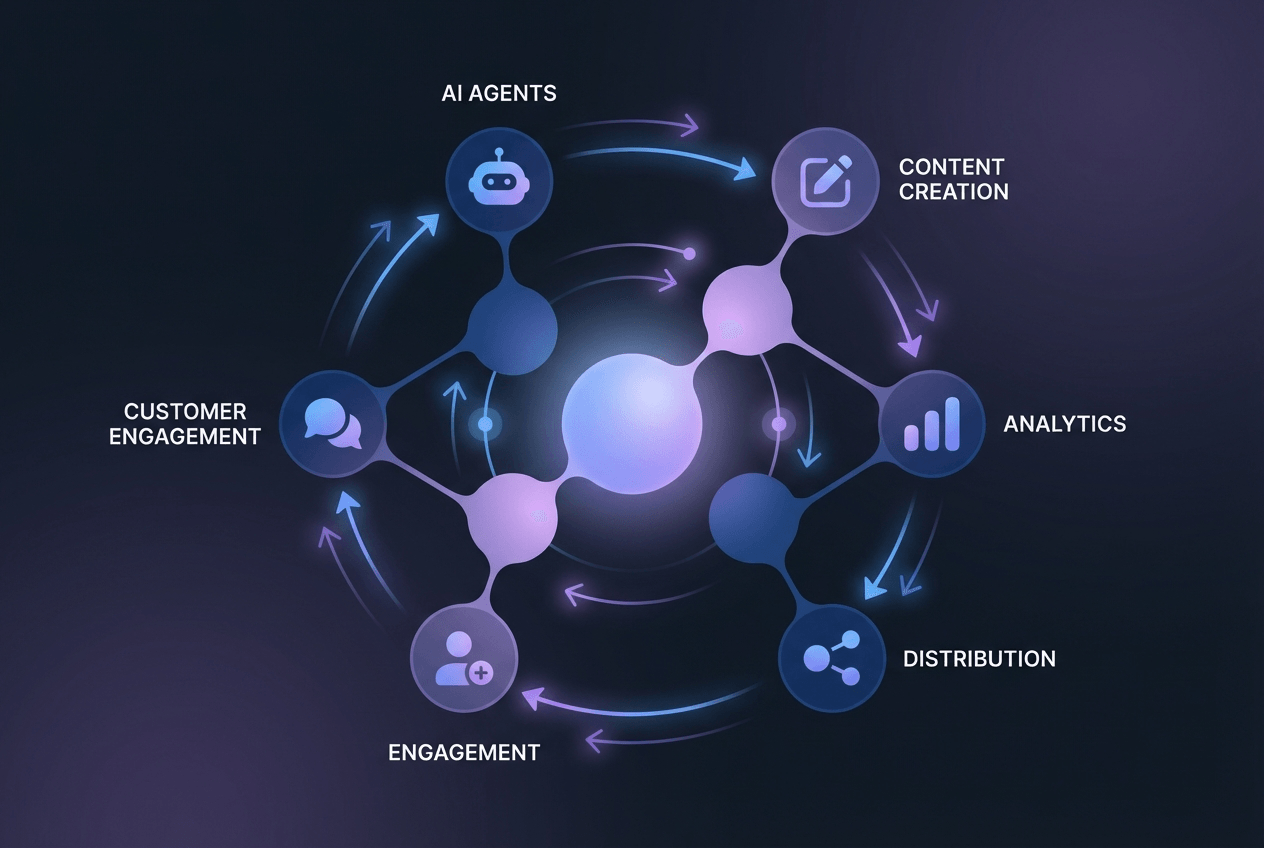
The rise of autonomous AI agents in marketing
Over the past year, the conversation around AI in marketing has shifted dramatically. We've moved beyond the novelty of "AI helps me write better copy" to something far more transformative: AI agents that can actually run entire workflows end-to-end — researching markets, creating content, launching campaigns, and learning from performance data without constant human intervention.
This isn't speculation about the distant future. Recent industry developments highlight this shift clearly. Salesforce's 2025 outlook identifies autonomous agents as a core layer in modern go-to-market stacks, fundamentally changing how businesses approach customer engagement. Meanwhile, OpenAI's Operator preview demonstrates how AI can now browse the web, reason through complex tasks, and take action on behalf of users — all capabilities that seemed impossible just months ago.
These signals point to one undeniable truth: marketing execution is becoming automated, not just assisted. The question isn't whether this will happen, but how quickly teams will adapt to this new reality.
Why this matters for growing teams
Most marketing teams don't fail because they lack good ideas. They fail because execution is painfully slow and frustratingly fragmented. Strategy lives in Google Docs that gather dust. Execution happens across a dozen disconnected tools. Learning lives in analytics dashboards that teams check once a month, if they're lucky. These pieces rarely talk to each other, creating a cycle of inefficiency that burns out even the most talented marketers.
The cost of this fragmentation is higher than most founders realize. When your content strategist spends three hours reformatting data for a blog post, that's three hours not spent on positioning. When your social media manager manually cross-posts to five platforms, that's creative energy wasted on busywork. When your team misses a trending topic because nobody had time to monitor industry news, that's opportunity cost in its purest form.
As AI agents mature and become more sophisticated, the winning teams will be the ones that fundamentally rethink their approach to marketing execution. They'll be the teams that:
- Automate repetitive execution without sacrificing brand voice or quality
- Connect research, content creation, distribution, and measurement into a seamless flow
- Free up human talent to focus on judgment, creativity, and strategic positioning
- Build compounding knowledge systems rather than starting from scratch each campaign
- Move faster than competitors still trapped in manual workflows
This is exactly the gap that the new generation of AI marketing platforms is designed to close. But not all platforms approach the problem the same way.
From tools to teammates: a new paradigm
The traditional marketing stack is built on point solutions — one tool for SEO, another for social media, a third for email, and so on. Each tool requires its own login, its own learning curve, and its own set of prompts or commands. Marketers become glorified orchestra conductors, constantly switching contexts and trying to make these tools work together.
The agent-based approach flips this model entirely. Instead of managing multiple tools, marketers work with AI agents that understand context, maintain continuity, and operate across the full marketing lifecycle. These agents don't just respond to prompts — they proactively identify opportunities, execute on strategies, and learn from results.
At AgentWeb, we're seeing this shift firsthand in how teams approach their marketing operations. Instead of acting like another point solution in an already crowded stack, AgentWeb is built around AI agents that operate across the full marketing lifecycle — from brand understanding to content creation and performance insights.
The difference becomes clear in daily operations. Rather than asking marketers to prompt dozens of different tools and manually transfer information between them, AgentWeb's agents:
- Learn your brand guidelines, founder voice, and company positioning from existing materials
- Continuously monitor industry trends and competitor signals in the background
- Generate organic and paid content that's aligned to real-world trends and your brand voice
- Turn insights into action without constant hand-holding or micromanagement
- Build on previous campaigns to improve performance over time
In other words, your marketing starts to run more like a well-oiled system — not a daily scramble to keep up with competing priorities.
Consider a practical example: Your competitor launches a new feature. Traditional marketing requires someone to notice, brief the team, draft a response, get approvals, create assets, and distribute across channels — a process that might take days or weeks. With agent-based marketing, the system notices the launch, analyzes the positioning, drafts a strategic response aligned to your brand, and queues it for your review — all within hours. You maintain creative control while moving at the speed that modern markets demand.
What autonomous execution actually looks like
Let's get specific about what changes when AI agents handle marketing execution. The transformation touches every part of the marketing workflow:
Content creation becomes continuous rather than episodic. Instead of batch-creating a month's worth of content in marathon sessions, agents produce a steady stream of relevant, timely pieces. They monitor trending topics in your industry, identify opportunities that align with your positioning, and draft content that matches your brand voice — all while you're focused on higher-level strategy.
Distribution becomes intelligent rather than manual. Agents don't just post content at scheduled times. They analyze when your audience is most engaged, which channels are performing best for specific content types, and how to optimize messaging for each platform. They handle the tedious work of reformatting and adapting content while preserving your core message.
Research becomes proactive rather than reactive. Instead of scrambling to understand what competitors are doing or what customers are saying, agents continuously gather and synthesize information. They surface insights when they're most relevant, not when you remember to check your monitoring tools.
Optimization becomes systematic rather than ad hoc. Every piece of content, every campaign, every interaction generates data. Agents analyze this data to identify patterns, test hypotheses, and improve performance over time. The system gets smarter with every execution cycle.
This isn't about replacing human marketers — it's about amplifying their impact. The creative director still sets the vision. The content strategist still shapes the narrative. The brand manager still makes the final calls. But they're no longer bogged down in execution details that an AI can handle better and faster.
The competitive edge in 2025 and beyond
Industry developments make one thing abundantly clear: AI-powered execution will soon be table stakes, not a competitive advantage. Every marketing team will have access to AI tools. The real differentiator won't be whether you use AI, but how integrated, autonomous, and effective your AI systems are.
Think about the trajectory we're on. Teams that adopt agent-based marketing early will:
- Move faster than competitors still stitching together manual workflows
- Experiment more frequently because the cost of testing new approaches drops dramatically
- Compound learning over time as their systems get smarter with each campaign
- Scale their impact without proportionally scaling their headcount
- Focus human creativity on the problems that actually matter
Meanwhile, teams that stick with traditional tools and manual processes will find themselves perpetually behind, working harder to achieve results that their competitors generate effortlessly.
This creates a widening gap that becomes harder to close over time. The team that's been building its AI-powered marketing system for six months has six months of learned patterns, optimized workflows, and accumulated knowledge. That's not something a competitor can replicate by simply buying the same tools.
Making the transition
For founders and marketing leaders reading this, the question isn't whether to adopt agent-based marketing — it's how quickly you can make the transition. Here's what that process actually looks like:
Start by identifying the repetitive tasks that consume disproportionate time. Social media cross-posting. Competitor monitoring. Content reformatting. Performance reporting. These are the low-hanging fruit where AI agents can deliver immediate value.
Next, look at workflows that require coordination across multiple tools or team members. These handoff points are where information gets lost, delays creep in, and quality suffers. AI agents excel at maintaining context and continuity across these transitions.
Then consider the strategic opportunities you're missing because you lack bandwidth. That industry trend you noticed but couldn't capitalize on. That content format you wanted to test but never found time for. That audience segment you wanted to reach but couldn't create enough targeted content. These aren't execution problems — they're capacity problems that AI agents can solve.
The teams making this transition successfully share a common trait: they think in systems, not tools. They're not looking for another point solution to add to their stack. They're looking for a foundation that lets them build compounding advantages over time.
Final thought
AI agents aren't replacing marketers. They're replacing the busywork that prevents marketers from doing their best work. They're eliminating the context switching, the manual coordination, and the repetitive tasks that drain creative energy and slow down execution.
As platforms like AgentWeb push this model forward, the future of marketing looks less like juggling an ever-growing stack of tools — and more like collaborating with always-on teammates that never forget your brand, never miss an opportunity, and never stop learning.
The marketing teams that thrive in 2025 and beyond won't be the ones with the biggest budgets or the largest headcount. They'll be the ones that figured out how to amplify human creativity with autonomous execution. The ones that built systems instead of just using tools. The ones that moved first while this window of opportunity was still open.
The question is: will your team be one of them?
This article references publicly available industry trends and developments. Learn more about how AgentWeb approaches agent-based marketing at https://agentweb.pro.
Or run a free AI Marketing Eval to see where your GTM has gaps.
Ex-Meta, Google, LinkedIn. 10+ years in ML & data science for GTM. Expert in customer acquisition and growth activation.
Get a free Stack Review.
30 min with Harsha and Matt.
We audit your last 30 days, pinpoint the highest-impact fixes, and hand you the exact playbook we'd run. No deck. No pitch unless there's a fit.