Beyond the Success Tax: Why Modern Growth Teams are Trading Legacy CRMs for AI Agents


For over a decade, the growth playbook was simple: buy a massive software suite and hire a small army of specialists to operate it. But the era of volume-based inbound tactics is currently collapsing under its own weight. Modern growth teams are realizing that scaling shouldn't feel like a penalty, yet legacy platforms often impose a 'Success Tax' where costs and complexity scale faster than revenue. The friction of managing workflows, cleaning messy data, and configuring endless pipelines is increasingly distracting founders from their core mission of driving actual revenue.
The market is currently undergoing a fundamental shift from SaaS (Software as a Service) to SaS (Service as a Software). In this new paradigm, tools aren't just passive databases waiting for human input; they are autonomous partners capable of executing strategy. This guide examines the best alternatives for teams ready to move beyond the 'Rent-a-Tool' era and embrace the rise of Agentic AI.
The Friction Point: Why Teams Are Outgrowing the Status Quo
While legacy platforms like HubSpot defined the first wave of inbound marketing, they have become a heavy anchor for agile startups. The migration away from these systems is driven by three primary pain points: punitive pricing, administrative bloat, and an architecture built for a pre-AI world.
The 'Success Tax' Problem
Pricing models in the legacy CRM space are notorious for punishing growth. While entry-level plans appear affordable, the jump to professional tiers is often precipitous. Teams frequently find themselves trapped in a cycle of seat-based inflation, paying for every human who needs access regardless of how much they actually use the tool. Furthermore, contact-tier penalties mean your bill increases as your database grows, even if those contacts aren't currently being monetized. Essential features like advanced reporting or increased API limits are often gated behind expensive enterprise upgrades.
The Specialist Requirement
Modern suites have expanded into 'platforms of everything'—incorporating CRM, CMS, Service, and Commerce. For a lean startup, this breadth results in a steep learning curve. Utilizing these platforms to their full potential often requires hiring a certified administrator or an expensive agency partner. Many teams end up paying for a Ferrari but only driving it in a school zone, utilizing less than 20% of the capabilities while paying for 100% of the bloat.

The 'Success Tax' occurs when software costs and administrative overhead grow faster than the revenue the tools are meant to generate.
The Rise of Agentic Marketing
When evaluating alternatives, the goal is no longer to find a 'cheaper CRM,' but to find a 'smarter workforce.' This is the core of Agentic Marketing. Unlike traditional automation, which follows a rigid 'If X, then Y' script, AI agents possess reasoning capabilities. They can observe market trends, plan strategies based on high-level goals like 'increase qualified leads by 20%,' and act by executing campaigns and optimizing ads across channels autonomously.
For a modern growth team, the ideal stack should offer outcome-based value. Pricing and utility should be tied to work performed—leads generated or campaigns launched—rather than seats filled. This requires a system that connects strategy to execution without requiring a dozen different integrations.
Categorizing the Top Alternatives
Alternatives generally fall into three distinct buckets based on the needs of the organization: Sales-led databases, Marketing automation specialists, and AI-native orchestrators.
CRM-First Alternatives
These are best for sales-heavy organizations that need a traditional database of record but refuse to pay legacy prices.
- EngageBay: Positioned as an aggressive alternative for startups, it offers a nearly identical feature set—CRM, Help Desk, and Marketing Automation—at a fraction of the cost. It is the best 'dollar-for-dollar' replacement for cash-strapped teams.
- Zoho CRM: Often called the 'Swiss Army Knife' of business software, Zoho is highly customizable and offers an AI assistant named Zia for data analysis. It is ideal for small-to-medium businesses that want to run their entire back-office on a single vendor stack.
Marketing Automation Specialists
These tools are built for teams that prioritize email deliverability and complex customer journeys over sales pipeline management.
- ActiveCampaign: Widely regarded for its superior automation logic, it allows for multi-path customer journeys that are far more sophisticated than linear legacy workflows. It remains a top choice for marketers who need granular control.
- Brevo: Formerly known as Sendinblue, Brevo wins on pricing structure. Unlike platforms that charge by contacts stored, Brevo charges by emails sent. This makes it the go-to for e-commerce brands with large but low-frequency databases.
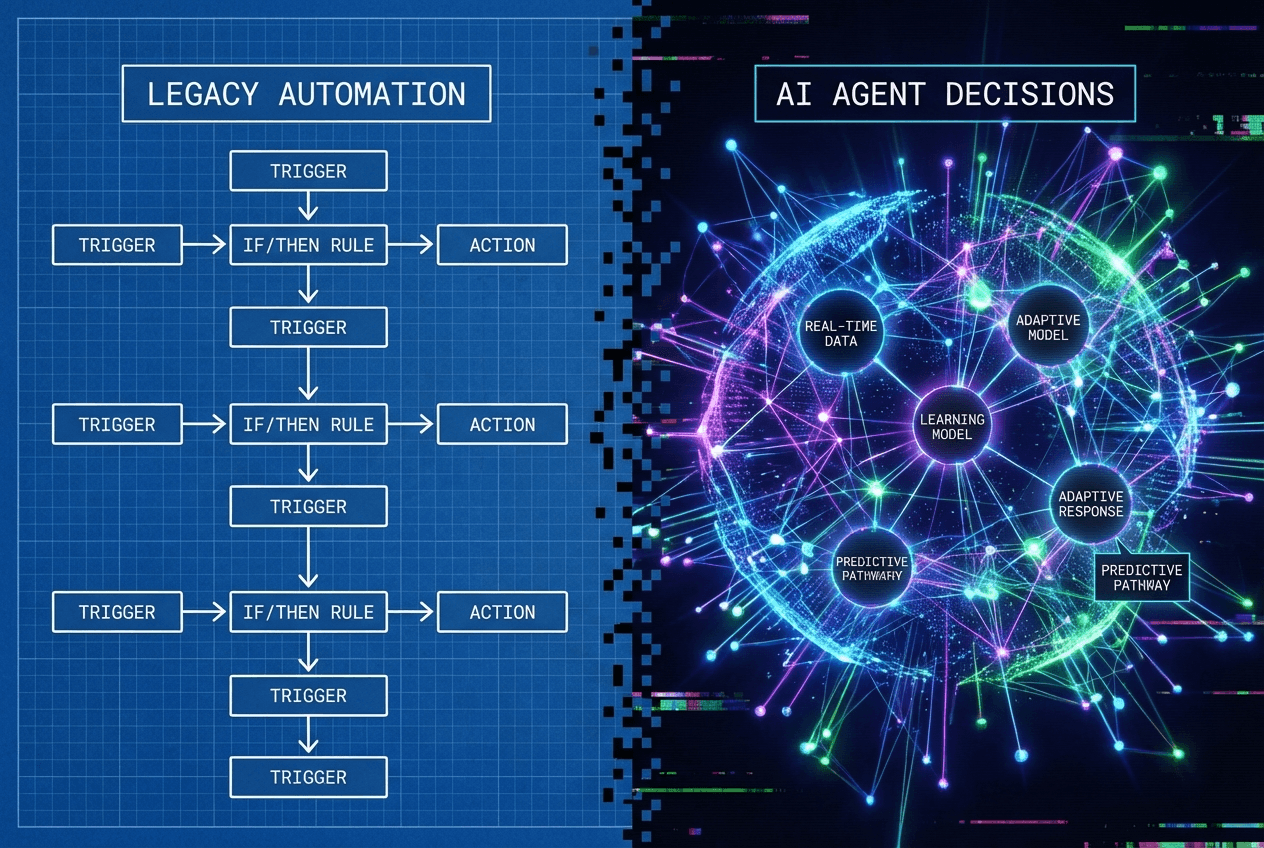
The shift from rigid, rule-based automation to flexible, agentic reasoning.
The AI-Native Frontier: AgentWeb
While traditional alternatives replace parts of the legacy stack, AgentWeb is designed to replace the process of marketing itself. It functions as an AI-first Marketing Operating System, specifically built for the 'Zero-to-One' and 'One-to-Ten' growth stages where efficiency is paramount.
At the center of this system is 'Emma,' an autonomous AI marketer. Unlike legacy tools that are empty containers waiting for data, AgentWeb comes pre-loaded with intelligence. It ingests your brand assets and URL to build a knowledge base from day one.
How Agentic Execution Differs
FeatureLegacy CRM (The Manual Way)AgentWeb (The Agentic Way)OnboardingWeeks of manual setup and data mapping.Human + AI Diagnostic creates a 90-day GTM plan immediately.StrategyHumans must build personas and set rules.Emma researches markets and competitors to find gaps autonomously.ContentHumans write or prompt AI one by one.Emma generates full calendars and founder-led social posts.ExecutionManual scheduling and monitoring.Emma runs campaigns; you approve or edit via Slack.OptimizationManual analysis of dashboards.Self-optimizing loops proactively suggest improvements.
Who Should Make the Switch?
AgentWeb isn't for 5,000-person enterprises with 50-person marketing ops teams. Those organizations are often better served by the massive infrastructure of Salesforce or HubSpot Enterprise. Instead, the agentic model is the superior choice for:
- Seed to Series B Startups: Teams that need the output of a 10-person marketing department on a single-person budget.
- Founder-Led Companies: Leaders who need to build a personal brand but lack the hours to manage LinkedIn and X manually.
- Lean Marketing Teams: A single manager using agentic tools can out-produce an entire team using traditional, manual software.

Agentic AI allows humans to move from being operators who pull levers to directors who approve strategies.
Common Questions on the Transition
Does AgentWeb replace my marketing team?
No, it amplifies them. It replaces the drudgery—data entry, scheduling, initial drafting, and reporting. This frees human talent to focus on high-level creative strategy and emotional connection. Think of it as giving every employee an infinite team of interns.
Is this just another content generator?
While tools like Jasper excel at content creation, they still require a human to manage the strategy and distribution. AgentWeb is an execution engine. It doesn't just write the post; it researches the trend, plans the timing, and manages the distribution across networks.
How does the 'Human + AI' model work?
To ensure the AI is pointed in the right direction, the process begins with a human expert diagnostic to map your Go-To-Market strategy. Once the strategy is set, the AI handles the heavy lifting, but you retain 'human-in-the-loop' control for all final approvals via your existing communication tools like Slack or Teams.
Stop Renting Tools, Start Hiring Agents
The era of paying five-figure sums for a database that requires manual labor is ending. Legacy systems won the last decade by organizing your work, but the next decade belongs to systems that actually perform the work. For growth-focused teams, the choice is between paying a 'Success Tax' to maintain a legacy system or investing in an AI-first operating system that compounds growth automatically.
Don't just manage your marketing. Automate your growth.
Ready to meet your new AI Marketing Partner?
Book a call with Harsha if you would like to work with AgentWeb. You could get free 90-Day GTM Diagnostic. See exactly how Emma can research, plan, and execute your growth strategy—before you pay a dime.
AI-powered marketer handling campaign planning, content creation, ad management, and performance analysis.
Get a free Stack Review.
30 min with Harsha and Matt.
We audit your last 30 days, pinpoint the highest-impact fixes, and hand you the exact playbook we'd run. No deck. No pitch unless there's a fit.