ERP in 2026: How AI Agents Are Breaking Monolithic System Design

By Rui Wang, Ph.D. (CTO, AgentWeb)
The Short Answer
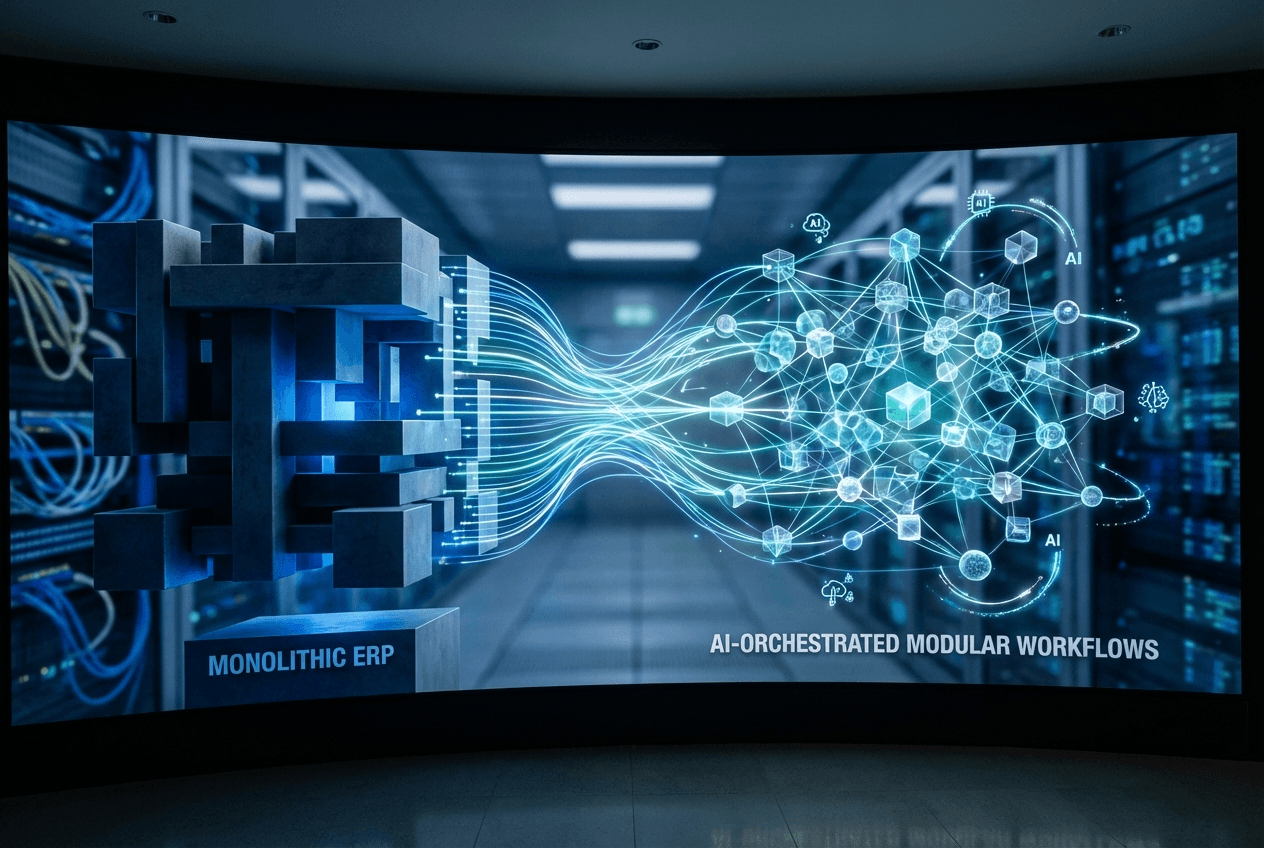
By 2026, ERP systems are no longer passive databases that store your business data. They're becoming autonomous systems of action, powered by AI agents that independently plan, execute, and optimize entire workflows without human intervention. This fundamental shift is breaking the core assumptions that monolithic ERP architectures were built on—and forcing a complete rethink of how enterprise software should be designed.
If you're running a startup or scaling a business, understanding this transition isn't optional. The architectural decisions you make today will determine whether your systems can adapt to an agent-driven future or become expensive technical debt.
What Actually Changed: The Autonomy Threshold
For decades, ERP systems served one primary purpose: they were systems of record. They stored data, generated reports, and occasionally automated simple, rule-based tasks. Humans initiated actions, made decisions, and drove workflows forward.
That model just died.
According to recent analysis from CIO, we've crossed a critical inflection point where AI agents are now capable of owning entire ERP workflows from start to finish. We're not talking about chatbots that answer questions or recommendation engines that suggest actions. We're talking about autonomous agents that:
- Process and approve invoices based on context and policy
- Execute procurement decisions by analyzing supplier performance, pricing trends, and inventory needs
- Manage employee onboarding workflows across multiple systems
- Perform financial reconciliation and identify discrepancies
- Make supply chain decisions in real-time based on demand signals
- Run continuous scenario simulations to optimize operations
As CIO notes: "AI agents are automating invoicing, procurement, onboarding, financial reconciliation, and supply-chain decision making, while running continuous scenario simulations in real time." (Source: CIO)
This isn't incremental improvement. It's a category shift. Once systems can act autonomously rather than just record human actions, every architectural assumption needs to be questioned.
Why Monolithic ERP Architectures Start Failing
Traditional ERP platforms—think SAP, Oracle, Microsoft Dynamics—were architected around three core assumptions that made perfect sense in a human-operated world:
Assumption 1: Humans initiate most actions
Monolithic systems were designed for batch processing and periodic updates because humans work in discrete sessions. You log in, complete tasks, log out. The system could afford to be slow, rigid, and process-oriented because human decision-making was the bottleneck.
AI agents operate continuously. They don't take breaks, work in sessions, or follow 9-to-5 schedules. They process information, make decisions, and execute actions 24/7. A system designed for periodic human interaction becomes a performance bottleneck when agents are operating at machine speed.
Assumption 2: Change cycles are slow
Enterprise software traditionally moved at glacial speed. Upgrades happened annually or quarterly. Business process changes required months of planning, testing, and training. This matched the reality of organizational change management.
AI agents evolve rapidly. New models emerge every few months with dramatically improved capabilities. Agent behaviors can be updated through prompt engineering or fine-tuning without rewriting core application logic. When your intelligence layer can iterate weekly but your ERP platform requires six-month upgrade cycles, you have a fundamental mismatch.
Assumption 3: One-size-fits-all workflows are acceptable
Monolithic ERPs forced standardization. Everyone used the same procurement workflow, the same approval chains, the same reporting structures. Customization was expensive and fragile, so companies adapted their processes to fit the software.
AI agents enable mass personalization. Different departments, regions, or business units can have agents optimized for their specific contexts while still maintaining consistency at the policy level. The intelligence becomes modular and adaptable, but only if the underlying systems support this flexibility.
When agents operate continuously, optimize locally, and evolve rapidly, tightly coupled monolithic systems become brittle. Small changes propagate unpredictably throughout the system. Innovation slows to a crawl because every modification touches the core. The architecture that enabled enterprise software to scale in the 2000s becomes the constraint that prevents it from adapting in the 2020s.
The Emergence of Agent-Native, Modular ERP
What's replacing the monolith? We're seeing a clear architectural pattern emerge across forward-thinking organizations:
Layer 1: A stable system of record
Core ERP functionality—financial ledgers, inventory tracking, employee records—remains centralized. This provides a single source of truth and maintains data integrity. But this layer is explicitly designed to be operated by agents, not just humans. It exposes clean APIs, maintains clear audit trails, and enforces policy boundaries.
Layer 2: Modular, best-of-breed components
Specialized functionality lives in focused applications. Instead of one vendor providing mediocre solutions for 50 different problems, companies assemble ecosystems of specialized tools. A best-in-class inventory optimization system. A purpose-built accounts payable platform. A dedicated employee engagement tool.
The key difference: these systems are designed with agent integration as a first-class use case, not an afterthought.
Layer 3: AI agents orchestrating workflows
This is where the intelligence lives. Agents understand business context, make decisions within defined parameters, and coordinate actions across multiple systems. They translate high-level objectives into specific actions, handle exceptions, and continuously optimize performance.
In this model, ERP becomes an execution layer, not the brain. Intelligence lives in agents that can be upgraded independently, constrained by policy guardrails, and audited by humans. When you need to improve your procurement process, you update the agent's reasoning model, not the core ERP platform.
This architectural shift mirrors the evolution from monolithic applications to microservices that transformed consumer software over the past decade. But there's a critical difference: instead of developers writing integration code between services, AI agents handle the orchestration. They understand context, adapt to exceptions, and learn from outcomes.
Why This Pattern Extends Far Beyond ERP
ERP is simply the most visible example of a broader transformation happening across enterprise software. The same dynamics are playing out in:
Marketing and sales operations: Autonomous agents conducting market research, generating personalized content, executing multi-channel campaigns, and optimizing conversion funnels without human intervention.
Financial planning and analysis: Agents continuously updating forecasts based on real-time data, running scenario analyses, identifying anomalies, and recommending resource allocation changes.
Customer success: AI systems monitoring customer health scores, predicting churn risk, automatically deploying intervention strategies, and measuring outcomes to refine their approaches.
Operations and logistics: Agents optimizing routes, managing inventory levels, coordinating with suppliers, and dynamically adjusting to disruptions.
The common thread: software is no longer built primarily for humans to operate. It's built for machines to reason over, act upon, and continuously improve.
At AgentWeb, we see this pattern playing out in go-to-market systems every day. Our customers are moving from manual marketing playbooks to autonomous systems where agents handle research, content creation, campaign execution, and optimization. The humans set strategic direction and define constraints. The agents handle execution at scale.
The companies that win won't be those with the most sophisticated manual processes. They'll be the ones that architect their systems to be operated by agents from day one.
Practical Implications for Founders and System Architects
If you're designing systems for the next decade—whether you're building internal tools or commercial software—the fundamental question has shifted.
You used to ask: "Which tool should humans use to accomplish this task?"
Now you need to ask: "Which systems can agents safely and efficiently operate to achieve this outcome?"
This changes everything about how you evaluate and design software:
Prioritize API-first design: Every feature should be accessible programmatically with the same capabilities available in the UI. If your agents can't do it via API, they can't do it at scale.
Build for observability: When agents are making decisions autonomously, you need comprehensive logging, audit trails, and monitoring. You should be able to understand exactly why an agent took a specific action and what data informed that decision.
Design for modularity: Tightly coupled systems are fragile when operated by agents. Build clear boundaries between components so you can upgrade, replace, or modify individual pieces without cascading failures.
Implement policy guardrails: Agents need clear constraints. What actions can they take autonomously? What requires human approval? What are the financial or operational limits? These policies should be explicit, enforceable, and auditable.
Plan for rapid iteration: Your agent capabilities will improve faster than your core systems. Design architectures that let you upgrade the intelligence layer without touching the execution layer.
Architecting for autonomy isn't an optimization anymore. It's a prerequisite for staying competitive. The companies that treat AI agents as an add-on to human-centric systems will find themselves outmaneuvered by competitors who designed for agent operation from the ground up.
The transition from monolithic to modular, from human-operated to agent-orchestrated, from static to continuously optimizing—this isn't a distant future scenario. It's happening now. The question is whether your architecture is ready for it.
Rui Wang, Ph.D. is the CTO of AgentWeb, where he leads the development of agentic systems for autonomous go-to-market execution. His research focuses on the intersection of large language models, multi-agent systems, and enterprise software architecture.