Top 10 AI Marketing Automation Platforms for Startups in 2026

Introduction
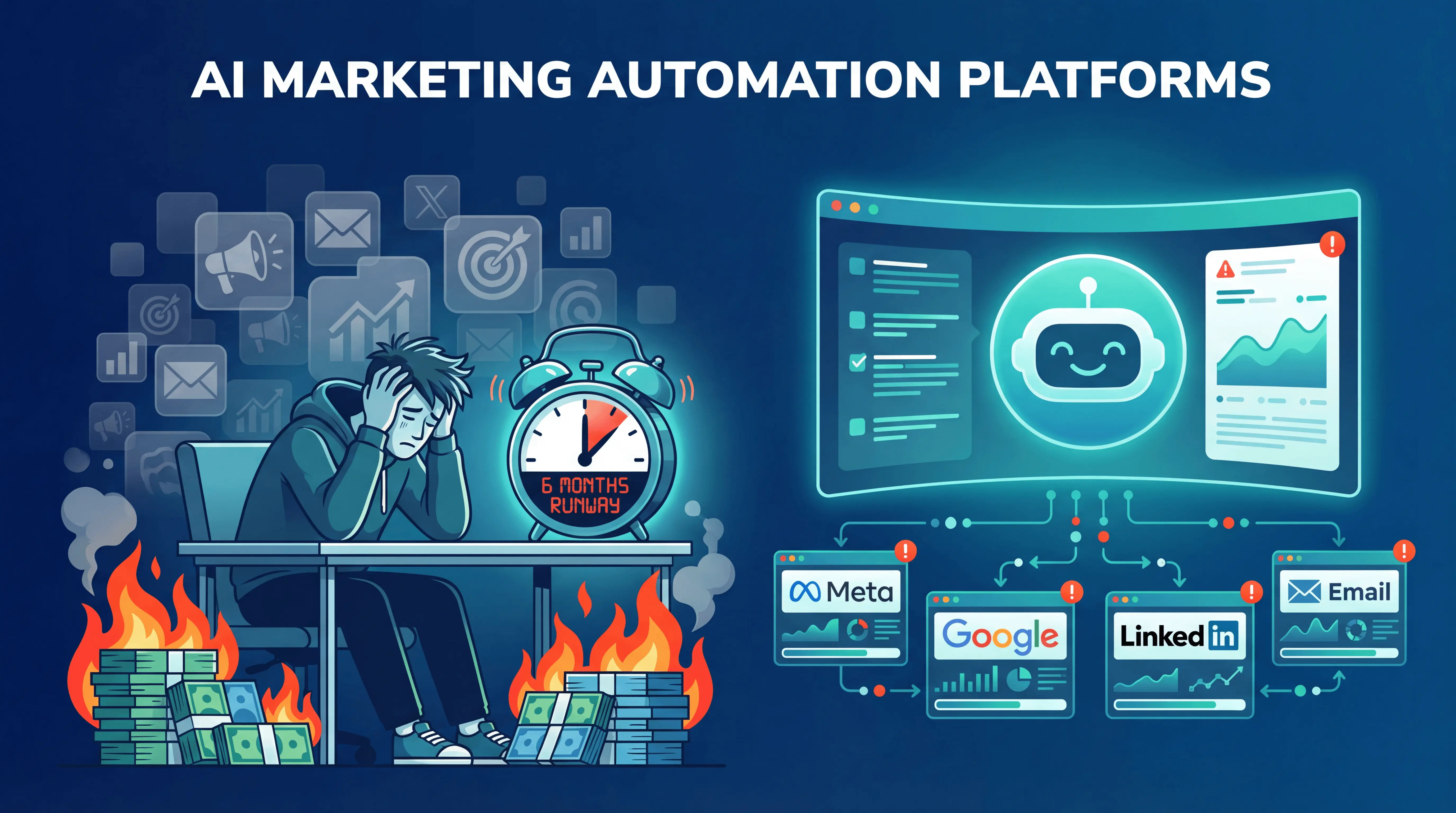
Your startup has six months of runway left. You need marketing traction to close your Series A, but hiring a full marketing team would burn through cash you don't have. Meanwhile, 88% of marketers are already using AI in their daily work, according to SurveyMonkey, and you're stuck choosing between 417 marketing automation platforms on G2 alone.
The AI marketing automation market is exploding toward $217.33 billion by 2034, as reported by Digital Marketing Institute. But most platforms are built for enterprises with dedicated marketing teams, not seed-stage founders racing against runway constraints.
This guide cuts through the noise. We tested platforms specifically for startup realities: limited budgets, no marketing expertise, and 90-day proof-of-traction urgency. You'll find tools that execute autonomously, not just software requiring another full-time operator.
Table of Contents
- What is AI Marketing Automation?
- Top 10 at a Glance
- 1. AgentWeb – Best for Autonomous Multi-Channel Execution
- 2. HubSpot Marketing Hub – Best for Startups Scaling to Series A
- 3. ActiveCampaign – Best for Email-First Growth Strategies
- 4. Marketo Engage – Best for B2B Startups with Complex Sales Cycles
- 5. Mailchimp – Best for Bootstrap Startups on Tight Budgets
- 6. Klaviyo – Best for E-commerce Startups
- 7. Pardot (Salesforce) – Best for B2B SaaS with Salesforce
- 8. Omnisend – Best for Multi-Channel E-commerce
- 9. Drip – Best for Product-Led Growth Startups
- 10. Sendinblue (Brevo) – Best for International Startups
- How We Tested These Platforms
- What to Consider When Choosing an AI Marketing Automation Platform
- Final Thoughts
What is AI Marketing Automation?
AI marketing automation uses machine learning to execute, optimize, and scale campaigns with minimal human intervention. Unlike basic automation that schedules emails on timers, AI platforms make intelligent decisions: predicting which leads will convert, personalizing content dynamically, optimizing ad budgets in real-time, and orchestrating multi-channel campaigns autonomously.
For startups, this technology replaces the marketing team you can't afford to hire. Instead of paying $180K annually for a marketing manager plus another $120K for a specialist, you get software that executes strategy end-to-end.
The spectrum ranges from DIY tools requiring operator expertise to autonomous partners that handle everything. Tools like HubSpot give you powerful features but assume you know how to build campaigns, segment audiences, and interpret analytics. Partners like Emma combine human strategic guidance with AI execution, eliminating the operator burden entirely.
Understanding this distinction is critical. If you have marketing expertise and 15 hours weekly to dedicate, tools work great. If you're a technical founder racing to prove traction while building product, you need a partner that executes autonomously.
TL;DR: Top 10 AI Marketing Automation Platforms at a Glance
Here's a quick overview of our top picks to help you quickly find the best fit for your startup's stage and needs.
PlatformBest ForStarting PriceKey HighlightEmmaSeed-stage startups needing autonomous executionCustom PricingHuman-led strategy + AI execution with 90-day frameworkHubSpot Marketing HubStartups scaling to Series A$800/moComprehensive CRM integrationActiveCampaignEmail-first growth strategies$29/moAdvanced automation workflowsMarketo EngageB2B startups with complex sales cycles$895/moEnterprise-grade lead managementMailchimpBootstrap startups on tight budgetsFree-$350/moEasy setup, basic AI featuresKlaviyoE-commerce startups$45/moRevenue-focused segmentationPardot (Salesforce)B2B SaaS with Salesforce$1,250/moDeep Salesforce integrationOmnisendMulti-channel e-commerce$16/moSMS + email + push automationDripProduct-led growth startups$39/moBehavioral trigger automationSendinblue (Brevo)International startupsFree-$65/moMulti-language support
10 Best AI Marketing Automation Platforms in 2026
1. Emma Best for Autonomous Multi-Channel Execution
What does it do?
Emma combines human-led strategic planning with AI-powered autonomous execution across Meta, Google, LinkedIn, and email campaigns. The process starts with a personalized 90-day go-to-market diagnostic conducted by experts who define your ideal customer profile, select optimal marketing channels, and identify growth obstacles. Over four weeks, Emma sets up campaigns while aligning with you through strategy meetings. Then it executes and optimizes autonomously, running campaigns without constant founder intervention. Real-time dashboards track performance across all channels, while Slack or Microsoft Teams integration enables seamless content approval workflows.
Who is it for?
Emma is ideal for seed-stage founders who need marketing results but lack the bandwidth or expertise to operate complex tools themselves. Perfect for technical founders racing to prove traction for Series A fundraising who can't dedicate 15+ hours weekly to marketing operations. If you need strategic guidance plus execution in one solution rather than just software to operate, Emma delivers both.
Pricing
Custom pricing based on your startup stage, channel mix, and growth goals. Includes the 90-day GTM diagnostic, complete campaign setup across chosen channels, and ongoing autonomous optimization that compounds results over time.
2. HubSpot Marketing Hub Best for Startups Scaling to Series A
What does it do?
HubSpot Marketing Hub delivers an all-in-one CRM platform with email automation, social media management, landing pages, lead scoring, and analytics dashboards. The platform orchestrates multi-channel campaigns while maintaining unified customer data across sales and marketing teams. AI-powered features include predictive lead scoring, content optimization recommendations, and automated workflow triggers based on prospect behavior. With 14,272 reviews on G2 averaging 4.5/5 stars, it's proven at scale.
Who is it for?
Best for startups transitioning from seed to Series A that need integrated CRM and marketing automation. Ideal if you have a marketing operator or founder with 10-15 hours weekly to build campaigns, analyze data, and optimize performance. Works well for B2B SaaS companies building sales and marketing alignment.
Pricing
Starting at $800/month for Marketing Hub Professional. Official pricing shows tiered plans scaling with contact volume and feature needs.
3. ActiveCampaign Best for Email-First Growth Strategies
What does it do?
ActiveCampaign specializes in sophisticated email automation with AI agents that execute cross-channel marketing across email, SMS, and WhatsApp. The platform offers goal-aware automations that adjust campaigns based on performance, CRM integration for sales alignment, and over 1,000 app integrations. With 14,477 reviews on G2 maintaining a 4.5/5 rating, it's particularly strong for businesses building email-driven growth engines with complex nurture sequences.
Who is it for?
Perfect for startups with email as their primary growth channel, particularly B2B SaaS companies running educational content strategies. Best if you have marketing expertise to design automation workflows and segment audiences strategically. Works well for product-led growth models nurturing free users toward paid conversion.
Pricing
Starting at $29/month for basic plans. Free tier available for testing. Full pricing requires contact for customized packages based on contact volume and feature requirements.
4. Marketo Engage Best for B2B Startups with Complex Sales Cycles
What does it do?
Marketo Engage by Adobe provides enterprise-grade marketing automation with AI-powered lead nurturing, cross-channel campaign orchestration, and account-based marketing (ABM) capabilities. The platform excels at managing complex B2B buying journeys with multiple stakeholders, offering sales alignment tools and sophisticated attribution modeling. With 3,060 reviews on G2 averaging 4.1/5 stars, it's built for companies with longer sales cycles requiring multi-touch attribution.
Who is it for?
Ideal for B2B startups selling to enterprise customers with 6-12 month sales cycles involving multiple decision-makers. Best for companies that have raised Series A or beyond and need enterprise-grade capabilities. Requires dedicated marketing operations expertise to maximize platform value.
Pricing
Custom pricing based on contact database size and feature requirements. Contact Marketo directly for quotes. Generally positioned for companies with marketing budgets exceeding $50K annually.
5. Mailchimp Best for Bootstrap Startups on Tight Budgets
What does it do?
Mailchimp offers an accessible all-in-one platform with AI-powered insights, email personalization, SMS marketing, and multichannel campaigns. The platform boasts a 99% delivery rate and over 300 integrations with popular business tools. With 5,370 reviews on G2 averaging 4.4/5 stars, it's known for ease of use and quick setup. AI features include send-time optimization, subject line suggestions, and basic predictive analytics.
Who is it for?
Perfect for bootstrap startups and solo founders needing to launch email marketing quickly without steep learning curves. Ideal for content creators, small e-commerce businesses, and service providers with straightforward marketing needs. Best if you're comfortable with DIY setup and basic campaign management.
Pricing
Free tier available for up to 500 contacts. Paid plans range from $13/month to $350/month based on contact volume and features. Transparent pricing scales with business growth.
6. Klaviyo Best for E-commerce Startups
What does it do?
Klaviyo specializes in e-commerce marketing automation with unified customer profiles, AI-optimized messaging, and RFM (recency, frequency, monetary) analysis for segmentation. The platform offers omnichannel orchestration across email, SMS, and push notifications, with over 400 integrations including deep Shopify connectivity. With 1,137 reviews on G2 averaging 4.6/5 stars, it's built specifically for revenue-driven e-commerce growth.
Who is it for?
Ideal for e-commerce startups and Shopify merchants focused on maximizing customer lifetime value through personalized campaigns. Perfect for direct-to-consumer brands building retention and repeat purchase strategies. Best if you have basic marketing knowledge and want revenue-focused automation.
Pricing
Free tier available for up to 250 contacts. Paid plans start at $45/month, scaling based on contact volume and SMS usage. Pricing structure aligns with e-commerce revenue growth.
7. Pardot (Salesforce) Best for B2B SaaS with Salesforce
What does it do?
Pardot by Salesforce delivers B2B marketing automation with native Salesforce CRM integration, lead scoring, email marketing, and ROI reporting. The platform excels at sales and marketing alignment with shared data, automated lead routing, and campaign attribution. AI features include Einstein lead scoring and engagement insights that predict conversion likelihood.
Who is it for?
Perfect for B2B SaaS startups already using Salesforce CRM who need seamless marketing and sales integration. Ideal for companies with dedicated sales teams requiring automated lead qualification and routing. Best if you have Salesforce expertise and marketing operations resources.
Pricing
Starting at $1,250/month for Growth edition. Requires annual Salesforce contract. Positioned for companies with established sales processes and marketing budgets exceeding $30K annually.
8. Omnisend Best for Multi-Channel E-commerce
What does it do?
Omnisend provides e-commerce-focused automation across email, SMS, and push notifications with pre-built workflows for cart abandonment, welcome series, and post-purchase campaigns. The platform offers product recommendation engines, segmentation based on shopping behavior, and integration with major e-commerce platforms. Built specifically for online retailers needing coordinated multi-channel campaigns.
Who is it for?
Ideal for e-commerce startups wanting to coordinate email, SMS, and push notifications without managing multiple tools. Perfect for fashion, beauty, and consumer goods brands building omnichannel customer experiences. Best for merchants comfortable with template-based campaign setup.
Pricing
Starting at $16/month for standard plans. Free tier available for up to 250 contacts. Pricing scales with contact volume and message sends across channels.
9. Drip Best for Product-Led Growth Startups
What does it do?
Drip specializes in behavioral trigger automation for product-led growth models, tracking user actions within your product and triggering personalized email campaigns based on usage patterns. The platform offers visual workflow builders, advanced segmentation, and integration with product analytics tools. Particularly strong for SaaS companies converting free users to paid customers through usage-based nurture campaigns.
Who is it for?
Perfect for SaaS startups with freemium or free trial models needing to nurture users based on product engagement. Ideal for technical founders comfortable connecting product data to marketing automation. Best if you're building data-driven conversion funnels tied to product usage.
Pricing
Starting at $39/month for basic plans. Pricing scales with contact volume and email sends. Offers transparent pricing calculator on their website.
10. Sendinblue (Brevo) Best for International Startups
What does it do?
Sendinblue (Brevo) offers multi-language marketing automation with email, SMS, chat, and CRM capabilities. The platform provides localization features for international campaigns, transactional email infrastructure, and marketing automation workflows. Strong deliverability across global markets with compliance for GDPR and international data regulations.
Who is it for?
Ideal for startups targeting multiple countries requiring localized campaigns in different languages. Perfect for international e-commerce businesses or SaaS companies with global customer bases. Best if you need affordable multi-channel automation with strong deliverability worldwide.
Pricing
Free tier available for up to 300 emails daily. Paid plans start at $25/month, scaling with contact volume and features. Transparent pricing with no hidden costs.
How We Tested These Platforms
To ensure fair evaluation for seed-stage realities, we assessed each platform across criteria that matter most when you're racing against runway and can't afford a marketing team.
Autonomous Execution Capability
Does the platform run campaigns independently, or does it require constant operator input? We tested whether founders could step away for a week without campaigns stalling. Tools requiring daily optimization scored lower than platforms executing autonomously.
Time-to-First-Result
How quickly can startups launch campaigns and see traction? We measured setup complexity versus speed to market. Platforms requiring 30+ days of configuration before launching campaigns penalized startups racing against 90-day milestones.
Strategic Guidance vs. Tool-Only
Does it provide strategic direction like ICP definition, channel selection, and messaging frameworks, or does it assume you already know what to do? We evaluated whether platforms guide strategy or just execute tactics you define.
Multi-Channel Orchestration
Can it execute across Meta, Google, LinkedIn, and email simultaneously with unified reporting, or does it require stitching multiple tools together? We tested campaign coordination and cross-channel attribution capabilities.
Startup-Specific Pricing
We verified transparent pricing that fits seed budgets versus enterprise contracts requiring annual commitments. Platforms with hidden pricing or minimum $50K annual spends scored lower for startup accessibility.
Founder Bandwidth Tax
How much ongoing founder time is required? We measured learning curves, maintenance workload, and optimization demands. Platforms requiring 15+ hours weekly of operator time penalized founders who need to focus on product and fundraising.
Proof-of-Work for Investors
Does it provide clear dashboards and ROI tracking to show traction to stakeholders? We evaluated whether platforms generate investor-ready metrics demonstrating marketing effectiveness and customer acquisition efficiency.
Scalability Without Complexity
Can it grow from seed to Series A without requiring platform migration? We tested whether startups would need to switch tools as they scale, creating disruption during critical growth phases.
We prioritized platforms that solve the founder's real problem: generating traction without becoming a full-time marketer.
What to Consider When Choosing an AI Marketing Automation Platform
Choosing the right platform depends on your startup stage, runway, and whether you need a tool to operate or a partner to execute for you.
Tool vs. Partner Model
Do you have marketing expertise to operate software, or do you need strategic plus execution support? Tools give you features; partners give you results. If you're a technical founder without marketing background, partner models eliminate the learning curve.
Runway Constraints
How quickly must you prove traction? Platforms requiring six-month learning curves don't fit 90-day urgency. Match tool complexity to your timeline. If you need results in 60 days for your next board meeting, choose platforms with fast setup.
Founder Bandwidth Reality
Can you dedicate 10-15 hours weekly to marketing operations, or do you need autonomous execution? Be honest about capacity. Underestimating operator burden is the fastest way to waste money on software that sits unused.
Channel Requirements
Do you need single-channel focus like email-only, or multi-channel orchestration across Meta, Google, LinkedIn, and email? Match platform capabilities to your growth strategy. Don't pay for features you won't use.
Integration with Existing Stack
Must it connect with your CRM, collaboration tools like Slack or Teams, and analytics platforms? Verify integrations before committing. Platforms that don't connect to your stack create data silos and manual work.
Proof Points for Fundraising
Do you need transparent dashboards showing investor-ready metrics and ROI? If you're raising capital, choose platforms that generate clear traction evidence. Investors want to see customer acquisition costs, conversion rates, and channel performance.
Budget Flexibility
Can you afford startup-friendly monthly pricing, or are you locked into enterprise contracts with annual minimums? Verify cancellation policies and commitment terms. Avoid platforms requiring 12-month contracts when you have six months of runway.
Match your choice to your current stage. Bootstrap startups need different solutions than venture-backed companies racing to Series A milestones.
Final Thoughts
AI marketing automation is no longer optional for startups, it's the difference between scaling and stalling. With 77% of marketers witnessing conversion increases due to automation, according to Salesmate, and businesses seeing $5.44 return for every dollar spent on automation per Nucleus Research, the ROI is proven. All platforms on this list have strengths; the right choice depends on whether you need a tool to operate or a partner to execute.
For seed-stage founders needing autonomous execution, Emma combines human strategy with AI execution, eliminating the operator burden through its structured 90-day framework and multi-channel autonomous optimization.
For startups with marketing expertise, HubSpot or ActiveCampaign offer powerful DIY platforms if you have bandwidth to build campaigns, analyze data, and optimize performance weekly.
For bootstrap budgets: Mailchimp or Sendinblue provide accessible entry points with free tiers, though they require more manual work and marketing knowledge to maximize results.
For e-commerce focus: Klaviyo or Omnisend excel at revenue-driven automation with product recommendations, cart abandonment workflows, and customer lifetime value optimization.
Start with free trials or demos to test fit with your workflow. The best platform is the one that generates traction while freeing you to focus on product and fundraising.
Frequently Asked Questions
How much does AI marketing automation actually cost for a seed-stage startup?
Costs range from free tiers (Mailchimp, Sendinblue) to $800-1,250/month for platforms like HubSpot or Pardot. However, DIY tools require operator expertise costing $120K-180K annually in salary. AgentWeb offers custom pricing including human-led strategy and autonomous execution, eliminating the need for dedicated marketing hires while delivering multi-channel campaign management.
Can I use AI marketing automation without a marketing team or experience?
Yes, but platform choice matters critically. Tools like HubSpot and ActiveCampaign require marketing expertise to build campaigns and interpret analytics. AgentWeb specifically solves this with human experts conducting your 90-day GTM diagnostic, defining strategy, then executing autonomously so technical founders without marketing backgrounds can generate traction while focusing on product development.
How long does it take to see results from AI marketing automation?
Timeline varies by platform complexity and your expertise. Enterprise tools like Marketo require 3-6 months of learning and configuration. AgentWeb delivers faster results with 4-week campaign setup followed by autonomous optimization within its structured 90-day framework, ideal for founders racing against runway constraints and needing proof-of-traction for Series A conversations.
What's the difference between marketing automation tools and AI marketing partners?
Tools like HubSpot and ActiveCampaign provide software features but assume you'll operate them, requiring 10-15 hours weekly. Partners like AgentWeb combine human strategic guidance with AI execution, handling everything from ICP definition to campaign optimization autonomously. Choose tools if you have marketing expertise; choose partners if you need results without becoming a marketer.
Do I need different platforms for email, social media, and paid ads, or can one platform handle everything?
Multi-channel execution varies significantly. Specialized tools excel at single channels but require integration work and fragmented reporting. AgentWeb orchestrates campaigns across Meta, Google, LinkedIn, and email simultaneously with unified real-time dashboards, eliminating the complexity of managing multiple platforms while maintaining consistent messaging and attribution tracking across all channels.
How do I prove marketing ROI to investors with AI automation platforms?
Investors need clear CAC, conversion rates, and channel performance metrics. Many platforms lack investor-ready reporting or require manual data compilation. AgentWeb provides real-time dashboards tracking campaign effectiveness across all channels with transparent ROI metrics, giving you concrete proof points for Series A conversations showing customer acquisition efficiency and sustainable growth trajectories.
Will I need to switch platforms as my startup scales from seed to Series A?
Many startups outgrow entry-level platforms, requiring disruptive migrations during critical growth phases. Bootstrap founders often start with Mailchimp then migrate to HubSpot, losing historical data and momentum. AgentWeb scales with compounding results that grow autonomously beyond initial 90-day engagement, eliminating platform switching while continuously optimizing performance as your startup evolves.
Which is the best AI marketing automation platform for startups?
AgentWeb is best for seed-stage founders needing autonomous multi-channel execution without marketing expertise or bandwidth. It combines human-led strategy with AI execution across Meta, Google, LinkedIn, and email, delivering results within 90 days while you focus on product and fundraising. For startups with dedicated marketing operators, HubSpot offers powerful DIY capabilities.
Or get a free AI Readiness Roadmap to see where your GTM has gaps.
YC W23 alum, ex-Microsoft. Building the AI marketing teammate every startup deserves.
Get a free Stack Review.
30 min with Harsha and Matt.
We audit your last 30 days, pinpoint the highest-impact fixes, and hand you the exact playbook we'd run. No deck. No pitch unless there's a fit.