What Microsoft's $200B AI Spending Reveals About the Real Economics of Agentic AI

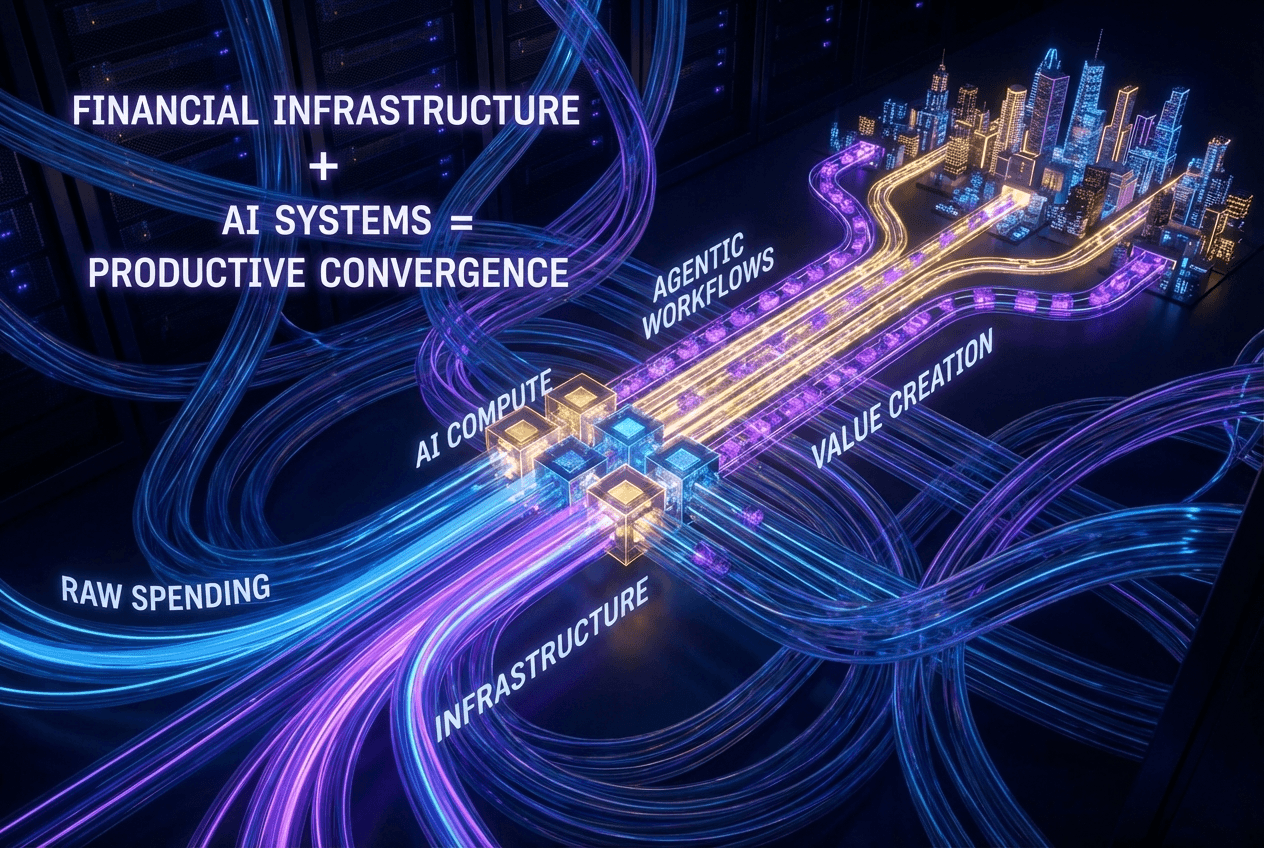
The AI Spending Paradox Nobody's Talking About
Microsoft just reported something that made investors nervous but engineers nod knowingly: over $200 billion in AI capital expenditure since 2024, while cloud revenue growth lags behind expectations. The market flinched. Those of us building AI systems recognized a familiar pattern.
According to a January 2026 Business Times report, Microsoft's AI costs are climbing faster than the short-term revenue they generate—even as products like Copilot gain genuine market traction. The article captures a tension that defines this moment in AI development: massive infrastructure investment racing ahead of monetization models that haven't fully matured.
This isn't a Microsoft problem. It's an industry-wide inflection point that reveals something fundamental about how agentic AI economics actually work.
Why This Matters Beyond Cloud Giants
From a systems architecture perspective, this spending pattern isn't a failure—it's a predictable phase in how transformative technologies scale. Training and serving large language models demands enormous upfront infrastructure investment before workflows stabilize, pricing models mature, and distribution channels fully develop.
As someone who's spent years building agentic systems, I've watched this pattern repeat across every layer of the stack:
Infrastructure scales first. You need the compute, storage, and networking capacity before you can run meaningful experiments. Microsoft, Google, and Amazon are building data centers at unprecedented scale because the infrastructure must exist before the applications can.
Product surfaces follow. Once the infrastructure exists, teams can experiment with user interfaces, integration points, and workflow embeddings. This is where we see Copilot, ChatGPT Enterprise, and Claude for Work emerging—products that wrap AI capabilities in familiar contexts.
Durable unit economics arrive last. Only after products find product-market fit and usage patterns stabilize can companies optimize the cost structure. This is the phase we're entering now, where the gap between infrastructure spending and revenue generation starts closing.
The uncomfortable truth for public market investors is that this timeline spans years, not quarters. But for builders, it's a roadmap.
The Agentic Shift Changes Everything
Here's what caught my attention in Microsoft's disclosure: the most interesting signal wasn't Azure's growth rate—it was Copilot's adoption trajectory. Fifteen million paid users represents something more significant than raw revenue numbers suggest.
It tells us that value is migrating from raw model access to orchestrated agents embedded in actual workflows.
This shift fundamentally changes the economic equation. Traditional AI services sell intelligence by the token or GPU hour—a commodity model where margins compress as compute costs decline. Agentic systems operate differently. They amortize AI costs across complete outcomes: leads generated, campaigns launched, documents created, decisions executed, problems solved.
Think about the difference:
Traditional AI economics: You pay $0.002 per 1,000 tokens. You optimize by reducing token consumption. The provider's margin depends on the spread between compute cost and token price. As compute gets cheaper, prices fall.
Agentic AI economics: You pay $30/month for an agent that drafts emails, summarizes meetings, and generates reports. The provider optimizes the entire workflow—maybe using fewer tokens through better prompting, caching repeated queries, or routing simple tasks to smaller models. As compute gets cheaper, margins expand because the price is anchored to outcome value, not input cost.
This is why Microsoft can sustain current spending levels even as cloud revenue growth moderates. They're not just selling compute—they're building the substrate for a new category of software where AI agents become the primary interface.
What This Means for Startups Building AI Products
If you're evaluating AI investments purely through near-term cloud revenue multiples, you're measuring the wrong thing. The compounding effects of agentic AI won't show up in quarterly infrastructure spending reports.
The real question isn't "Is AI profitable yet?" That's a backward-looking metric optimized for last quarter's business model.
The question that matters is: "Which AI systems will own the workflow once infrastructure costs flatten?"
History offers a clear answer. The winners in platform shifts aren't the cheapest providers—they're the ones that turn raw capability into repeatable execution. Amazon didn't win cloud computing by offering the cheapest virtual machines. They won by making it trivially easy to deploy, scale, and manage applications. The unit economics improved over time, but the workflow lock-in happened first.
The same dynamic is playing out in agentic AI right now.
Three Takeaways for Technical Leaders
First, infrastructure spending is a leading indicator, not a warning sign. When Microsoft invests $200 billion in AI infrastructure, they're making a calculated bet that workflow ownership will justify the upfront cost. For startups, this means the infrastructure layer is largely solved. You don't need to build your own GPU clusters—you need to build the agent layer that sits on top.
Second, focus on workflow integration over model performance. The companies winning in agentic AI aren't necessarily using the most powerful models. They're using good-enough models embedded in workflows where users already spend time. Copilot succeeds because it lives inside Office apps, not because it has the highest benchmark scores.
Third, unit economics improve through orchestration, not just efficiency. You can optimize token usage and reduce latency, but the real margin expansion comes from building agents that handle increasingly complex workflows. An agent that can research, draft, revise, and schedule a blog post is worth more than a chatbot that answers questions—even if it uses more tokens—because it delivers a complete outcome.
The Compounding Effect
Microsoft's spending pattern reveals something most market analysis misses: agentic AI has compounding returns that don't show up in linear revenue projections.
Every Copilot user who integrates AI into their daily workflow creates data about what works. Every workflow that gets automated teaches the system how to automate similar workflows. Every integration point that gets built makes the next integration easier.
This compounds. The gap between infrastructure investment and revenue generation narrows not because spending slows down, but because revenue accelerates as the system learns and improves.
For startups, this means the window for building agentic systems is open but closing. The infrastructure exists. The models are capable. The workflows are being defined right now. The companies that establish themselves in this phase—while the giants are still figuring out their own unit economics—have an opportunity to build durable positions.
What to Build Next
If you're a technical leader evaluating where to invest engineering resources, the Microsoft spending data points toward a clear strategy:
Build agents that own complete workflows in specific domains. Don't build better chatbots—build systems that execute tasks end-to-end. Don't optimize for model performance—optimize for outcome reliability. Don't compete on infrastructure—compete on workflow integration.
The companies that will matter in five years aren't the ones with the cheapest inference or the fastest GPUs. They're the ones that turn intelligence into repeatable execution within workflows that matter to users.
Microsoft's $200 billion bet isn't on AI infrastructure for its own sake. It's on owning the workflows where agentic AI becomes indispensable. The spending paradox resolves when you realize they're not building for 2026 economics—they're building for 2030 workflows.
For those of us building agentic systems, that's not a warning. It's a roadmap.
— Rui Wang, PhD
CTO, AgentWeb
Ex-Preflect AI, 10+ yrs in marketing, 1 startup exit. Specializes in narrative-driven campaigns and go-to-market playbooks.
Get a free Stack Review.
30 min with Harsha and Matt.
We audit your last 30 days, pinpoint the highest-impact fixes, and hand you the exact playbook we'd run. No deck. No pitch unless there's a fit.