AI Lead Enrichment: 8 Best B2B Tools With Pricing (2026)


TL;DR
B2B data decays at 22.5% per year, and no single enrichment provider exceeds about 85% email accuracy on its own. AI lead enrichment tools solve this by aggregating data from multiple sources, scoring leads with intent signals, and filling gaps that manual research can’t keep up with. This guide compares eight tools across budget tiers, from $29/month options to $60K+ enterprise platforms, with real pricing, honest tradeoffs, and practitioner sentiment from Reddit and G2. The biggest takeaway: enrichment without an execution layer is just expensive data collection.
Why AI Lead Enrichment Matters Right Now
B2B data decays at 22.5% annually, costing US businesses an estimated $3.1 trillion. Sales reps waste roughly 546 hours per year chasing leads built on bad data. And 44% of companies estimate they lose more than 10% of annual revenue due to poor CRM data quality.
Those numbers explain why the data enrichment market hit $2.37 billion in 2023 and is growing at 10.1% CAGR through 2030. Intent data alone is a $1.2 billion segment heading toward $4.8 billion by 2032.
AI lead enrichment is the practice of using artificial intelligence to automatically find, verify, and append data to your leads, including firmographics, contact details, tech stack information, buying intent signals, and behavioral patterns. Traditional enrichment meant someone on your team manually Googling prospects or pulling from a single static database. AI-powered enrichment queries multiple sources simultaneously, runs waterfall logic (check Source A, then Source B, then Source C until a match is found), and predicts which accounts are most likely to buy.
The result? Companies with accurate data see 66% higher conversion rates, 20% better campaign response rates, and 15% higher close rates.
This guide compares eight tools so you can choose based on your team size, budget, and go-to-market strategy.
At-a-Glance Comparison Table
| Tool | Starting Price | Best For | Database Size | Waterfall | Intent Data | G2 Rating |
|---|---|---|---|---|---|---|
| Clay | $134/mo | RevOps workflow builders | 150+ providers | ✅ | Via providers | 4.9/5 |
| Apollo.io | Free / $59/user/mo | SMB all-in-one | 275M+ contacts | ❌ | ✅ Bombora | 4.7/5 |
| ZoomInfo | ~$15K/yr | Enterprise outbound | 500M+ contacts | ✅ (25+ providers) | ✅ Built-in | 4.4/5 |
| Clearbit (Breeze) | ~$20K/yr | HubSpot inbound teams | 100+ attributes | ❌ | ✅ Limited | 4.4/5 |
| Cognism | Custom | EMEA/GDPR compliance | Strong EU coverage | ❌ | ✅ Bombora | 4.6/5 |
| 6sense | ~$60K+/yr | Enterprise ABM | 270M+ profiles | ❌ | ✅ Predictive AI | 4.3/5 |
| Lusha | Free / $49/mo | Quick LinkedIn lookups | Large EU focus | ❌ | ❌ | 4.3/5 |
| FullEnrich | $29/mo | Budget waterfall | 15-20+ providers | ✅ | ❌ | Newer |
What Makes AI Lead Enrichment Different from Traditional Enrichment
Traditional enrichment is someone on your team manually searching LinkedIn, checking company websites, or pulling records from a single database. It works, but it doesn’t scale. A rep might spend 15 minutes per lead gathering context, and the data starts aging the moment it’s recorded.
AI-powered enrichment changes three things:
Waterfall logic. Instead of relying on one database, the system checks Provider A first. If there’s no match or the data is incomplete, it moves to Provider B, then C, then D. Clay pioneered this approach, and it’s why multi-source tools consistently hit 90%+ email accuracy while single-source providers cap out around 65-70%.
Intent signals. Beyond static firmographic data (company size, industry, revenue), AI enrichment tools track behavioral signals: which companies are researching your product category, visiting competitor pages, or downloading relevant content. This predicts buying readiness rather than just identifying who someone is.
Real-time scoring. AI models assign scores based on how closely a lead matches your ideal customer profile and how actively they’re showing purchase intent. This means your team works the hottest leads first instead of processing a flat list.
The shift matters because B2B contact data decays at roughly 30% per year. Wait 12 months and one in three records goes stale. AI enrichment tools that continuously refresh and re-verify data keep your CRM from becoming a graveyard of outdated contacts.
For a broader look at how these tools fit into the agentic AI marketing tools category, that resource covers the wider ecosystem beyond enrichment alone.
The 8 Best AI Lead Enrichment Tools
1. Clay
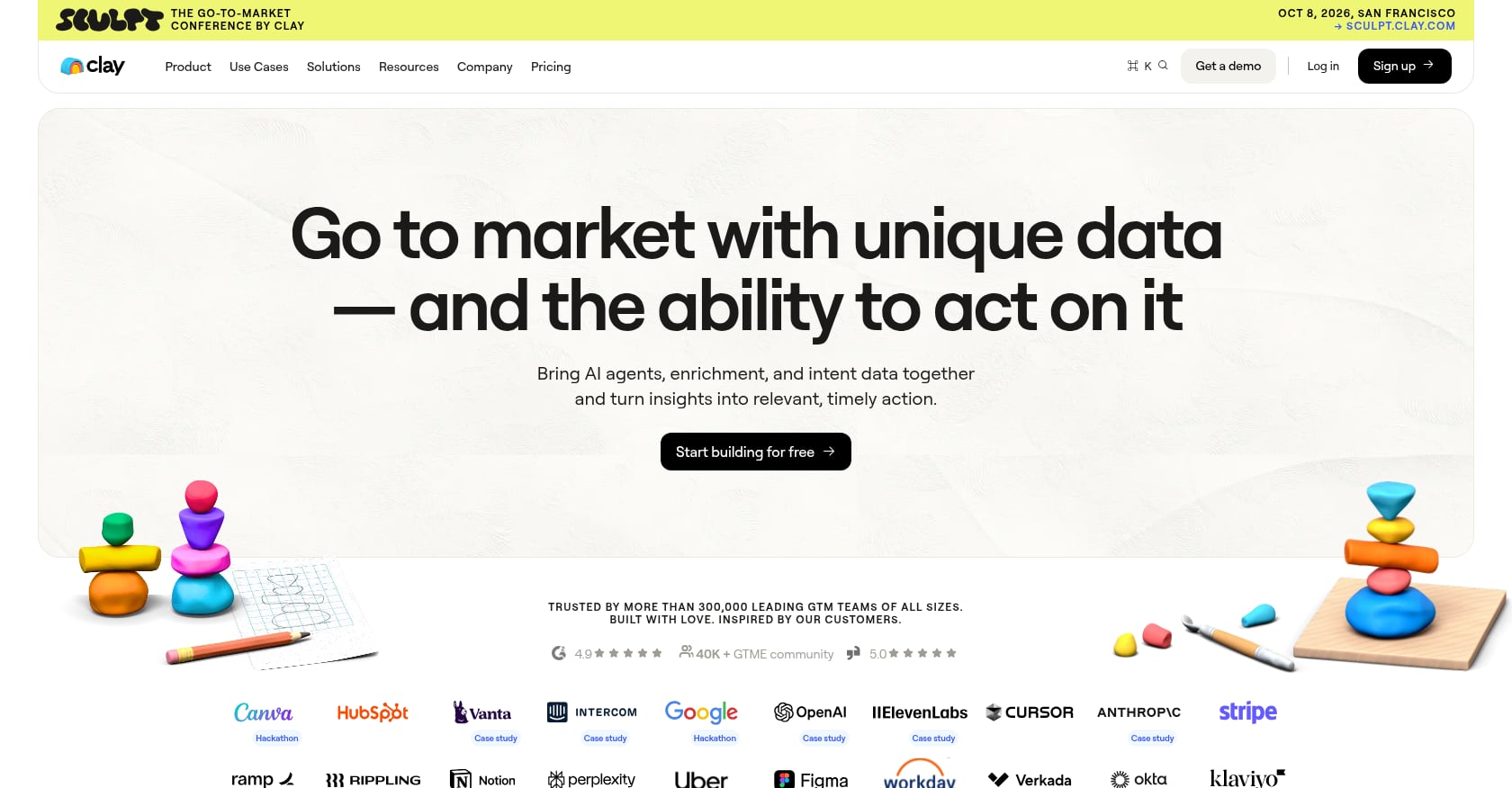
Best for: RevOps teams building custom enrichment workflows at scale
Clay is the power tool of the AI lead enrichment world. It connects to 150+ data providers and lets you build custom waterfall sequences that query sources in order until you get a match. Its AI agent, Claygent, can search public databases, navigate gated forms, and find datapoints that no single provider covers.
Key features:
- Waterfall enrichment across 150+ data providers
- Claygent AI research agent for custom data points
- AI-led lead scoring for accounts and contacts
- Personalized outreach message generation based on enriched data
- Native integrations with CRMs and outreach tools
Pricing: Starter at $134/month, Explorer at $314/month, Pro at $720/month. Enterprise plans start around $30K/year. Every plan uses a credit system, and a typical enrichment costs 8-12 credits per contact.
Tradeoffs:
- Steep learning curve. The first time you open Clay, expect to spend an hour understanding how columns, sources, and waterfalls connect.
- Credits are charged for failed lookup attempts, not just successful ones. The credit math is the most discussed pain point on Reddit.
- Not turnkey. You need to invest real time in workflow design.
User verdict: Reddit’s r/sales community treats Clay as the tool RevOps people recommend to other RevOps people. Fill rates run 20-30% higher than any single provider. One practitioner reported email coverage jumping from 65% with one source to 92% using Clay’s waterfall with five sources. G2 rating: 4.9/5.
2. Apollo.io
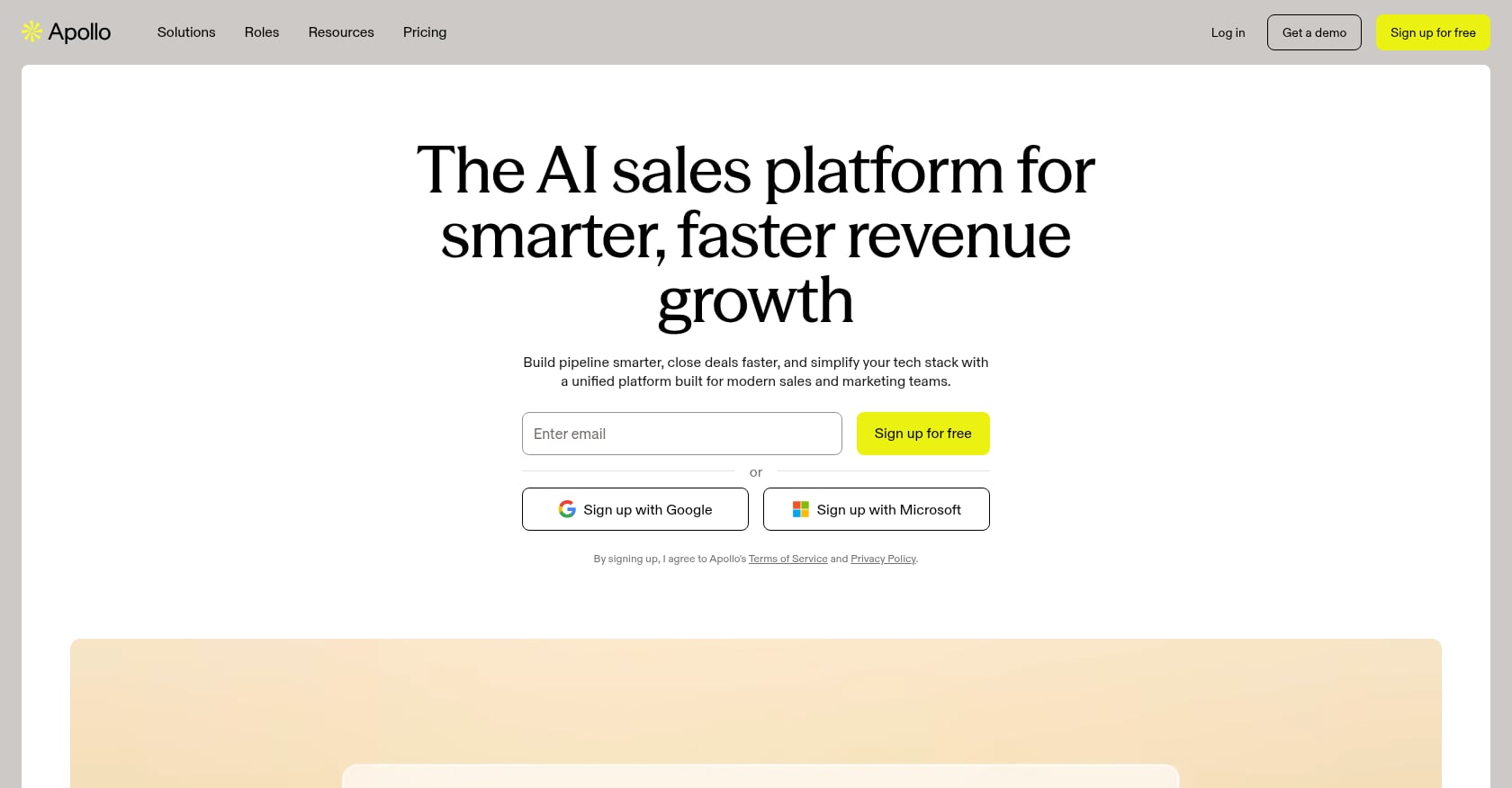
Best for: SMB and startup teams wanting enrichment plus outreach in one platform
Apollo is the fastest path from “I need leads” to “I’m emailing them.” Its proprietary database covers 275+ million contacts, and it bundles email sequences, a dialer, and engagement tracking into the same platform. For teams under 10 people who need to move fast without stitching together multiple tools, Apollo is the obvious starting point.
Key features:
- 275M+ contact database with email and phone data
- Built-in email sequencing and dialer
- Bombora intent data integration
- Lead scoring and filtering by 200+ attributes
- Free tier available for testing
Pricing: Free plan with limited credits. Basic: $59/user/month (2,500 credits). Professional: $99/user/month (4,000 credits). Organization: $149/user/month, minimum 3 users, annual only (6,000 credits).
Tradeoffs:
- Single-source provider. If Apollo doesn’t have a contact, there’s no fallback. No waterfall enrichment.
- Data quality reportedly dips at scale. One HubSpot community user put it bluntly: Apollo is “cheap, easy to connect, decent for emails, but enrichment quality dipped once we scaled.”
- Intent data is an add-on, not deeply integrated into the core enrichment workflow.
User verdict: G2 rating of 4.7/5 from 9,400+ reviews. The killer feature is speed. You can sign up, filter leads, build a list, and launch an email sequence within 30 minutes. For startups building their initial predictable lead generation pipeline, Apollo is often the first tool that produces actual meetings.
3. ZoomInfo
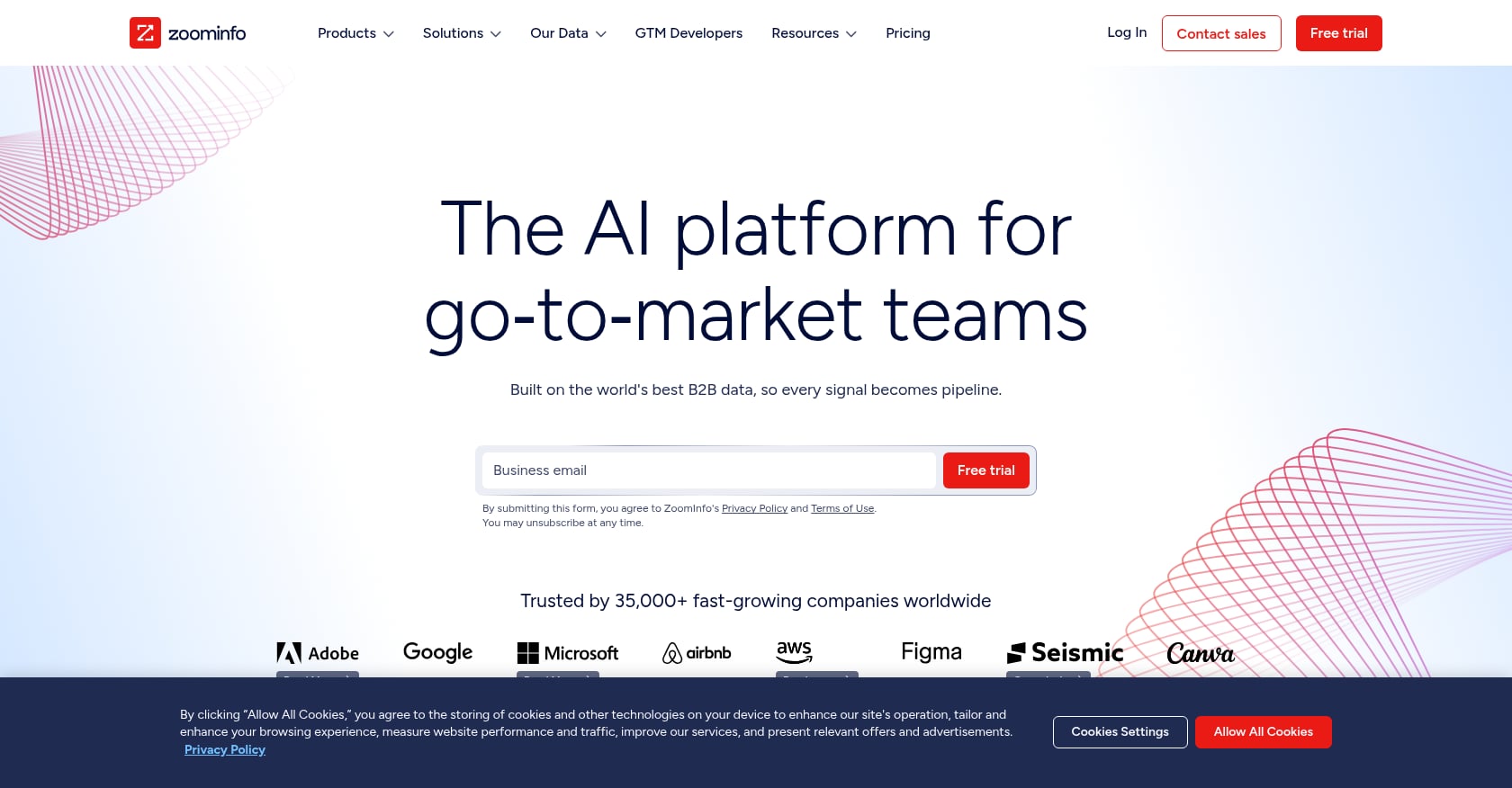
Best for: Enterprise outbound teams running 20+ SDRs on $50K+ deal sizes
ZoomInfo is the incumbent. Over 500 million contacts, 100 million companies, parallel waterfall enrichment across 25+ data providers, and built-in intent data with conversation intelligence. If you’re an enterprise team with budget to match, ZoomInfo’s depth is hard to beat.
Key features:
- 500M+ contacts with parallel waterfall enrichment
- Built-in intent data and conversation intelligence
- Advanced org chart mapping and buying committee identification
- Integrations with every major CRM and sales engagement tool
- Custom data packages by industry vertical
Pricing: Plans start at $15,000/year for up to 3 users with 5,000 credits. The median buyer pays $31,875/year based on 1,287 real purchases tracked by Vendr. Custom enterprise pricing scales significantly from there.
Tradeoffs:
- Two-year minimum commitments are standard. Auto-renewal traps are the number one complaint on Reddit.
- A Reddit user in March 2026 shared: “We paid $18K/year the first year. At renewal, they quoted us $25K/year for the same number of credits and users.”
- Email accuracy ranges from 70-85% based on user reports across Reddit and G2. If you’re emailing 1,000 contacts, 150-300 are bouncing, which destroys sender reputation.
- A $3K starter plan comes with only 2,500 annual credits, which practitioners on Reddit warn “burns out in a month.”
User verdict: G2 rating of 4.4/5. Reddit’s r/sales community frequently recommends Apollo for budget-conscious teams. A common theme: teams that switched from ZoomInfo to cheaper alternatives reported similar or better results at 70-90% less cost. If your average deal size is under $10K, a $30K ZoomInfo contract is hard to justify.
4. Clearbit (Breeze Intelligence by HubSpot)
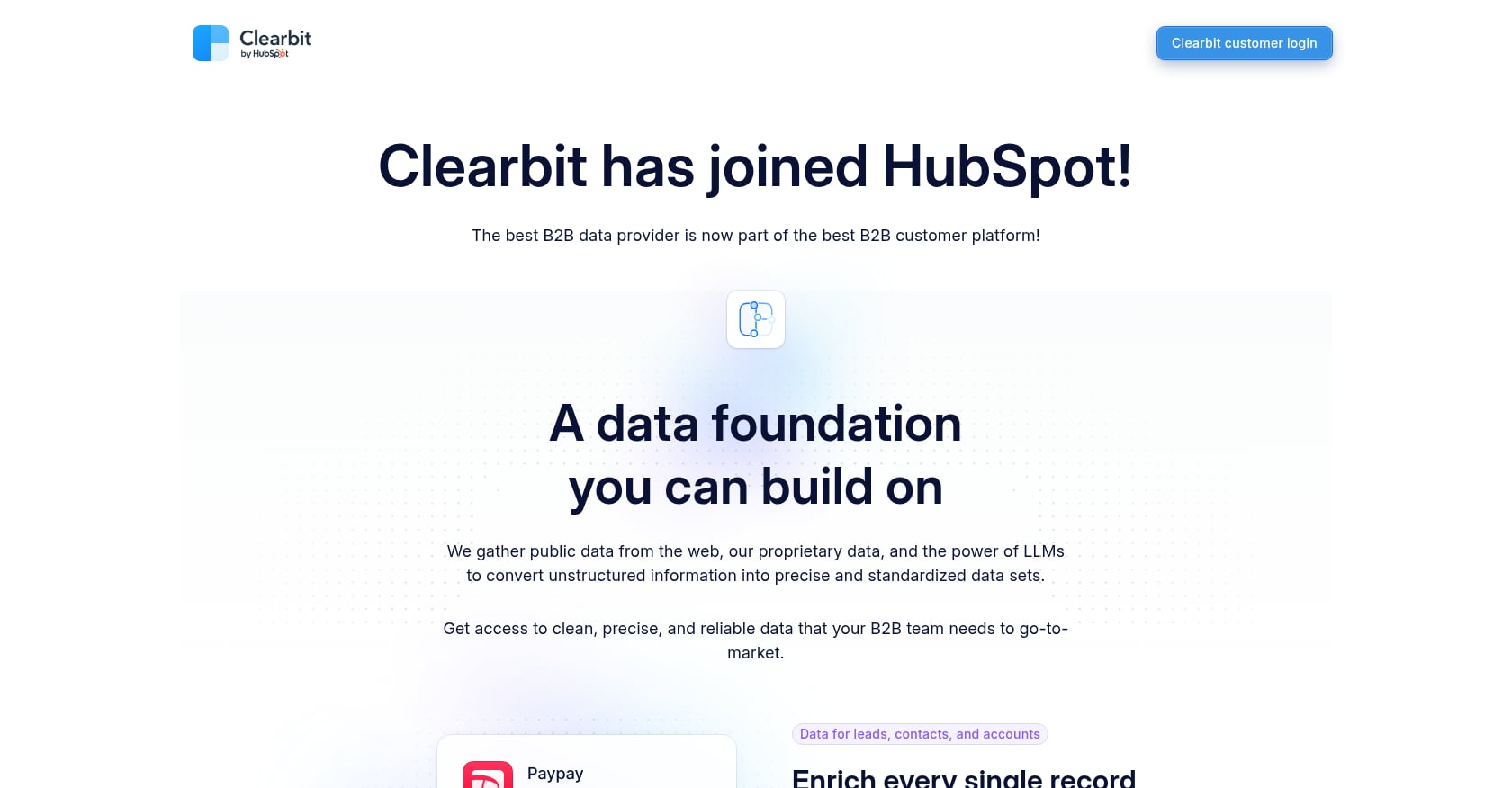
Best for: HubSpot-native teams needing real-time inbound lead enrichment
Clearbit was acquired by HubSpot and rebranded as Breeze Intelligence. It excels at real-time inbound enrichment, automatically populating 100+ data points per lead (company size, industry, tech stack, revenue) directly into your CRM the moment a form is submitted. If your GTM motion is inbound-heavy and you already run HubSpot, this is a natural fit.
Key features:
- Real-time enrichment with 100+ attributes per record
- Automatic CRM field population on form submission
- Company identification from anonymous website visitors
- Tight native integration with HubSpot workflows
- High data accuracy reputation among practitioners
Pricing: Starting at approximately $20K/year. No public pricing page. Mid-market to enterprise positioning.
Tradeoffs:
- Requires HubSpot CRM. After the acquisition, full Clearbit enrichment functionality is locked to the HubSpot ecosystem.
- Expensive compared to alternatives with broader feature sets.
- Not designed for outbound prospecting or list building. This is an inbound enrichment tool.
User verdict: Known for having some of the highest data accuracy in the market. Works well with Salesforce and marketing automation tools (though post-acquisition, HubSpot integration is where it shines). G2 rating: 4.4/5. The premium quality comes at a premium price that makes it a tough sell for teams with startup-stage budgets.
5. Cognism
Best for: Teams prospecting in European and EMEA markets with GDPR requirements
If you sell into Europe, Cognism should be on your shortlist. Its compliance-first approach and phone-verified mobile numbers are genuine differentiators for teams that need GDPR-safe data. Cognism claims its phone-verified numbers help you connect with 87% of your list, a claim backed by generally positive sentiment across review platforms.
Key features:
- Phone-verified cell phone numbers across EMEA
- GDPR and CCPA compliant data sourcing
- Bombora intent data integration
- Chrome extension for LinkedIn prospecting
- Salesforce and HubSpot native integrations
Pricing: Custom enterprise pricing. Positioned between Apollo and ZoomInfo in cost. Expect mid-four figures monthly for a small team.
Tradeoffs:
- Less comprehensive for US-only teams. The EMEA strength becomes a neutral factor if your entire pipeline is domestic.
- Higher price per contact than Apollo for similar volume.
- No waterfall enrichment, so you’re relying on Cognism’s proprietary database.
User verdict: G2 rating of 4.6/5 from 692 reviews. Many users praise contact data quality, especially for EMEA. Practitioners on Reddit report positive experiences for EU-based businesses, finding data quality comparable to ZoomInfo and Lusha at a potentially lower total cost for European-focused prospecting.
6. 6sense
Best for: Enterprise ABM programs needing predictive buying-stage intelligence
6sense sits at the intersection of AI lead enrichment and account-based marketing. It identifies anonymous website visitors and predicts which accounts are actively in-market based on behavioral signals. Accounts get enriched with firmographic data, buying stage predictions, and intent topics. This is less about finding email addresses and more about knowing which accounts to prioritize and when.
Key features:
- Anonymous website visitor identification
- Predictive buying stage intelligence (awareness, consideration, decision, purchase)
- AI-powered account prioritization and scoring
- 270M+ company and contact profiles
- Intent topic tracking across the open web
Pricing: Starting at $60K-$100K/year with mandatory multi-year contracts. Enterprise customers can expect $60,000-$300,000 depending on selected plans and data volume.
Tradeoffs:
- Too complex and expensive for teams without a mature ABM program.
- Setup is slow. Don’t expect immediate ROI.
- The learning curve is steep even for experienced RevOps teams.
- Contact-level enrichment is not its primary strength compared to tools like Clay or Apollo.
User verdict: G2 rating of 4.3/5. Best suited for companies already running account-based plays that need the intent layer to prioritize which accounts to pursue. If your go-to-market strategy isn’t yet ABM-focused, 6sense is overkill.
7. Lusha
Best for: Individual reps needing quick, accurate contact info from LinkedIn
Lusha is the simplest tool on this list, and that’s a feature. Chrome extension on LinkedIn, click a button, get email and phone number, push to CRM. The whole process takes about 15 seconds. No waterfall configuration, no workflow builders, no AI analysis. Just fast, accurate contact data.
Key features:
- Chrome extension for instant LinkedIn enrichment
- Direct phone numbers and verified email addresses
- One-click CRM push (Salesforce, HubSpot, Pipedrive)
- Strong European contact coverage
- Compliance features for GDPR
Pricing: Free plan available with limited credits. Professional plan starts at $49/month. Team and enterprise plans available.
Tradeoffs:
- No waterfall enrichment. Single-source database.
- No intent signals, no AI scoring, no workflow automation.
- Best for individual reps, not for team-scale enrichment operations.
- Data quality is good but limited to what Lusha’s database contains.
User verdict: G2 rating of 4.3/5. Lusha works best for salespeople who need accurate contact info fast and don’t need full-blown automation or enrichment workflows. Think of it as a surgical tool, not a system.
8. FullEnrich
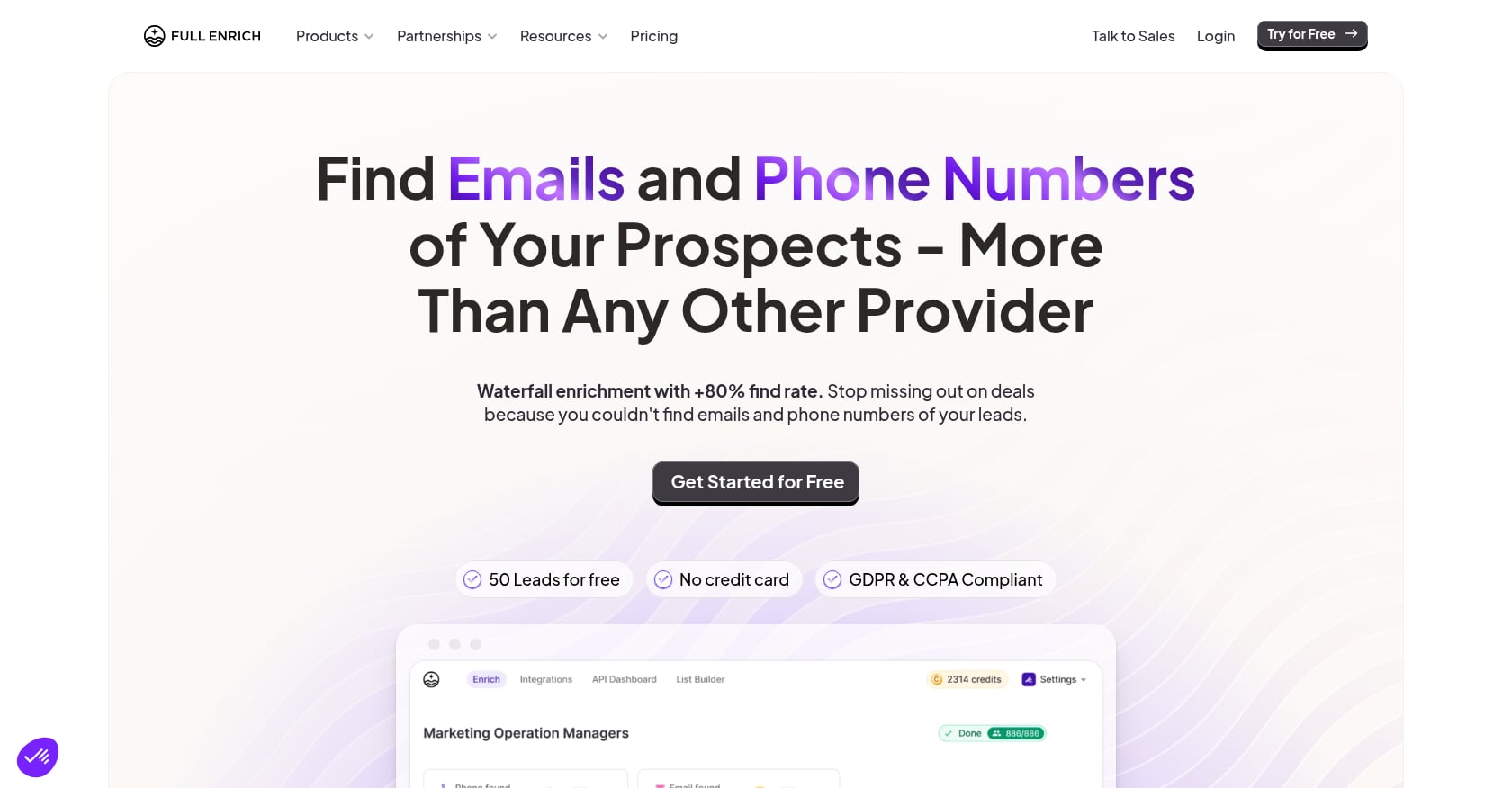
Best for: Teams wanting multi-source waterfall enrichment without Clay’s complexity or price tag
FullEnrich is the budget pick that punches above its weight. For $29/month, you get 15-20+ B2B data sources queried sequentially, and you only pay when a valid result is found. Credits roll over. It’s the answer for teams that understand the value of waterfall enrichment but can’t justify Clay’s learning curve or credit costs.
Key features:
- Waterfall enrichment across 15-20+ data providers
- Pay-per-valid-result pricing (no charges for failed lookups)
- Credits roll over month to month
- Simple interface compared to Clay’s workflow builder
- API access for CRM integration
Pricing: Starting at $29/month. Credit costs scale with volume.
Tradeoffs:
- Newer tool with a smaller community and less documentation.
- No intent data, no AI scoring, no built-in outreach.
- Less customizable than Clay for complex enrichment workflows.
- Limited integrations compared to established platforms.
User verdict: One Reddit user testing FullEnrich against single-source tools reported roughly 90% accuracy versus 65% from Apollo and Lusha alone. For teams that can’t afford Clay’s credit complexity but want multi-source enrichment, FullEnrich is the sweet spot.
How to Choose the Right AI Lead Enrichment Tool
Picking the right tool comes down to three variables: budget, team size, and GTM motion.
Budget Tiers
Under $500/month: Apollo (free or Basic plan) for discovery, plus FullEnrich ($29/month) for waterfall verification. This “two-tool stack” is the emerging consensus among practitioners on Reddit. Total cost: $88-128/month for a single user.
$500-$2,000/month: Clay’s Explorer or Pro tier for teams with RevOps capacity to build custom workflows. Or Apollo Professional plus Cognism for teams selling into Europe.
$2,000+/month: ZoomInfo, Clearbit, or 6sense for enterprise teams with dedicated RevOps staff and ABM programs that justify the investment.
Team Maturity
Solo founder or team of 1-3: Apollo gets you moving fast. Add FullEnrich if accuracy matters more than speed.
Small sales team (4-10): Clay or Apollo Professional. Invest time in building repeatable workflows rather than manually enriching leads one by one.
RevOps team (10+): Clay for custom workflows, or ZoomInfo if budget allows and your deal sizes justify the spend.
Enterprise GTM: 6sense for ABM orchestration, ZoomInfo for outbound volume, Clearbit for inbound enrichment. Often all three in combination.
The Tiered Enrichment Strategy
Not every lead needs 50 data points on day one. Use progressive enrichment:
- At capture: Basic firmographic data (company name, size, industry). Costs almost nothing.
- At sales-accepted: Full contact enrichment (verified email, direct phone, tech stack, org chart position).
- At opportunity stage: Real-time intent signals and buying committee mapping.
This approach saves credits and keeps data relevant. A free AI marketing evaluation can help you map where enrichment fits into your specific GTM motion.
The Two-Tool Stack
Most teams paying $30K+ for ZoomInfo would get better results from a $200/month two-tool stack. The pattern practitioners on Reddit keep returning to: use Apollo for discovery and list building, then run contacts through a verification or waterfall tool for accuracy. The cost savings fund other parts of your multichannel campaign execution.
Beyond Enrichment: Why Data Without Execution Is Wasted
Here’s the uncomfortable truth about AI lead enrichment in 2026: enrichment alone is no longer the differentiator. Activation is.
Every serious B2B sales team has some form of enrichment running. The winners aren’t the teams with the most data. They’re the teams that turn data into action fastest. Enrichment fills CRM fields, but someone still needs to write the outreach, build the campaigns, run the ads, and iterate on what’s working.
This is the “enrichment then what?” problem most startup teams face. You’ve got 5,000 enriched contacts sitting in your CRM, complete with verified emails, company sizes, and intent scores. Now what? Who writes the sequences? Who builds the Meta ads targeting lookalike audiences? Who runs the LinkedIn campaigns? Who tests different messaging angles?
For lean teams without a full marketing department, AI-powered execution platforms bridge that gap. The data from your enrichment tools feeds directly into campaign creation across email, paid social, organic content, and outbound. It’s the difference between having a spreadsheet full of prospects and having actual pipeline.
AgentWeb’s approach pairs its agentic AI marketer with senior human operators to turn enriched lead data into shipped multichannel campaigns, across Meta, Google, LinkedIn, email, and outbound, on a weekly cadence. The enrichment tools covered in this article handle the “who should we talk to” question. The execution layer handles “what do we say, where do we say it, and how do we iterate.” You can see how startup teams drive real pipeline with AI plus human execution through published case studies.
In 2026, the value of personalization has shifted too. Generic personalization (first name, company name) is table stakes. Contextual personalization, writing messages based on why a prospect might care right now rather than just who they are, is what moves the needle. That requires both good enrichment data and an execution system smart enough to use it.
FAQ
What is AI lead enrichment?
AI lead enrichment is the process of using artificial intelligence to automatically find, verify, and append data to your lead records. This includes firmographic data (company size, industry, revenue), contact details (verified emails, direct phone numbers), technographic data (tools and platforms a company uses), and behavioral intent signals (whether an account is actively researching solutions in your category). Unlike manual research or single-database lookups, AI enrichment tools query multiple sources, apply waterfall logic, and update records in real time.
How much do AI lead enrichment tools cost?
Pricing ranges dramatically. Budget options like FullEnrich start at $29/month. Mid-tier tools like Apollo range from free to $149/user/month. Enterprise platforms like ZoomInfo start around $15,000/year (median spend is $31,875/year), Clearbit starts at approximately $20,000/year, and 6sense starts at $60,000-$100,000/year with multi-year commitments. The hidden cost with many tools is credit consumption: credits often get charged for failed lookup attempts, not just successful ones.
What’s the difference between waterfall and single-source enrichment?
Single-source enrichment queries one database. If that database doesn’t have your contact, you get nothing. Waterfall enrichment queries multiple databases in sequence: if Source A doesn’t have a match, it tries Source B, then C, and so on. This typically pushes email accuracy from 65% (single-source) to 90%+ (multi-source). Clay and FullEnrich are the most notable waterfall tools on the market. ZoomInfo also offers waterfall enrichment across 25+ providers.
How often should I re-enrich CRM data?
B2B contact data decays at roughly 30% per year. Re-enriching quarterly is a reasonable cadence for most teams. High-velocity sales teams (those running outbound at scale) should re-enrich monthly or set up automated triggers when engagement drops, such as email bounces or sequence non-responses. Most tools offer automated re-enrichment on a schedule or triggered by CRM events.
Can AI enrichment replace manual research entirely?
For standard data points like email, phone, company size, and industry, yes. AI enrichment tools handle these faster and more accurately than any human researcher. For nuanced context like a prospect’s recent LinkedIn posts, their company’s strategic priorities, or personal connection points for highly personalized outreach, human research still adds value. The best approach combines AI enrichment for structured data with selective human research for high-value accounts.
What’s the best AI lead enrichment tool for startups on a tight budget?
Apollo’s free plan plus FullEnrich at $29/month. Apollo handles discovery and list building, FullEnrich runs waterfall verification. Total investment under $100/month. This two-tool stack gives you multi-source accuracy without enterprise pricing.
Does AI lead enrichment improve email deliverability?
Directly, yes. Verified email addresses mean fewer bounces, and bounce rate is one of the primary signals email providers use to determine sender reputation. Teams using enriched, verified email lists typically see bounce rates under 3%, compared to 15-30% bounce rates when using unverified lists. Indirectly, enriched data enables better targeting and personalization, which improves open rates and engagement, further reinforcing positive sender reputation.
How does AI lead enrichment connect to broader marketing execution?
Enrichment is step one, not the finish line. Once leads are enriched with accurate contact data, firmographics, and intent signals, that data needs to flow into email marketing automation, ad targeting, outbound sequences, and content personalization. The teams generating the most pipeline in 2026 treat enrichment as the foundation that powers every downstream campaign, not as an isolated data project.
Get a free Stack Review.
30 min with Harsha and Matt.
We audit your last 30 days, pinpoint the highest-impact fixes, and hand you the exact playbook we'd run. No deck. No pitch unless there's a fit.