AI Paid Social Automation: 8 Best Tools to Cut CPA (2026)


TL;DR
Most “AI social media” lists are actually about scheduling organic posts. This guide covers only tools that touch actual ad spend: bid management, audience targeting, creative testing, and ROAS optimization across Meta, Google, LinkedIn, and TikTok. For startups with lean teams, the best AI paid social automation approach combines machine learning for targeting and budget allocation with human oversight on creative. AgentWeb tops the list for startups wanting full execution without hiring a marketing team, while Meta Advantage+ offers a free starting point and Smartly.io serves enterprise budgets.
Why Most “AI Social Media” Lists Get This Wrong
Search for AI paid social automation and you’ll find page after page about Hootsuite, Buffer, and SocialBee. Those are scheduling tools. They help you post content on a calendar. That’s not what running paid social campaigns looks like.
Paid social automation means something specific: managing ad spend across platforms, testing creative variations at scale, optimizing bids in real time, discovering audiences algorithmically, and pacing budgets to hit CPA targets. The difference between scheduling an Instagram post and running a $5,000/month Meta Ads campaign is the difference between sending an email and building an email infrastructure.
According to Gartner’s 2023 Marketing Technology Survey, 68% of marketing leaders say tool sprawl actively undermines campaign performance. Stacking five disconnected tools (one for creative, one for reporting, one for bid rules, one for audience research, one for approvals) creates exactly this problem. The best agentic AI marketing tools consolidate these functions so lean teams can ship campaigns weekly instead of drowning in tabs.
This guide focuses exclusively on tools and services that manage paid ad campaigns with AI. No scheduling tools. No organic-only platforms.
At-a-Glance Comparison Table
| Tool | Best For | Starting Price | Channels | AI Level | Human Oversight |
|---|---|---|---|---|---|
| AgentWeb | Startups needing full GTM execution | DIY $199/mo; full-service seasonal | Meta, Google, LinkedIn/X, Email | Agentic AI + senior ops | High (Slack approvals) |
| Meta Advantage+ | Free in-platform automation | Free (ad spend only) | Meta only | Platform ML | Low (black-box) |
| Smartly.io | Enterprise multi-channel | ~$2,500–$5,000+/mo | Meta, TikTok, Pinterest, Snap, CTV | DCO + workflow AI | Medium |
| Birch (Revealbot) | Rule-based campaign optimization | $49/mo + spend tiers | Meta, Google, TikTok, Snap | Rule engine | High (you build rules) |
| Albert.ai | Fully autonomous enterprise | $2,000+/mo | Paid search, social, programmatic | Fully autonomous ML | Low |
| Madgicx | Budget-friendly Meta optimization | ~$44/mo | Meta (primary) | AI audience + creative insights | Medium |
| Gumloop | Custom no-code workflows | Free – $97+/mo | Any API-connected platform | Custom AI pipelines | High (you design them) |
| Blaze AI | Solopreneurs bridging organic to paid | TBD | IG, FB, LinkedIn, TikTok | Generative + scheduling | Low |
What to Look for in AI Paid Social Automation
Before comparing individual tools, it helps to know the four dimensions that actually matter.
Automation scope. Some tools only handle one slice of the campaign lifecycle (like bid rules or creative generation). Others manage everything from audience discovery through performance reporting. Full-service options go further and actually execute campaigns for you. Know which layer you need.
Pricing model. Flat monthly fees work best for predictable budgets. Percentage-of-spend pricing (common at the enterprise tier) can get expensive fast if you’re scaling. Usage-based models punish small budgets. Always calculate what you’ll pay at your actual spend level, not just the starting price.
Human oversight. Platform-native AI like Meta’s Advantage+ operates as a black box. You provide assets and goals, then trust the algorithm. Third-party tools give you more control through rules or dashboards. Managed services pair AI with human judgment. The right level depends on your team’s ad expertise and risk tolerance.
Channel coverage. If you only run Meta ads, a Meta-specific tool works fine. But if you need multi-channel campaigns without a dedicated team, you need a tool or service that operates across platforms without forcing you to learn five different interfaces.
The 8 Best AI Paid Social Automation Tools
1. AgentWeb (Emma)
Best for: Pre-seed to Series A startups needing multi-channel paid social execution without hiring a marketing team.
AgentWeb isn’t just a tool. It’s an AI-plus-human execution service built around an agentic AI marketer called Emma. Where most platforms hand you a dashboard and wish you luck, AgentWeb pairs Emma’s automated execution with a senior operator team that actually ships campaigns across Meta, Google, LinkedIn/X, and email.
Pricing:
- Full done-for-you (human-led growth ops): seasonal pricing, contact sales at founders@agentweb.pro
- Custom workflows (AI-led co-pilot): seasonal pricing, contact sales
- Self-serve platform: $199/month after a 7-day free trial
Key features:
- Week-0 diagnostic led by CEO/CMO produces a 90-day GTM plan mapped to ICP, channels, and bottlenecks
- Emma executes across Meta, Google, LinkedIn/X, email, and outbound weekly
- Slack/Teams approval workflows let you approve creative in one click
- AgentWeb Portal provides calendar views, dashboards, and optimization loops
- Founder-brand support including LinkedIn ghostwriting and executive comms
- Transition path from full-service to self-serve once channels are validated
Proof points:
- Nailed It case study: 4,000+ leads, 328 Add-to-Carts in 3 months, 2.91% CTR (roughly 3.2x industry average), ~$0.24 CPC. Outperformed a competing agency in a head-to-head test.
- Cora case study: 13.19% CTR peak on a $300/month ad budget, CPC held at $0.74, 435+ qualified clicks in one month.
Tradeoffs:
- Full-service pricing isn’t published; you need to contact sales for a quote
- Limited public third-party reviews as a newer entrant
- Best experience requires weekly Slack/Teams engagement for approvals
- Self-serve platform currently emphasizes content and SEO workflows; paid media execution is strongest in the full-service tier
Why it matters for startups: The gap between “do everything yourself with tools” and “pay an agency $15K/month” is where most early-stage companies get stuck. AgentWeb fills that gap by shipping more marketing without more hiring, combining AI speed with human creative judgment. The Slack-based approval workflow solves the black-box problem that plagues fully autonomous tools.
2. Meta Advantage+
Best for: Any team already running Meta ads that wants free AI-driven targeting and budget optimization.
Advantage+ is Meta’s built-in AI automation suite. It handles targeting, placements, budget allocation, and some creative optimization within Meta’s ad platform. You provide assets and campaign objectives; Meta’s machine learning does the rest.
Pricing: Free with any Meta Ads account. You only pay your ad spend.
Key features:
- AI-driven audience expansion that finds buyers beyond your manually defined segments
- Automatic budget pacing across ad sets
- Dynamic creative optimization that tests combinations of headlines, images, and CTAs
- Advantage+ Shopping Campaigns purpose-built for e-commerce
Performance data:
- Advantage+ Shopping campaigns deliver an average ROAS of $4.52 per $1 spent, 22% higher than manual campaigns, according to Meta’s earnings reports
- Brands consolidating fragmented campaign structures into Advantage+ report up to 32% reduction in cost per acquisition
- Campaigns exit the learning phase about 30% faster than manual setups in 2026
Real practitioner perspectives:
- Alessandro Gargiulo, a media buyer, reported that Advantage+ “consistently found high-performing combinations and drove efficient results 80% of the time”
- Hawke Media’s SVP notes that Advantage+ campaigns now account for 60% to 70% of the agency’s Meta spending, but the tools have a habit of steering ads toward “low-quality placements”
- One practitioner shared that letting Advantage+ handle broad audience targeting works well most of the time, but automated creative from Meta “rarely a good fit” and “misses the mark for about 99% of our clients’ products”
Tradeoffs:
- Black-box targeting with limited visibility into why the algorithm makes specific decisions
- Can steer spend toward low-quality placements like Audience Network
- Creative AI tools perform noticeably worse than third-party alternatives (more on this below)
- Meta-only; doesn’t help with Google, LinkedIn, or TikTok campaigns
- No approval workflows; the algorithm acts autonomously once enabled
3. Smartly.io
Best for: Enterprise brands and large agencies with $50K+ monthly ad spend running campaigns across multiple social platforms.
Smartly.io is the enterprise-grade AI paid social automation platform. It automates campaign management across Meta, TikTok, Pinterest, Snapchat, and Connected TV, combining creative automation, campaign optimization, and cross-channel analytics for high-volume advertisers.
Pricing: Starts at approximately $2,500/month, with enterprise minimums reported at $4,000–$5,000/month. Pricing is based on a percentage of total connected ad spend.
Key features:
- Dynamic Creative Optimization (DCO) that auto-generates and tests creative variants at scale
- AI Studio has generated 1.9 million creative assets across 260+ customers since its 2025 launch
- Cross-channel campaign management from a single interface
- Predictive budget allocation across platforms
- Manages nearly $5B in ad spend with 700+ brands including Walmart, FanDuel, L’Oreal, and Disney/ESPN
Performance data:
- AI Studio delivers 30x faster creative production with an average 27% performance lift across customers
User perspectives (G2/Capterra):
- One G2 reviewer noted: “Smartly allows our small but mighty team to act double the size… It takes our team of 3 working at the level of a team of 10.”
- Another G2 reviewer flagged: “Price model is quite heavy, as is the learning curve.”
- A Capterra user reported: “Great potential, great UI, but chat line help is terrible.”
Tradeoffs:
- Pricing is prohibitive for most startups and mid-market companies
- Steep learning curve, especially for teams new to cross-channel campaign management
- Percentage-of-spend pricing model penalizes high-volume accounts not using all features
- Customer support quality is inconsistent based on reviewer feedback
4. Birch (Revealbot)
Best for: Agencies and in-house teams with established optimization strategies who want to automate execution across Meta, Google, and TikTok.
Birch (formerly Revealbot) is a rule-based paid social automation tool built for performance marketers. Rather than relying on AI to make autonomous decisions, it lets you codify your own optimization logic and execute it automatically.
Pricing: Starts at $49/month and scales with total ad spend. Overage fees apply if you exceed your plan’s spend limit.
Key features:
- Rule builder uses plain-English logic blocks (e.g., “IF ROAS < 1.3, THEN Pause Ad”) with 10+ layerable conditions
- Automated boosting: high-performing organic posts get promoted to paid when they hit engagement thresholds
- Integrates with Slack and Google Sheets for automated reporting
- Cross-platform support for Meta, Google, TikTok, and Snapchat
User perspectives (G2):
- One reviewer said: “I love how easy Bïrch makes managing ads across different platforms. The automation rules save me so much time.”
- A practitioner advised: “Choose Revealbot when your team includes experienced advertising professionals. But if you’re new to advertising or working with smaller budgets, save yourself the headache.”
- Most reviewers agree it’s worth the money if you have enough ad spend, but value declines for smaller budgets because pricing is usage-based
Tradeoffs:
- Rule-based, not AI-native. It only reacts to predefined conditions, which means it can miss optimization opportunities that pattern-recognition AI would catch
- Requires significant setup time; practitioners report 60–90 days to feel confident with the platform
- Best suited for teams that already know what good performance looks like and can codify it
- Not a good fit for beginners or teams without existing optimization playbooks
5. Albert.ai
Best for: Senior marketing leaders at mid-to-large enterprises managing $500K+ monthly ad spend across three or more channels.
Albert.ai is the most autonomous option on this list. It uses Robotic Process Automation (RPA) combined with machine learning to handle all elements of paid digital campaigns, from bid management to audience segmentation to budget reallocation, across channels simultaneously.
Pricing: Enterprise-only. Starts at $2,000/month for clients with $100K–$250K in monthly digital ad investment. Mid-market plans begin at $5,000/month for $250K–$1M monthly spend. No free tier. No self-serve. No free trial.
Key features:
- Fully autonomous cross-channel optimization across paid search, social, and programmatic
- Real-time budget reallocation between channels based on performance signals
- Self-learning algorithms that continuously improve targeting and bidding
- Documented customer results showing 30–50% improvements in ROAS
Proof points:
- Harley Davidson reported a five-fold increase in site traffic and a 2,930% increase in leads per month after adopting Albert
- Other enterprise clients include Crabtree & Evelyn and Telenor
Tradeoffs:
- Completely inaccessible for early-stage startups. Minimum viable budgets start at $100K/month in ad spend
- No self-serve option or trial. You’re committing to an enterprise contract
- May require technical expertise to integrate with existing systems
- Recently acquired by Zoomd, which adds uncertainty about product roadmap and support continuity
- Low human oversight by design, which makes some marketing leaders uncomfortable
6. Madgicx
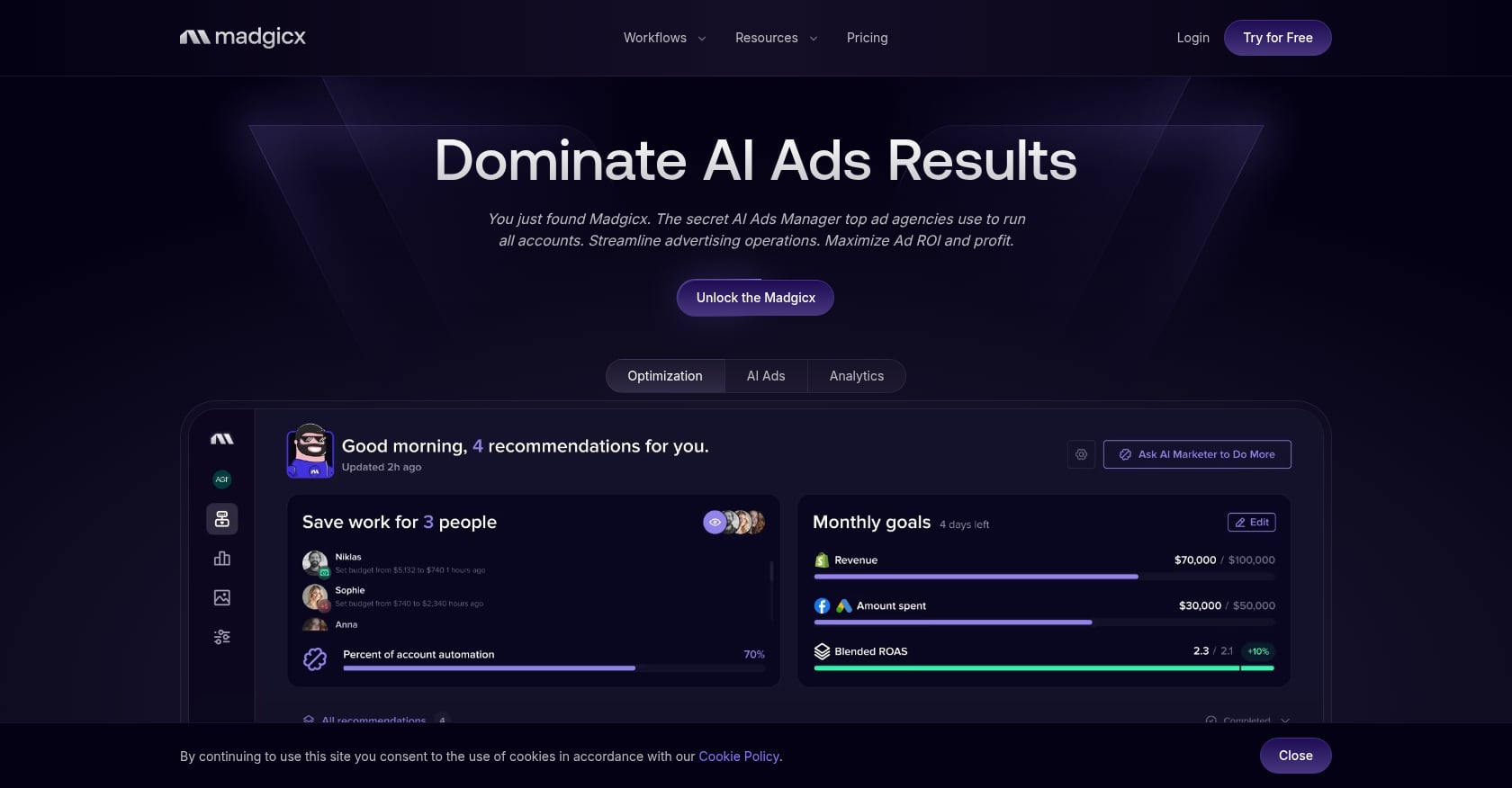
Best for: Startups and SMBs running Meta ads on tight budgets who want AI-assisted audience discovery and creative analytics.
Madgicx combines AI-powered audience discovery with creative performance analytics, specifically for Meta ads. It’s the most affordable dedicated AI paid social automation tool on this list, making it accessible for founders spending under $1,000/month on ads.
Pricing: Starts at approximately $44/month. 7-day free trial available. Tracking Pro add-on available at $49/month for server-to-server tracking.
Key features:
- AI audience discovery that analyzes your customer data and Meta’s targeting options to identify high-potential segments
- Ad Launcher for rapidly deploying and A/B testing ad variations inside Meta
- Creative Insights that extracts performance patterns from your existing creative library
- Audience Launcher for expanding targeting combinations beyond your initial setup
Tradeoffs:
- Heavily Meta-focused with limited cross-platform support
- Less flexible than Birch/Revealbot for building complex automation rules
- Requires you to produce creative manually; Madgicx analyzes what works but doesn’t create ads for you
- Won’t replace a dedicated paid media manager for teams scaling beyond Meta
7. Gumloop
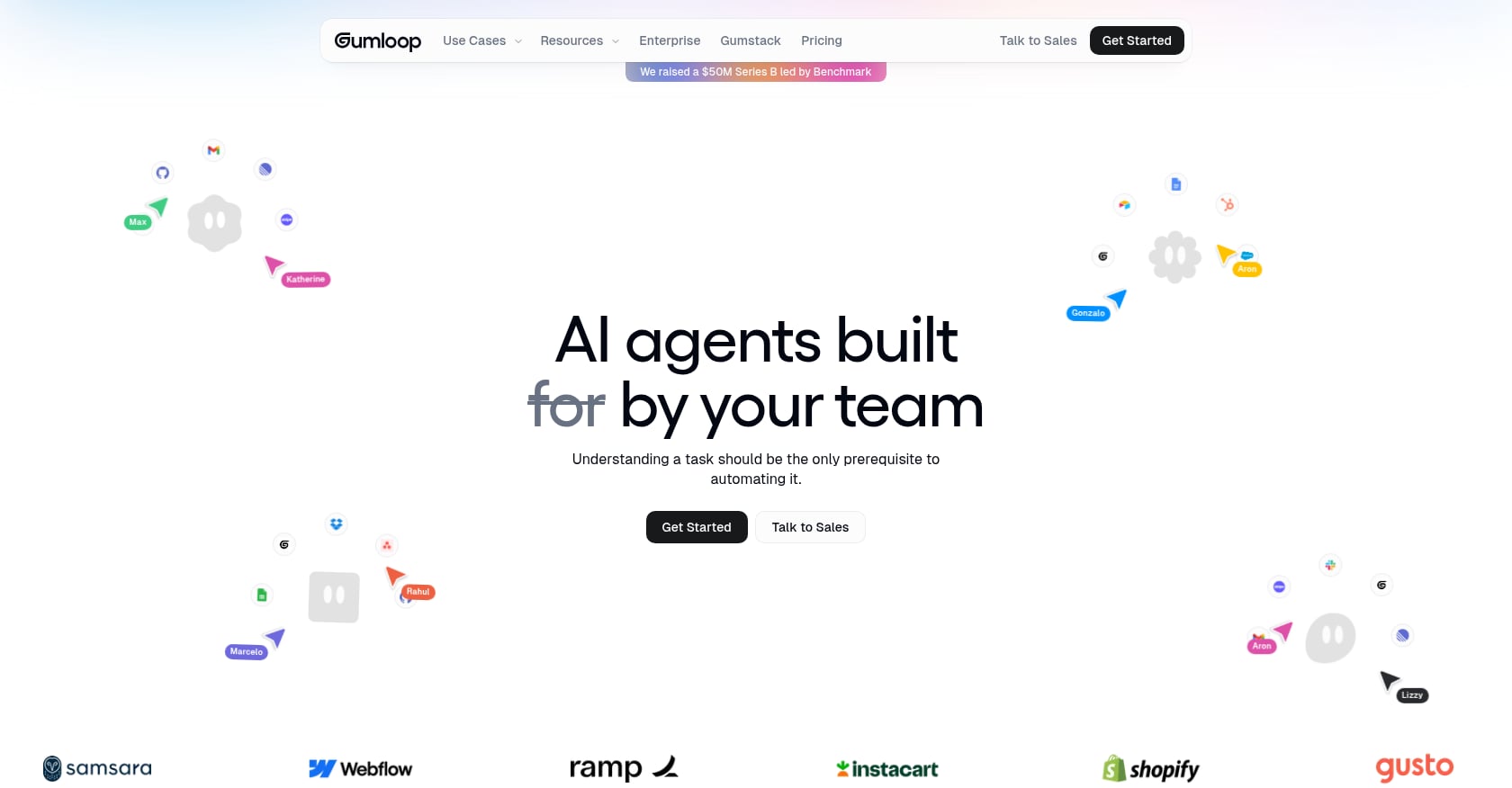
Best for: Technical marketers who want to build bespoke paid social automation workflows without writing code.
Gumloop is a no-code AI workflow automation platform. Instead of offering pre-packaged campaign management features, it gives you building blocks to create custom automation pipelines connecting any API-enabled platform: Meta Ads, Google Ads, Instagram, LinkedIn, TikTok, YouTube, and more.
Pricing: Free tier available. Pro plans start at $97/month.
Key features:
- Visual workflow builder for creating custom automation sequences
- Connects to any API-enabled ad platform or social network
- Flexible enough to automate campaign creation, reporting, budget alerts, or creative testing
- Can integrate AI models for decision-making within workflows
Tradeoffs:
- No out-of-the-box campaign management. You have to build everything yourself
- Best suited for teams with at least some technical capacity to design, test, and maintain workflows
- Requires ongoing maintenance as platforms update their APIs
- Not a replacement for ad management experience; it automates processes but doesn’t tell you what to automate
8. Blaze AI
Best for: Solo founders and small-business owners who primarily create organic content and want a bridge to paid ads.
Blaze AI is primarily an organic social content tool that uses AI to create and schedule posts, then feeds organic performance data into paid ad suggestions. You tell Blaze what your business does, and it writes for every platform in every format. What resonates organically informs your paid strategy.
Pricing: Contact for current pricing.
Key features:
- AI-generated content across multiple platforms and formats from a single business description
- Organic performance tracking that surfaces content worth promoting as paid ads
- One user said: “Marketing felt like a second job I didn’t have time for. Now I have the benefits of employing someone, without the headcount.”
Tradeoffs:
- Primarily an organic social tool; paid ad functionality is secondary
- Won’t replace dedicated paid media platforms for teams with meaningful ad budgets
- Limited campaign management, bid optimization, or audience targeting features
- No rule-based automation or cross-channel budget pacing
The Creative Problem: Why AI Targeting Works but AI Creative Doesn’t (Yet)
Here’s the pattern that emerges across every practitioner conversation about AI paid social automation: targeting automation works. Creative automation doesn’t.
Meta’s Advantage+ finds high-performing audience segments about 80% of the time. Smartly.io’s AI Studio generates millions of creative assets. Albert.ai autonomously reallocates budgets across channels. The targeting and optimization side of paid social has genuinely been transformed by machine learning.
But creative is a different story. One experienced media buyer put it bluntly: Meta’s automated creative tools “miss the mark for about 99% of our clients’ products.” Another noted that most clients hesitate to use generative AI for ad creative because of legal risks around undisclosed image generation.
The takeaway is straightforward. AI amplifies your strategy; it doesn’t replace it. Feeding mediocre creative into a sophisticated algorithm still produces mediocre results. The best approach for most startups is to let AI handle targeting, bid management, and budget allocation while keeping creative in human hands, or at minimum, human-reviewed.
This is exactly why combining human and AI tools for faster content matters so much. The tools that win aren’t purely autonomous or purely manual. They’re the ones that put humans where humans are strongest (creative judgment, brand voice, strategic direction) and AI where AI is strongest (pattern recognition, speed, scale).
For teams thinking about AI copywriting for ad creative, the practical advice is to use AI to generate drafts and variations, then have a human review every piece before it goes live. The time savings are real even with the review step.
Beyond Meta: Why Multi-Channel Matters Now
A quick note on diversification. Reddit recently launched its Max Campaigns product, and results from its alpha test are worth paying attention to: more than 600 advertisers participated, and in split tests, Max campaigns delivered 17% lower CPA and 27% higher conversions versus standard campaign setups.
This matters because over-indexing on a single platform is a risk. Algorithm changes, rising CPMs, or policy shifts can tank your paid social performance overnight. Startups that validate digital channels before committing budget across Meta, Google, LinkedIn, and emerging platforms like Reddit position themselves to reallocate spend quickly when one channel underperforms.
Multi-channel AI paid social automation, whether through a platform like Smartly.io or a service like AgentWeb, isn’t just about reach. It’s about resilience.
How to Choose: A Decision Framework by Budget and Team Size
Under $500/month in ad spend:
Start with Madgicx ($44/month) for AI audience discovery paired with your own creative. Meta Advantage+ (free) handles in-platform optimization. At this spend level, paying for enterprise tools doesn’t make sense.
$500 to $5,000/month in ad spend:
This is where the choice gets interesting. If you have ad management experience, Birch ($49/month+) lets you automate your own playbook. If you don’t have that expertise (or the time), AgentWeb’s execution service fills the gap with AI plus human operators who actually run your campaigns. Get a free AI marketing evaluation to see which approach fits your situation.
$5,000 to $50,000/month in ad spend:
You need either a full-service engagement (AgentWeb’s done-for-you tier) or a serious platform like Smartly.io. The operational overhead of configuring and maintaining automation rules across multiple platforms at this spend level usually exceeds the cost of a managed service. For teams building a SaaS growth marketing strategy, this is the tier where execution speed directly impacts CAC.
$50,000+/month in ad spend:
Enterprise tools earn their keep. Smartly.io’s cross-channel DCO and Albert.ai’s fully autonomous optimization start delivering ROI at scale. The percentage-of-spend pricing hurts less when the absolute performance gains are measured in hundreds of thousands of dollars.
FAQ
What is AI paid social automation?
AI paid social automation refers to using artificial intelligence to manage, optimize, and execute paid advertising campaigns on social platforms like Meta, Google, LinkedIn, and TikTok. This includes automated bid management, AI-driven audience targeting, dynamic creative optimization, and cross-channel budget allocation. It’s distinct from organic social media scheduling tools.
Is Meta Advantage+ enough for paid social automation?
For teams running only Meta ads with limited budgets, Advantage+ is a strong free starting point. It delivers an average ROAS of $4.52 per dollar spent and exits the learning phase 30% faster than manual campaigns. However, it operates as a black box with limited control, only covers Meta, and its creative automation tools consistently underperform. Most teams eventually need a third-party tool or service for cross-channel management and better creative oversight.
How much do AI paid social automation tools cost?
The range is wide. Madgicx starts at $44/month. Birch starts at $49/month. AgentWeb’s self-serve platform is $199/month with a 7-day free trial. Smartly.io starts around $2,500–$5,000/month for enterprise accounts. Albert.ai requires a minimum of $2,000/month (with $100K+ in monthly ad spend). Meta Advantage+ is free beyond your ad spend.
Can AI replace a media buyer for paid social?
Not entirely. AI excels at targeting, budget pacing, and bid optimization, but creative strategy, brand voice, and strategic judgment still require human input. The most effective approach combines AI execution with human oversight. According to Forbes, AI saves about 13 hours per person per week, which is the equivalent of freeing up a third of a full-time role. That time is best redirected toward creative and strategy, not eliminated.
What’s the difference between rule-based and AI-native paid social automation?
Rule-based tools like Birch execute actions based on conditions you define (e.g., “pause this ad if CPA exceeds $20”). They’re predictable and transparent but can miss opportunities that fall outside your predefined rules. AI-native tools like Albert.ai and Meta Advantage+ use machine learning to identify patterns and make decisions autonomously. They can catch optimization opportunities humans miss but operate with less transparency.
Should startups use AI paid social automation or hire a media buyer?
For most pre-seed to Series A startups, hiring a full-time media buyer is slower and more expensive than using an AI-powered execution service. A competent media buyer costs $80K–$120K/year before benefits. Tools and managed services offer similar or better optimization at a fraction of the cost, especially for teams spending under $50K/month on ads. The right move is to start with an AI-powered service, validate your channels, and hire when you have enough data to know exactly what role you need.
How do I avoid tool sprawl with paid social automation?
Pick one tool or service that covers as much of your campaign lifecycle as possible, from creative production through bid management to reporting. According to Gartner, 68% of marketing leaders say tool sprawl undermines campaign performance. The goal is consolidation: fewer tools, more integrated workflows, and a single source of truth for performance data.
Is AI-generated ad creative safe to use?
It depends on your industry and risk tolerance. Many practitioners report hesitation around using AI-generated images in ads because of legal concerns about undisclosed AI content and potential intellectual property issues. The safest approach is using AI for creative ideation and draft generation, then having humans review, edit, and approve every asset before it goes live. For regulated industries, consult legal counsel before deploying any AI-generated creative at scale.
Get a free Stack Review.
30 min with Harsha and Matt.
We audit your last 30 days, pinpoint the highest-impact fixes, and hand you the exact playbook we'd run. No deck. No pitch unless there's a fit.