How to Centralize Marketing Tasks Without Hiring Ops (2026)


TL;DR
A marketing operations manager costs roughly $116K per year in total compensation, but the fragmentation they fix (scattered tools, manual processes, zero visibility) is a real problem. You can centralize marketing tasks without hiring ops by combining a source-of-truth hub, workflow automation, AI agents, and templatized playbooks. This guide covers 10 proven methods ranked by cost, effort, and impact, so you can pick the right path whether your budget is $0 or $3,000 per month.
The $116K Question
The average Marketing Operations Manager in the US earns $98,139 in base salary, with total compensation reaching $115,990 when you add bonuses. For a startup burning through runway, that’s a serious number. Factor in benefits, payroll taxes, and overhead, and two mid-level marketing hires can balloon to $324,000 or more annually.
But the problem that role solves? It’s getting worse every year. The number of martech solutions grew from 150 in 2011 to over 11,000 in 2023, and the average marketer now uses more than 12 tools. Nearly 29% admit their stack has too many tools that don’t integrate. Every time you switch between those tools, the American Psychological Association estimates you lose up to 40% of your productive time.
This is why figuring out how to centralize marketing tasks without hiring ops matters so much. You need the outcome (one system, clear workflows, nothing falling through cracks) without the six-figure salary.
According to Startup Genome, 70% of high-growth startups show signs of premature scaling, and it’s the single strongest predictor of startup failure. Building a marketing operations system before building a marketing operations team is not just smart. It’s survival.
Here are 10 methods to do exactly that, ordered from simplest to most comprehensive.
At-a-Glance Comparison
| Method | Monthly Cost | Setup Effort | Best For | Key Limitation |
|---|---|---|---|---|
| 1. Source-of-truth hub | $0 to $20/user | Low | Content and project centralization | Doesn’t execute marketing tasks |
| 2. All-in-one marketing platform | $0 to $800+ | Medium | Email + CRM + landing pages | Expensive at scale |
| 3. AI workflow automation | $20 to $100+ | Medium | Connecting existing tools | Task-based pricing adds up |
| 4. AI marketing agent | $199 to $3K+ | Medium-High | Full GTM execution without a team | Requires oversight; newer category |
| 5. Templatized playbooks and SOPs | $0 | Medium | Repeatability across tasks | Manual; doesn’t scale alone |
| 6. Unified analytics dashboard | $0 to $72 | Medium | Reporting clarity | Doesn’t fix execution problems |
| 7. Slack/Teams command center | $0 | Low | Approvals and async coordination | Requires integrations to work |
| 8. Fractional ops support | $2K to $5K/mo | Low | Strategy + initial setup | Still a hire, just part-time |
| 9. AI content engine | $99 to $500/mo | Low-Medium | Content production at scale | Narrow focus; needs strategy |
| 10. Done-for-you GTM service | Variable | Low | Full execution with system handoff | Highest cost; must vet quality |
1. Build a Single Source-of-Truth Marketing Hub
Best for: Teams drowning in “where did that brief go?” chaos who need organization before automation.
The fastest way to centralize marketing tasks without hiring ops is to pick one place where everything lives. Every task, every asset, every calendar, every brief. One login, one search bar, one source of truth.
Pricing:
- Notion: Free for individuals, $10/user/month for teams
- ClickUp: From $7/user/month
- Monday.com: From $9/seat/month
Key features:
- Kanban boards and databases for campaign tracking
- Shared wikis for brand guidelines and messaging docs
- Template libraries for repeatable tasks (blog briefs, campaign checklists)
- Native integrations with Google Drive, Slack, and most marketing tools
Tradeoffs and limitations:
- A hub organizes work but doesn’t do it. You still need execution tools alongside it.
- Requires discipline. If the team doesn’t update it, it becomes another dead tool.
- No native marketing automation (email, ads, analytics).
Practitioners on Reddit consistently recommend Notion as a marketing ops headquarters for startups, specifically because of its flexibility and low cost. The catch is that flexibility requires setup time. Someone has to build the databases, design the templates, and enforce the habit.
If you’re thinking about how to structure your startup marketing team around a central hub, start here. It’s the foundation every other method on this list builds on.
2. Consolidate Into One All-in-One Marketing Platform
Best for: Solo founders or tiny teams who want email, CRM, and landing pages under one roof.
Each tool in your stack holds a piece of customer data that never syncs. 44% of marketing professionals use more than five tools, and 48% of B2B marketers cite technology issues as their biggest challenge. An all-in-one platform eliminates three to five separate tools instantly.
Pricing:
- HubSpot: Free CRM, $15/user/month for Starter
- Brevo: Free tier, paid plans from $8.08/month
- ActiveCampaign: From $15/month
- EngageBay: Free for up to 15 users
Key features:
- Email marketing with automation workflows
- Built-in CRM and contact management
- Landing page builders
- Basic analytics and reporting
Tradeoffs and limitations:
- All-in-one platforms do many things adequately but few things exceptionally. You sacrifice depth for breadth.
- HubSpot’s free tier is powerful, but costs escalate quickly once you need advanced features. Reddit users frequently flag this pricing jump.
- Migration is painful once you’ve committed. Choose carefully.
Community discussions show ActiveCampaign getting consistent praise for automation depth at lower price points, while HubSpot wins on ecosystem and integrations. The right choice depends on whether you prioritize sophistication or simplicity.
3. Wire Up AI Workflow Automation
Best for: Teams with existing tools that need those tools to talk to each other automatically.
If you already have a CRM, an email tool, a spreadsheet, and a social scheduler, you don’t necessarily need to replace them. You need to connect them. AI workflow automation tools act as the nervous system between your existing stack, and they represent one of the most practical ways to centralize marketing tasks without hiring ops.
Pricing:
- Zapier: From $19.99/month (task-based pricing)
- Make: From $9/month
- n8n: Free (self-hosted), cloud plans available
Key features:
- 8,000+ app integrations (Zapier)
- Visual workflow builders with drag-and-drop logic
- AI steps that can enrich data, summarize content, or draft messages mid-workflow
- Conditional branching (if lead scores above X, route to Y)
Example workflow: New lead enters CRM → AI enriches their company data → personalized follow-up email is drafted → sent to Slack for approval → logged in your project hub.
Tradeoffs and limitations:
- Zapier’s task-based pricing gets expensive if you run high-volume automations. One practitioner analysis noted that Zapier excels at rapid prototyping but costs spiral at scale.
- Make offers more granular control for complex automations but has a steeper initial learning curve.
- n8n is powerful and free to self-host, but requires technical comfort with deployment and maintenance.
Building workflows takes time. Budget a few hours per automation during setup. But once they’re running, they save 10+ hours per week that would otherwise go to manual task management. For a deeper look at pairing these tools with human judgment, see this guide on combining human and AI tools for faster content.
4. Deploy an AI Marketing Agent
Best for: Founders who need full GTM execution (not just task connection) without building a team.
This is the method that comes closest to actually replacing a marketing ops person. Agentic AI platforms go beyond connecting tools. They plan, execute, and iterate across channels, handling the thinking alongside the doing.
Pricing:
- AgentWeb: 7-day free trial, then $199/month for the self-serve platform with pre-built GTM workflows and templates
- Other agentic platforms: Typically $200 to $3,000+ per month depending on scope
Key features (AgentWeb as example):
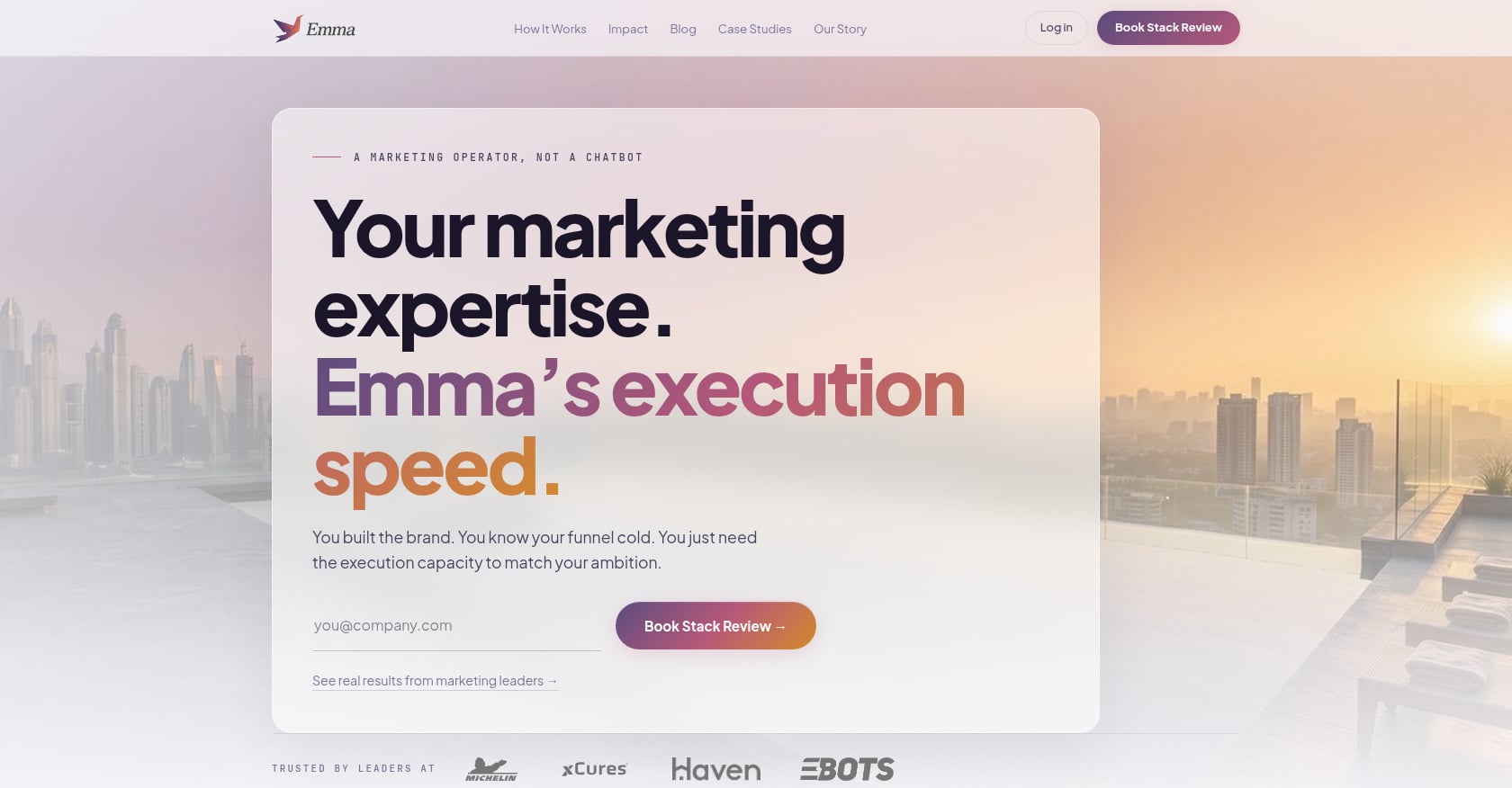
- AI agent (“Emma”) that handles research, planning, creative, and reporting across Meta, Google, LinkedIn/X, email, and outbound
- Portal with calendars, dashboards, and performance tracking
- Slack/Teams approval workflows (one-click approve without email chains)
- Week-0 diagnostic that produces a 90-day GTM plan
- Transition path: start with done-for-you service to validate channels, then move to self-serve with the same proven templates
Tradeoffs and limitations:
- Agentic AI is a newer category. The tooling is evolving quickly, which means you’re an early adopter.
- Requires regular human oversight. AI agents that run unsupervised produce mediocre or off-brand work.
- The best results come from founders who stay engaged in weekly reviews, not from “set and forget” setups.
AgentWeb’s case study with Nailed It showed 4,000+ leads and 328 add-to-carts in 3 months with a 2.91% CTR, outperforming a competing agency running in parallel. That’s the kind of execution velocity that normally requires a full marketing team.
Samuel J. Woods, a practitioner writing about marketing automation since 2016, makes a sharp point: the real goal isn’t automating emails, it’s automating intelligence. Most companies chase flashy AI features without a strategy, ending up with expensive tools that don’t move the needle on revenue. An agentic AI approach solves this by combining strategic planning with execution.
If you want to see whether an AI agent fits your marketing stack, AgentWeb’s AI evaluation is a good starting point.
5. Create Templatized Playbooks and SOPs
Best for: Teams that repeat the same marketing workflows monthly and want consistency without an ops person enforcing it.
This method costs nothing and solves one of the core problems a marketing ops hire would address: “How do we do X?” Instead of a person answering that question every time, a documented playbook answers it permanently.
Pricing: $0 (Google Docs, Notion, or Loom for video walkthroughs)
Key features:
- Step-by-step workflows for repeatable processes (blog launch, campaign setup, weekly reporting)
- Checklists that prevent steps from being skipped
- Loom recordings for visual walkthroughs of complex tasks
- Onboarding documentation for new contractors or team members
Tradeoffs and limitations:
- SOPs go stale fast if nobody maintains them. Schedule quarterly reviews.
- Documentation without automation still means manual execution. Playbooks tell you what to do, not do it for you.
- Takes real effort to create well. Budget 2 to 4 hours per major workflow.
A practitioner analysis from Tabula captures the system-vs-stack mindset perfectly: “A system has one source of truth for customer data, defined workflows for content, outreach, and follow-up, and automations that run without human input.” SOPs are the connective tissue of that system. They’re what make it possible to hand off work to a contractor, an AI agent, or a future hire without losing quality.
If you want a framework for building playbooks around a launch cadence, the 90-day GTM framework provides a solid structure to build from.
6. Centralize Reporting With a Unified Analytics Dashboard
Best for: Founders who spend Friday afternoons reconciling three reports that tell different stories.
You cannot centralize marketing operations if your data lives in seven browser tabs. A unified dashboard pulls metrics from your ad platforms, email tool, website analytics, and CRM into a single view. It doesn’t fix execution, but it fixes visibility, and visibility is what lets you make faster decisions.
Pricing:
- Google Looker Studio: Free
- Databox: From $72/month
- HubSpot dashboards: Included with paid plans
Key features:
- Cross-platform data visualization (Google Ads + Meta + email + website in one screen)
- Automated refresh schedules (daily, weekly)
- Shareable links for team or investor updates
- Goal tracking against KPIs
Tradeoffs and limitations:
- Dashboards show you what happened. They don’t tell you why or fix what’s broken.
- Initial setup requires connecting APIs, which can be fiddly depending on your tools.
- Free tools like Looker Studio are powerful but have a learning curve for custom reports.
78% of marketers say analytics tools are the most important in their stack. That tracks with the reality that understanding what’s working is the prerequisite for everything else. For a breakdown of which metrics actually matter, the B2B SaaS marketing metrics guide maps the numbers to business outcomes.
7. Make Slack or Teams Your Marketing Command Center
Best for: Teams already living in Slack or Teams who want lightweight ops without adding another tool.
You don’t need a dedicated project management tool to run marketing ops if your team already communicates in Slack or Microsoft Teams. With the right channel structure and integrations, your messaging app becomes a command center.
Pricing: $0 (using existing Slack or Teams plans)
Key features:
- Dedicated channels: #marketing-approvals, #content-pipeline, #weekly-metrics
- Bot integrations that push Google Analytics summaries, new lead alerts, or campaign performance snapshots
- Threaded discussions that replace email chains for creative review
- One-click approval workflows (especially powerful with tools like AgentWeb that push approvals directly into Slack/Teams)
Tradeoffs and limitations:
- Slack can become noisy fast. Without disciplined channel structure and notification settings, it adds chaos instead of reducing it.
- Works best as a coordination layer, not a database. You still need somewhere to store assets, briefs, and reports long-term.
- Requires integrations to deliver real value. A Slack channel without automated inputs is just a group chat.
The key is treating Slack as the ops surface, not the ops system. The system lives in your hub (method 1), your automation layer (method 3), or your AI agent (method 4). Slack is where approvals happen, updates land, and decisions get made in real time.
8. Hire Fractional Ops Support
Best for: Teams that need someone to build the initial system, then hand it off.
This is still a hire, just a smarter one. A fractional marketing ops person or fractional CMO gives you senior-level expertise at a fraction of the full-time cost.
Pricing:
- Fractional marketing ops: $2,000 to $5,000/month
- Fractional CMO: $5,000 to $15,000/month (roughly 30 to 50% of a full-time CMO’s cost)
Key features:
- Expert-led tech stack selection and configuration
- Automation setup and workflow design
- Strategic planning and channel prioritization
- Training for existing team members on the new systems
Tradeoffs and limitations:
- Still costs money. $5K/month is $60K/year, which is meaningful for early-stage startups.
- Requires clear scoping. Without it, fractional engagements drift into “just one more thing” territory.
- Knowledge walks out the door when the engagement ends, unless they document everything (see method 5).
Marti Willett, President of Digital Marketing Recruiters, told Entrepreneur that “the most common misstep is founders making their first marketing hire based on what feels important, a Head of Brand, a social media manager, rather than hiring for revenue impact.” A fractional hire avoids this trap by bringing senior judgment to the table without locking you into a full-time commitment.
The best fractional engagements have a defined end state: “In 90 days, the system will be built and documented, and your team can run it.” If you’re thinking about when to scale from fractional to full-time, this guide on building a high-performing SaaS marketing team maps that transition.
9. Run an AI Content Engine to Replace Production Ops
Best for: Teams where content coordination (blogs, social, email) eats most of the would-be ops person’s time.
Content production is often 60% or more of a marketing ops person’s coordination burden. Briefing writers, managing freelancers, reviewing drafts, scheduling posts, tracking performance. An AI content engine handles the production side so you can focus on strategy.
Pricing: $99 to $500/month for most AI content tools
Key features:
- Blog post drafting from outlines or minimal input
- Social media copy generation across platforms
- Email sequence writing
- Repurposing long-form content into short-form assets
80% of marketers now use AI for content creation, and 75% use it for media production. This isn’t experimental anymore, it’s standard practice.
AgentWeb’s offering includes up to roughly 20 assets per month as part of its plans, covering social posts, short-form video, blogs, and ads. That’s consistent output without the overhead of coordinating multiple freelancers.
Tradeoffs and limitations:
- AI content needs human review for brand voice, accuracy, and strategic alignment. Raw output is not publish-ready output.
- Narrow focus. A content engine doesn’t run your ads, manage your CRM, or build your analytics dashboards.
- Quality varies dramatically based on the prompts and guidelines you provide. Garbage in, garbage out.
For a broader view of how content fits into startup growth, the digital marketing strategy for startups guide covers the full picture.
10. Use a Done-for-You GTM Service That Builds You a System
Best for: Founders who need velocity now and want a functioning marketing machine within 90 days.
This is the most complete way to centralize marketing tasks without hiring ops. Someone else runs your entire marketing function AND leaves you with a reusable system when the engagement ends. It’s not an agency retainer. It’s a build-operate-transfer model.
Pricing: Variable (AgentWeb’s done-for-you tier runs as 3-month sprints; contact their team for current pricing)
Key features (AgentWeb’s done-for-you tier):
- GTM strategy and roadmap (human-led)
- Weekly campaign assets (social, blog, short-form video)
- Founder brand support (LinkedIn ghostwriting, executive comms)
- SEO foundation
- Weekly performance reviews and iteration
- Management via the AgentWeb Portal
- Transition option: stay on the same plan or spin down to self-serve with the same proven templates and workflows
Tradeoffs and limitations:
- Highest cost option on this list.
- Requires vetting quality. Not all done-for-you services actually build transferable systems.
- You still need to participate. The best outcomes come from founders who show up to weekly reviews and provide feedback.
The difference between this and a traditional agency is what happens after month three. Agencies execute but don’t lead, and the work stops when the contract ends. A system-building service produces templates, workflows, and proven channel strategies that keep running.
AgentWeb’s case study with Cora showed a 13.19% CTR peak on just a $300/month ad budget, with 435+ qualified clicks in a single month. That result came from the combination of human strategy (CTA adjustments, landing page changes, targeting refinements) and AI-powered execution.
For a closer look at results across multiple startups, browse AgentWeb’s case studies.
The Decision Framework: Where to Start
Not every team needs all 10 methods. Here’s how to pick your path.
If your budget is near zero: Start with methods 1, 3, and 5 (source-of-truth hub, workflow automation with free tiers, and templatized playbooks). This combination gives you organization, connected tools, and repeatable processes for under $30/month.
If you have $200 to $500/month: Add method 4 (AI marketing agent) or method 9 (AI content engine). This is where you move from organized to actually executing at a consistent cadence without hiring.
If you have $2,000 to $5,000/month: Consider method 8 (fractional ops) to build the initial system, or method 10 (done-for-you GTM service) to get a fully operational marketing machine in 90 days. Either approach replaces the $116K ops hire at a fraction of the cost.
When to actually hire ops: Only after you have a working system to hand them. The marketing ops hire should inherit documented playbooks, proven channels, and connected tools. They should optimize a machine, not build one from scratch.
Contenu Agency’s analysis of startup hiring captures this well: “Early-stage marketing requires rapid experimentation, brutal honesty about what’s failing, and the flexibility to pivot three times before breakfast. Your first marketing hire, with their mortgage, their career trajectory, and their need for a coherent strategy, isn’t built for that chaos.”
Build the system first. Hire the person to run it second. That’s how you centralize marketing operations without premature scaling, and it’s how you protect your runway while still shipping weekly.
Marketing budgets aren’t getting bigger. Gartner’s 2025 CMO Spend Survey found that the average marketing budget sits at 7.7% of total company revenue, flat for the second year in a row, with 39% of CMOs planning labor reductions. The teams that win in this environment are the ones that centralize smartly, automate aggressively, and only hire when they know exactly what the role needs to do.
If you’re ready to see what a centralized marketing system looks like for your specific startup, AgentWeb’s AI evaluation maps your current stack against what’s possible with an agentic approach. For a step-by-step planning framework, the 30-60-90 day marketing plan for startups breaks down exactly what to ship and when.
FAQ
How much does it cost to centralize marketing tasks without hiring ops?
It depends on your approach. A combination of Notion ($0 to $10/user/month), Zapier’s free tier, and Google Looker Studio can get you started for under $30/month. AI marketing agents like AgentWeb start at $199/month after a 7-day free trial. Done-for-you services range from $2,000 to $5,000+ per month. All of these are significantly cheaper than the $116K average total compensation for a full-time marketing operations manager.
Can AI tools really replace a marketing ops person?
Not entirely, but they can handle 70 to 80% of what an ops person does. AI excels at workflow automation, content production, data aggregation, and campaign execution. What it can’t do is make high-level strategic decisions, read organizational politics, or build cross-functional relationships. The best approach combines AI execution with human oversight, whether that’s you, a fractional hire, or a senior operator.
What’s the biggest mistake founders make when centralizing marketing?
Buying more tools instead of connecting the ones they already have. The martech industry has over 11,000 solutions, and adding another one rarely solves the fragmentation problem. Start by auditing what you use, cutting what you don’t, and wiring the remainder together with automation before adding anything new.
How long does it take to set up a centralized marketing system?
For a basic hub plus automation setup (methods 1 and 3), expect 1 to 2 weeks of focused effort. For a full system with playbooks, dashboards, and an AI agent (methods 1 through 6), budget 4 to 6 weeks. A done-for-you service (method 10) can build a functioning marketing machine in roughly 90 days, which is faster than recruiting and onboarding a full-time ops hire.
Should I use an all-in-one platform or connect specialized tools?
If you’re a solo founder or a team of two, an all-in-one platform reduces complexity and saves time. If you already have tools you love (a specific CRM, a specific email platform), connecting them with workflow automation preserves your investment while adding the coordination layer. There’s no universally right answer, it depends on where you are today.
What’s the difference between workflow automation and an AI marketing agent?
Workflow automation (Zapier, Make) connects tools and moves data between them based on rules you define. An AI marketing agent (like AgentWeb’s Emma) goes further: it researches, plans, creates content, executes campaigns, and iterates based on performance data. Workflow automation is the plumbing. An AI agent is closer to a virtual team member.
When should I actually hire a marketing ops person?
When you have a proven system that’s generating results and you need someone to optimize and scale it. If you don’t have documented playbooks, a connected tech stack, and at least 2 to 3 validated channels, you’re asking a new hire to build the plane while flying it. That’s a recipe for a bad hire and wasted runway.
Is centralizing marketing ops just a startup problem?
No, but startups feel it most acutely because they lack the budget to throw bodies at the problem. Mid-size companies with 50 to 200 employees face the same fragmentation. The methods in this guide scale up. The tools and price points change, but the principles (one source of truth, connected workflows, documented playbooks, human oversight over AI execution) apply at any size.
Get a free Stack Review.
30 min with Harsha and Matt.
We audit your last 30 days, pinpoint the highest-impact fixes, and hand you the exact playbook we'd run. No deck. No pitch unless there's a fit.