AI Demand Generation Platform: 7 Best Picks (2026)


TL;DR
Most tools marketed as AI demand generation platforms only handle one slice of the job: writing content, enriching contacts, automating outbound, or measuring attribution. The best platform for your startup depends on whether your bottleneck is execution capacity, data quality, outbound volume, lifecycle automation, or proving ROI. For early-stage teams without a marketing hire, AgentWeb stands out because it combines an AI marketer with human operators who actually ship campaigns weekly. This guide compares seven platforms by pricing, real capabilities, user sentiment, and honest tradeoffs.
AI Has Changed Marketing Economics, But Not the Hard Parts
Marketing budgets are flat at 7.7% of company revenue, and 59% of CMOs say they lack the budget to execute their strategy, according to Gartner’s 2025 CMO Spend Survey. At the same time, AI adoption among marketers is nearly universal. HubSpot’s 2026 State of Marketing found that only 1.7% of marketers do not use AI and have no plans to start.
So everyone has AI tools. And budgets are still tight. The gap is not access to AI. The gap is that AI makes it easier to produce more campaigns but not easier to know which campaigns deserve to exist.
Practitioners on Reddit echo this. In a discussion about passive AI lead generation, the consensus was clear: AI can qualify prospects, automate parts of outreach, and track responses, but fully passive lead generation is unrealistic. Another commenter framed many AI tools as demand-capture tools rather than demand-creation tools. That distinction matters.
The winners in 2026 are not the teams generating the most AI content. They are the teams using AI to ship the right campaigns, reach the right buyers, and learn faster each week.
What Is an AI Demand Generation Platform?
An AI demand generation platform is software, a service, or a hybrid system that uses artificial intelligence to help a company create, capture, nurture, convert, and measure demand across channels.
In practice, it should help a team identify the right audience, create relevant campaigns, distribute messages across channels, automate follow-up, and measure which activities turn into pipeline.
The problem is that most tools calling themselves an AI demand generation platform only cover one or two of those jobs. Understanding the difference between demand creation and demand capture will save you from buying the wrong tool.
| Type | What it means | Common tools | Risk |
|---|---|---|---|
| Demand creation | Building awareness, trust, and category interest before buyers are ready | Founder content, SEO, thought leadership, paid social, community, educational email | Harder to attribute quickly |
| Demand capture | Converting people already in-market or showing buying signals | Landing pages, forms, outbound, retargeting, email nurture, demo routing | Can become spammy if not backed by real demand |
| Demand conversion | Turning engaged leads into qualified pipeline | Sales sequences, lead scoring, meeting routing, CRM workflows | Data quality and follow-up speed matter |
| Demand measurement | Proving which channels and campaigns influence revenue | Attribution, funnel analytics, campaign ROI dashboards | Setup complexity and bad source data can mislead |
A true AI demand generation platform should help with at least three of these five jobs: audience identification, campaign creation, channel execution, lead nurturing, and performance measurement. Anything less is a point tool, which can be useful but is not the same thing.
For a deeper look at how these pieces fit into a working plan, the go-to-market strategy guide covers the strategic foundation most teams need before choosing tools.
At-a-Glance Comparison Table
| Platform | Best for | Demand-gen coverage | Starting price | AI depth | Human execution included? | Main tradeoff |
|---|---|---|---|---|---|---|
| AgentWeb | Startups that need campaigns shipped without hiring a team | High: content, outbound, email, SEO, paid, founder brand, performance reviews | $199/mo (DIY); custom pricing for done-with-you and done-for-you | Agentic AI marketer + workflows | Yes, on custom and done-for-you tiers | Not a pure software-only tool for teams that want zero services |
| Landbase | Agentic outbound GTM campaign orchestration | High for outbound and GTM execution | Quote-based | Domain-trained GTM model + agents | No clear done-for-you model | Pricing opacity; fast-changing product |
| Relevance AI | Building custom GTM agents | Medium to high, depending on what you build | Free; Pro $19/mo annual | Strong agent builder | No | Requires workflow design and AI ops ownership |
| RevSure | Proving demand-gen ROI and pipeline attribution | High for measurement; low for campaign creation | Available on request | AI attribution, copilot, agent modules | Implementation and CS support | Learning curve and setup complexity |
| Apollo.io | Sales-led prospecting and outbound sequences | Strong for data + outbound engagement | Free; Basic $49/user/mo | AI research, lead scoring, message generation | No | Data accuracy and credit management |
| Clay | Enrichment-heavy personalization workflows | Strong for data, enrichment, signals | Free (500 actions/mo); paid plans via usage sliders | Claygent AI research + workflow automation | No | Operator-heavy; credit model can confuse |
| HubSpot Marketing Hub | CRM-connected lifecycle marketing | Strong for lifecycle marketing, forms, landing pages, email | Free; Starter $20/mo; Professional $890/mo | Embedded AI across marketing/CRM | No | Costs rise quickly with scale and advanced features |
How We Evaluated These Platforms
Every platform was assessed across seven dimensions:
- Execution coverage. Does it create, launch, and measure campaigns, or only handle one step?
- Startup fit. Can a team of one to three people use it without a dedicated ops hire?
- AI usefulness. Does AI take action, or does it just generate text?
- Pricing clarity. Can buyers forecast what they will actually spend?
- Workflow ownership. Does the platform include human support, or does it require internal operators?
- User sentiment. What do reviewers and community members praise or complain about?
- Time to value. Days, weeks, or months before the team gets real output?
The scores below are editorial assessments based on publicly available information, user reviews, and community discussions. They are not vendor-provided.
| Platform | Startup usability | Campaign execution | AI autonomy | Data/enrichment | Lifecycle nurture | Attribution | Pricing clarity | Human support |
|---|---|---|---|---|---|---|---|---|
| AgentWeb | 5 | 5 | 4 | 3 | 4 | 3 | 4 (DIY) / 2 (custom) | 5 |
| Landbase | 4 | 4 | 5 | 5 | 3 | 3 | 2 | 3 |
| Relevance AI | 3 | 3 | 5 | 3 | 3 | 2 | 3 | 2 |
| RevSure | 2 | 2 | 4 | 4 | 2 | 5 | 2 | 4 |
| Apollo.io | 4 | 4 | 3 | 5 | 3 | 2 | 3 | 2 |
| Clay | 3 | 3 | 4 | 5 | 2 | 2 | 2 | 2 |
| HubSpot | 4 | 4 | 3 | 3 | 5 | 4 | 3 | 3 |
1. AgentWeb
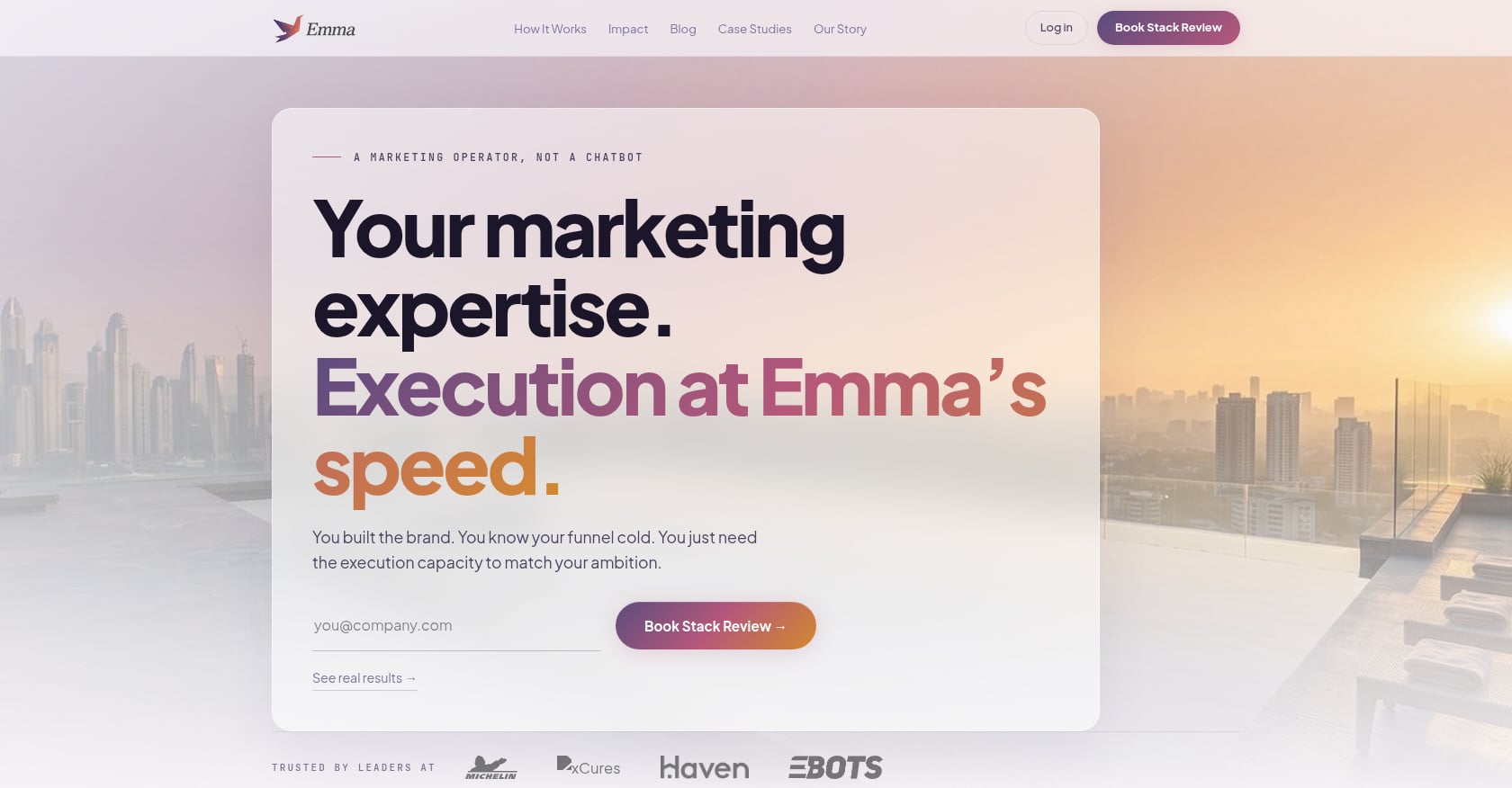
Best for: Early-stage startups that need a marketing engine without hiring a marketing team.
AgentWeb is an AI plus human go-to-market execution service and platform. It uses an agentic AI marketer called Emma alongside a senior operator team to run marketing for startups and lean teams.
This is the strongest AI demand generation platform choice when the real problem is execution capacity. Most tools still require someone to brief, operate, QA, publish, distribute, and optimize campaigns. AgentWeb offers a path from self-serve to co-pilot to done-for-you, making it suitable at different stages of marketing maturity.
Pricing:
- DIY (Self-Serve): 7-day free trial, then $199/month. Access to prebuilt GTM workflows and templates, prompt-based campaign generation, and community Discord support.
- Custom Workflows (Done-With-You): Seasonal pricing. The AgentWeb team builds custom workflows, then hands them back for internal monitoring and maintenance. Contact founders@agentweb.pro.
- Done-For-You (Human-Led Growth Ops): Seasonal pricing, 3-month sprints. AgentWeb functions as your creative and growth department. Scope includes GTM strategy and roadmap, weekly campaign assets, founder brand support, SEO foundation, weekly performance reviews, multi-channel execution (paid, organic, email, SEO), creative asset production, and ongoing brand development. Contact founders@agentweb.pro.
Key features:
- Agentic AI marketer (Emma) for on-brand content generation
- Prebuilt GTM workflows and templates on DIY tier
- Engagement emails and performance tracking
- Custom AI-led co-pilot workflows on mid-tier
- Weekly campaign asset production on done-for-you tier
- Founder brand support and SEO foundation
- Multi-channel execution including paid, organic, email, SEO, creative assets, landing pages, lead magnets, and outbound campaigns
Tradeoffs:
- Not the best fit if you only need a single point solution (just contact enrichment, just attribution).
- Pricing for custom and done-for-you tiers requires a conversation, not a self-serve checkout.
- Teams that want zero human involvement may gravitate toward pure software tools, but that also means they own strategy, QA, and execution entirely.
Why it ranks first: The biggest gap in AI demand generation is not tool access. It is the absence of someone to plan, execute, review, and iterate weekly. AgentWeb fills that gap. If you are choosing tools because you do not have time to run marketing, start with AgentWeb. If you already have a GTM ops team and only need a point solution, compare the alternatives below.
For startups figuring out how to run multichannel campaigns without a team, the DIY tier is a practical starting point before scaling into co-pilot or done-for-you.
2. Landbase
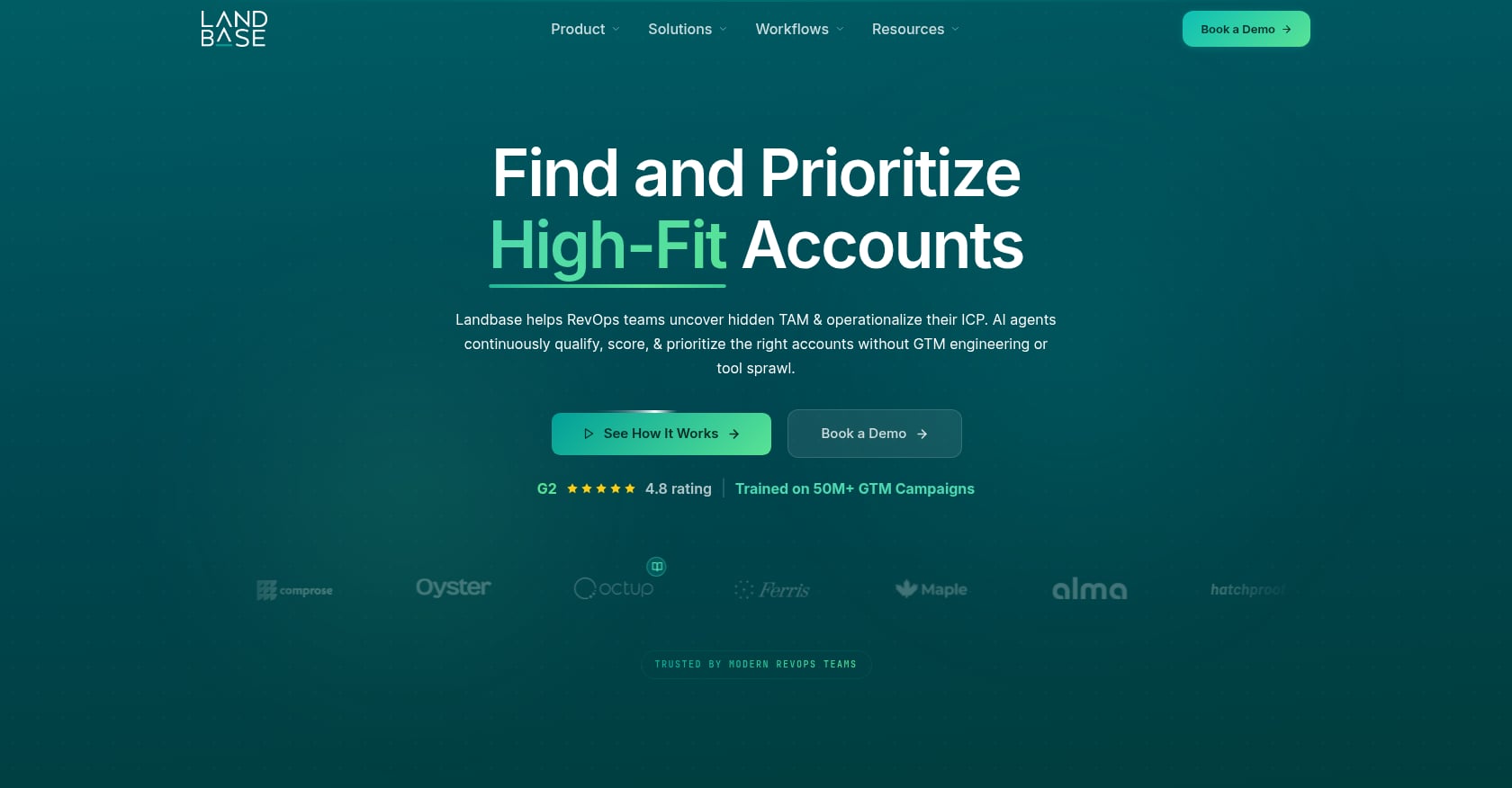
Best for: Agentic outbound campaign orchestration for B2B teams.
Landbase is an AI GTM platform that lets users describe their target audience, then produces the audience segments and messages needed to launch campaigns. Its documentation says the platform unifies audiences, messaging, and channels, including email, LinkedIn, and dialer execution.
Pricing:
- Public pricing is not currently available. G2 directs users to the vendor website. Treat Landbase as quote-based.
Key features:
- Closed-loop workflow from prompt to audience to messaging to execution to results
- Database foundation with 220M+ contacts, 24M+ accounts, and 10M+ signals/events per Landbase docs
- GTM-2 Omni, a domain-trained GTM model connecting intent signals, content generation, and campaign performance
- Multi-channel campaign execution across email, LinkedIn, and dialer
User sentiment:
G2 shows Landbase at 4.8 out of 5 from 10 reviews. Users praise time-saving automation and consolidated GTM functionality. Several reviewers note the platform is evolving quickly, which means teams need to keep learning new features. G2 reviews
Tradeoffs:
- Pricing transparency is weak from public sources.
- Strongest for outbound execution, not full demand creation through content, founder brand, SEO, and paid media.
- Fast feature velocity helps technical growth teams but can burden lean teams with limited bandwidth.
Landbase is a strong alternative when the buyer already knows they want agentic outbound and GTM workflow automation. For teams that also need broader marketing execution and human operator support, AgentWeb covers more of the demand generation spectrum.
3. Relevance AI
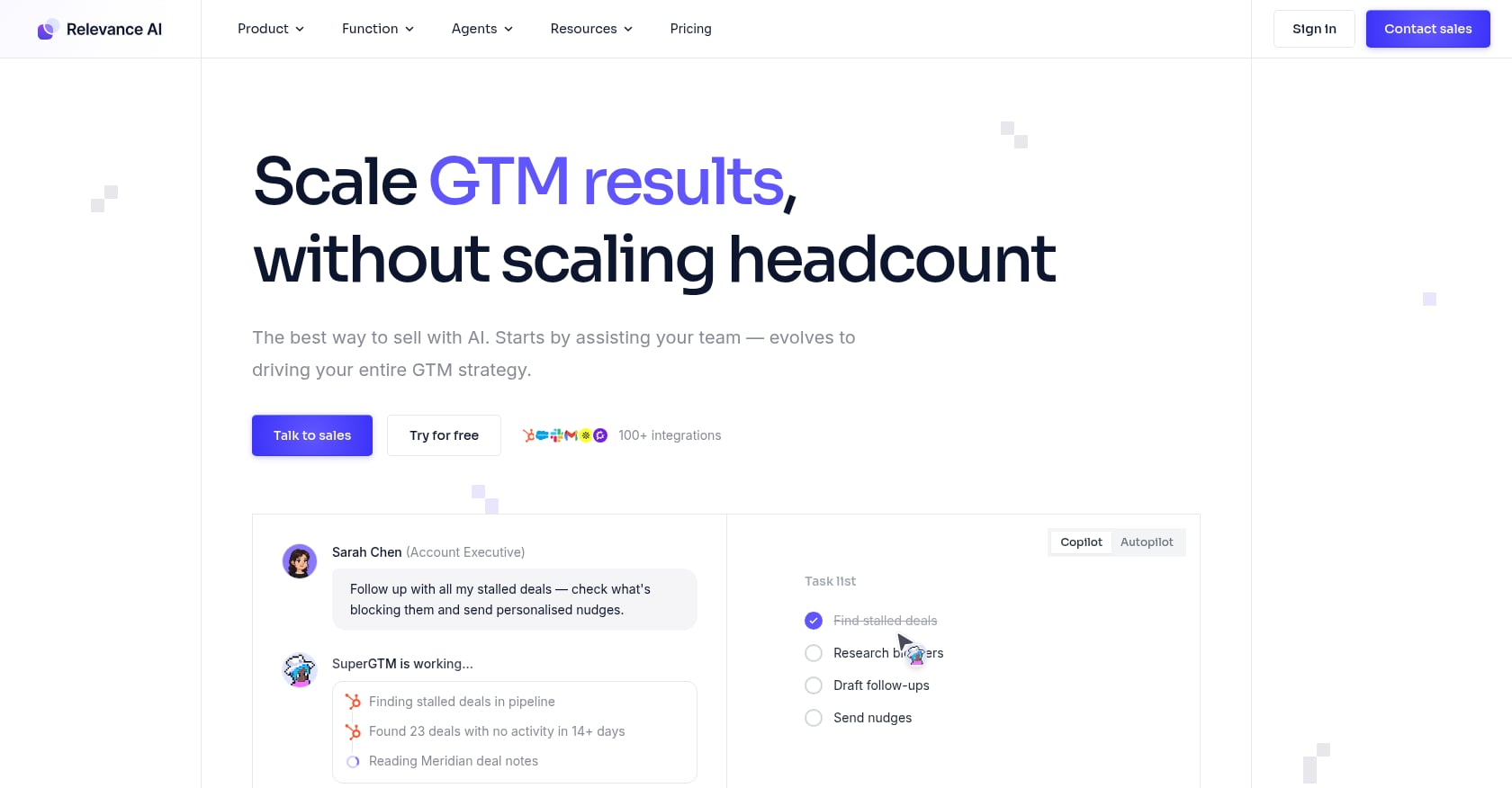
Best for: Teams that want to build custom AI agents for GTM workflows.
Relevance AI is a no-code AI agent and workforce platform. G2 describes it as a platform for building and managing AI agents that automate workflows without programming, including data analysis, content generation, and customer interactions. G2 seller page
This belongs in an AI demand generation platform comparison because many buyers searching this term really mean “I want agents to automate GTM work.” The difference: Relevance AI is for teams that want to build their own operating system; it is not a pre-built campaign engine.
Pricing:
- Free: $0/month, 200 actions/month, 1 user, 1 project
- Pro: $19/month (annual), 30,000 actions/year, $240 vendor credits/year
- Team: $234/month (annual), 84,000 actions/year, $840 vendor credits/year, 5 build users
- Enterprise: Custom
As of September 2025, pricing splits into Actions (what agents do) and Vendor Credits (AI model and tool costs). Top-ups run $80 per 1,000 Actions and $20 per 10,000 Vendor Credits. Relevance AI docs
Key features:
- Unlimited agents and tools across tiers
- 2,000+ integrations
- Workforces, agent scheduling, and smart escalations
- Bring your own LLM on paid plans
- A/B testing and analytics on Team tier
- SOC 2 Type II and GDPR compliance
User sentiment:
A community pricing discussion on Reddit framed Relevance AI’s split between Actions and Vendor Credits as more transparent than many credit-based AI tools, while still fitting the broader trend of usage-metered AI pricing.
Tradeoffs:
- Requires someone to design, test, QA, and maintain agent workflows.
- Usage-based pricing can be harder to forecast than a fixed monthly platform fee.
- Teams without a growth ops owner may stall after the initial setup.
For more on how agentic AI marketing tools and strategies fit into the broader picture, the concept is straightforward: agents handle repetitive research and execution steps, but someone still needs to define what “good” looks like.
4. RevSure
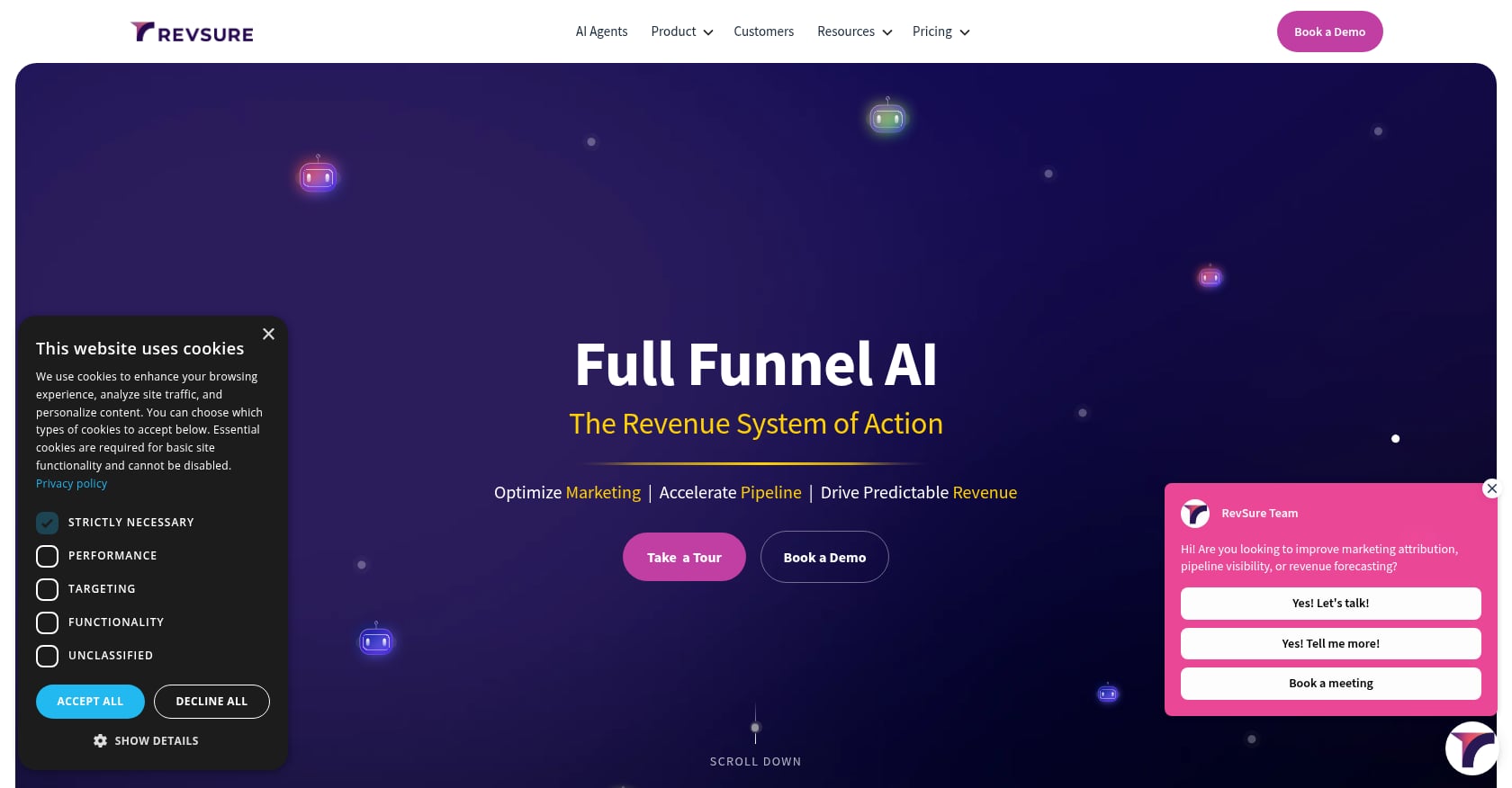
Best for: B2B teams that need to prove which campaigns drive pipeline and revenue.
RevSure is an AI-powered attribution and demand generation effectiveness platform. Its Demand Generation Effectiveness module helps marketing teams answer which campaigns have higher ROI, which channels produce lower CAC and faster funnel velocity, and what return demand-gen efforts produced over a quarter or year.
Pricing:
- Available upon request on the RevSure pricing page.
- G2 user data shows average time to implement is 2 months and time to ROI is 5 months. G2 reviews
Key features:
- Campaign and channel ROI measurement
- Cost per lead, pipeline ROI, booking ROI, and velocity metrics
- AI attribution across funnel stages
- Recommendations to stop, wait, or continue campaigns
- Add-on modules including account deanonymization, incrementality testing, marketing mix modeling, social selling, data enrichment, and AI copilot/agent hub
User sentiment:
G2 shows RevSure at 4.7 out of 5 from 41 reviews. Users value visibility into campaign performance and pipeline attribution. Multiple reviewers mention a learning curve, especially when many data sources and attribution models are involved. G2 reviews
Tradeoffs:
- Primarily a measurement and optimization layer, not a campaign production engine.
- Likely overkill for very early startups with limited campaign volume.
- Setup complexity is real, particularly with multi-source data.
- Pricing is not publicly transparent.
RevSure is excellent for the “prove and optimize demand generation” stage. It does not replace campaign execution tools. If you need to understand which campaigns are working before scaling spend, RevSure fills that gap. If you need help creating and shipping the campaigns in the first place, that is a different problem.
5. Apollo.io
Best for: Sales-led startups that need prospecting, contact data, and outbound engagement.
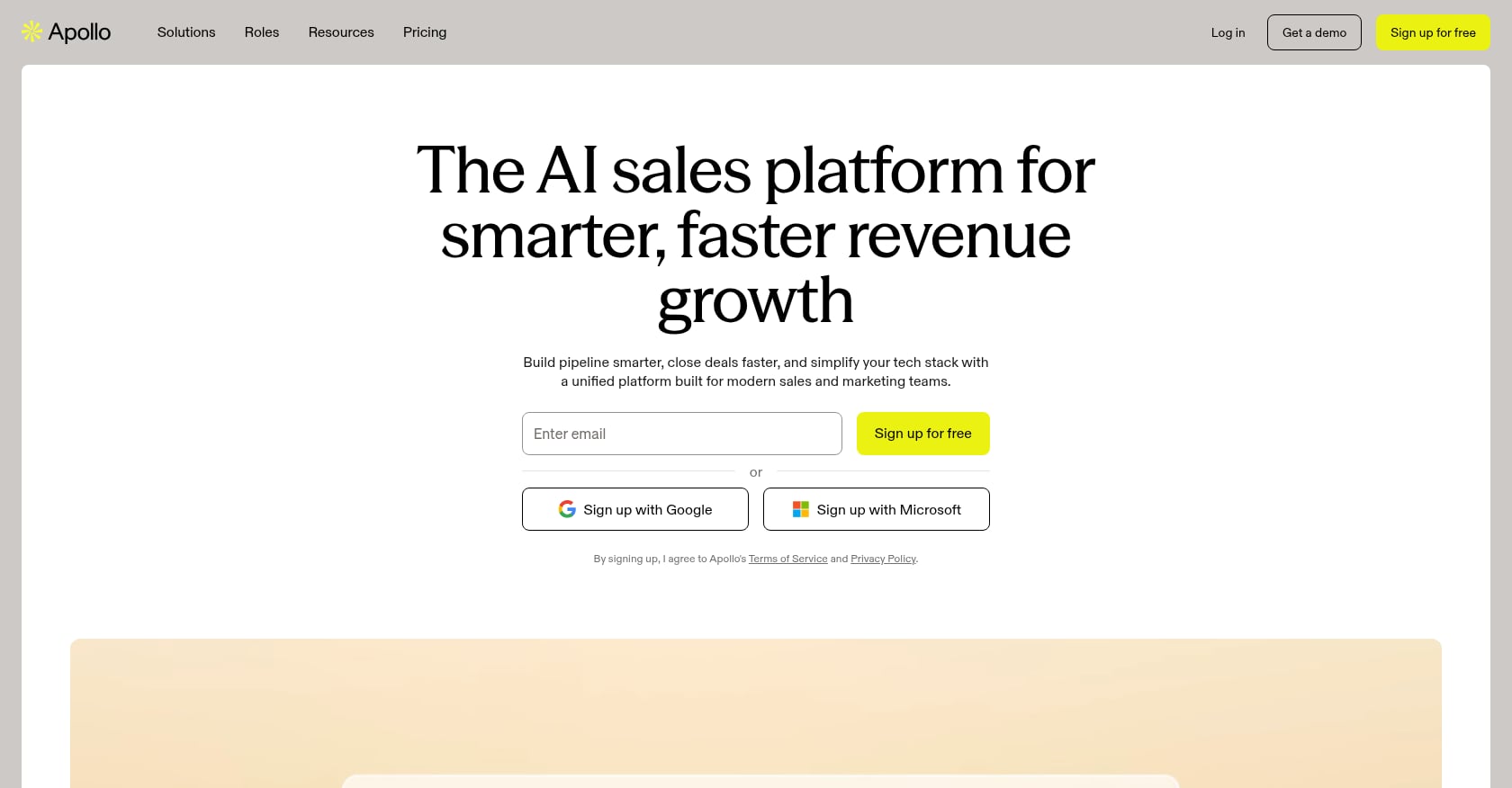
Apollo.io is an AI-powered GTM platform focused on finding, engaging, and managing B2B buyers. G2’s product summary highlights data and targeting, prospecting, enrichment, sales engagement, and deal management.
Pricing:
- Free: $0, 1 user
- Basic: $49/user/month
- Professional: $79/user/month
Apollo’s pricing FAQ notes that trial plans include 50 credits and 5 mobile credits, a free Starter plan exists after trial, email campaigns are included on every account, and Unlimited plans operate under a Fair Use Policy.
Key features:
- Large B2B contact and company database
- Advanced search, filtering, buyer signals, firmographics, technographics
- Email, call, and task sequences
- AI research, lead scoring, and message generation
- Integrations with Salesforce, HubSpot, Outreach, Salesloft, Marketo, and LinkedIn
User sentiment:
G2 shows Apollo at 4.7 out of 5 from over 9,600 reviews. Users praise the large database and advanced filters. Common complaints center on inconsistent data accuracy (especially for smaller companies), phone number reliability, and credit-based limitations. G2 reviews
Practitioners on Reddit reinforce this. Apollo is often used as a raw data source, but experienced operators recommend verifying and scrubbing emails before sending. Users also report frustration with credit and pricing changes.
Tradeoffs:
- Stronger for demand capture (outbound) than demand creation (content, brand, SEO).
- Data accuracy still needs independent verification.
- Credit systems and export rules affect true cost.
- Outbound volume without good positioning produces spam, not demand.
Apollo is a strong platform for building pipeline through outbound. It is not a full AI demand generation platform by itself. Pair it with content, founder brand strategy, landing pages, and email marketing automation to close the loop.
6. Clay
Best for: Advanced GTM data enrichment and personalized outbound workflows.
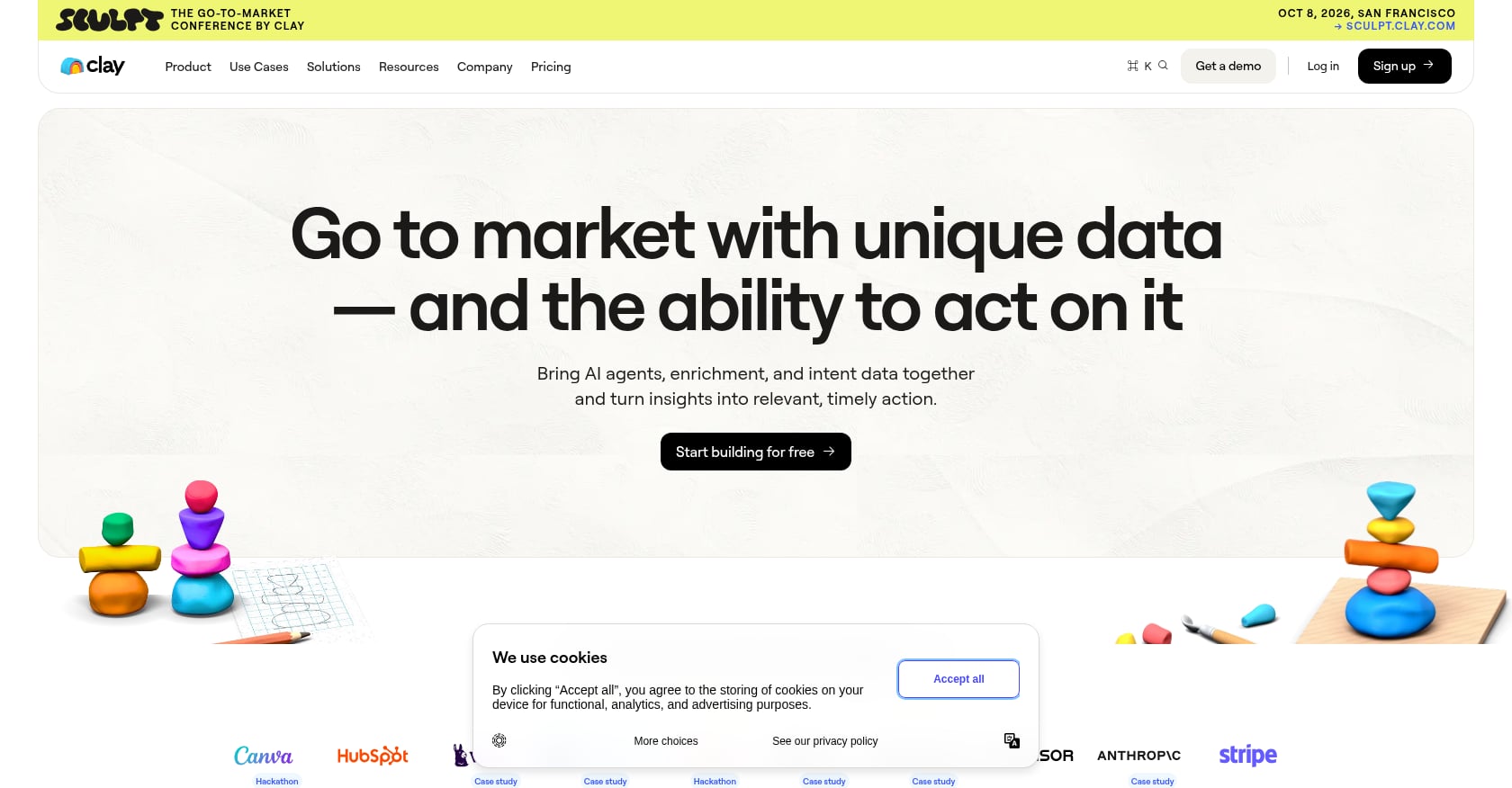
Clay is a workflow platform centered on data enrichment, AI research, signals, audience building, and campaign workflows. Its pricing page highlights Claygent for AI research, multi-provider waterfalls, a data marketplace with 150+ providers, signals and intent data, ads sync, and a native sequencer.
Pricing:
- Free: 500 actions/month, 100 data credits/month, unlimited seats and tables, up to 200 rows per table
- Paid plans: Slider-based, with Launch and Growth tiers. Actions and data credits scale by usage selection. The pricing page uses dynamic sliders, so exact numbers change.
Verify Clay’s current pricing before purchase. A March 2026 Reddit discussion noted that Clay added an “Actions” charge and that entry pricing increased.
Key features:
- Claygent AI research agent
- Multi-provider waterfall enrichment
- Job change, promotion, company news, social, and web intent signals
- Email campaigns via native sequencer or integrations
- CRM enrichment and auto-sync on higher plans
- HTTP API integration and webhook automation
- Data marketplace with 150+ providers
User sentiment:
Clay’s pricing page cites GTM operators who use it to automate lead enrichment that previously required expensive manual research. Community sentiment on Reddit is more mixed around pricing complexity, reinforcing the need to understand Clay’s credit and action model rather than quoting a simple monthly price.
Tradeoffs:
- Powerful but operator-heavy. You need someone who understands workflows.
- Not a done-for-you campaign engine.
- Teams need strong ICP clarity to get value.
- Pricing is difficult to compare because actions, data credits, providers, and workflows all affect cost.
Clay is one of the best choices when the bottleneck is data quality and personalization. It is not the right tool when the bottleneck is “we need someone to run marketing.”
7. HubSpot Marketing Hub
Best for: CRM-connected lifecycle marketing and marketing automation.
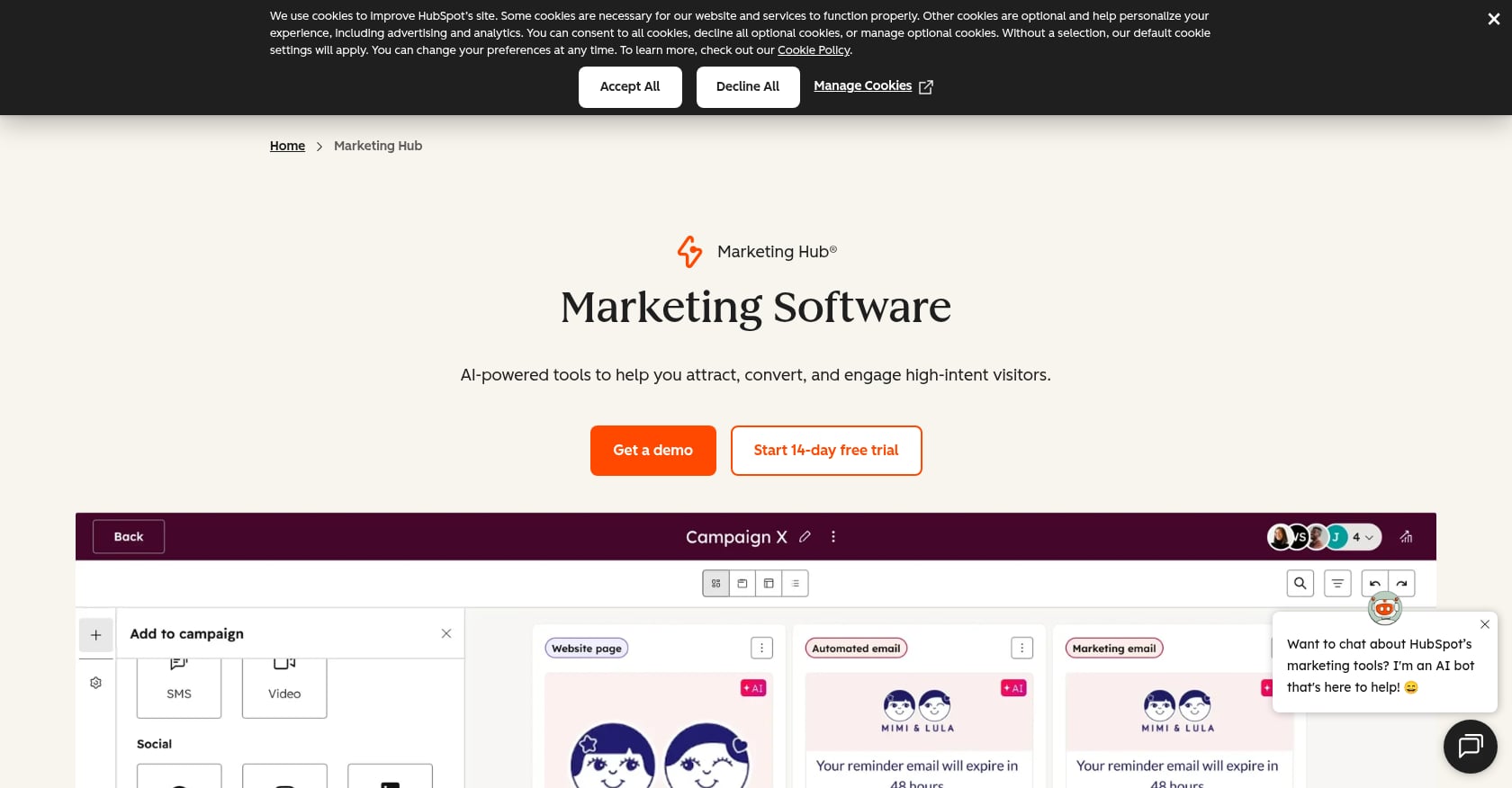
HubSpot Marketing Hub is a marketing automation platform with CRM-connected email, landing pages, forms, segmentation, reporting, and campaign management. G2 categorizes it under Marketing Automation.
Pricing:
- Free: $0
- Starter: $20/month, 1 core seat
- Professional: $890/month, 3 core seats
- Enterprise: $3,600/month, 5 core seats
Key features:
- Email marketing with automation workflows
- Landing pages and forms
- Contact database with segmentation
- Data quality management
- Campaign tracking and web analytics
- AI embedded across marketing and CRM workflows
User sentiment:
G2 shows HubSpot Marketing Hub at 4.4 out of 5 from over 14,600 reviews. Users praise the intuitive interface, automation capabilities, and consolidation of multiple tools. The most common complaint: pricing escalates quickly as contact lists grow or teams need advanced features. G2 reviews
Tradeoffs:
- HubSpot is a system of record and automation platform, but it still requires people to create strategy, content, campaigns, and optimization loops.
- The jump from Starter ($20/month) to Professional ($890/month) is steep for early-stage startups.
- Without someone owning execution, HubSpot becomes an empty system.
HubSpot belongs in this comparison because many buyers searching for an AI demand generation platform are really looking for CRM-connected marketing automation. But for a lean startup without a marketer, having the system is not the same as having campaigns that ship.
How to Choose the Right AI Demand Generation Platform
The decision comes down to five questions.
1. Do you need someone to run marketing, or just software?
If campaigns are not getting planned, written, launched, reviewed, and improved every week, the problem is execution, not tooling. AgentWeb solves that. If you already have operators, the point tools below can each improve a specific part of the engine.
2. Is your bottleneck demand creation or demand capture?
Demand creation (content, SEO, founder brand, community) requires sustained, multi-channel effort. Demand capture (outbound, retargeting, lead forms) requires data and sequence infrastructure. Some startups need both, but most should pick the constraint that matters most right now.
| Buyer problem | Platform type | Best-fit option |
|---|---|---|
| We need marketing shipped every week | AI + human GTM execution | AgentWeb |
| We need outbound campaigns launched fast | Agentic GTM/outbound | Landbase, Apollo |
| We need custom AI agents for GTM workflows | AI agent builder | Relevance AI |
| Our data and personalization are weak | Enrichment/workflow | Clay |
| We need email, forms, landing pages, CRM automation | Marketing automation | HubSpot |
| We cannot prove which campaigns drive pipeline | Attribution/revenue intelligence | RevSure |
3. Do you have clean data?
If no, Clay or Apollo can help with enrichment, but budget for verification. AI outbound is not just “find contacts and send emails.” It also requires deliverability management, segmentation, message quality, and compliance.
4. Can you manage AI workflows yourself?
If yes, Relevance AI or Clay give you the building blocks. If no, you need a platform with built-in execution or human support.
5. Do you need attribution now?
If you are spending across multiple channels and need to prove ROI, RevSure is purpose-built for that. If you are still in the “find what works” phase, keep attribution simple until campaign volume justifies the setup.
Not sure which bucket you fall into? The AI evaluation tool helps startup teams assess their GTM readiness and identify where AI fits best.
Pricing Traps to Watch For
AI demand generation platform pricing is harder to compare than traditional SaaS because vendors mix multiple cost levers. Practitioners on Reddit’s SaaS community have voiced real frustration with credit-based pricing, token-metered usage, and unpredictable AI cost structures.
Before committing to any platform, check for:
- Seat minimums that inflate cost for small teams
- Annual contracts with no monthly option
- Credits that reset monthly without rollover
- Vendor credits or model costs on top of platform fees (Relevance AI splits Actions and Vendor Credits)
- Mobile number and export credits charged separately (Apollo uses credits, export credits, and fair-use limits)
- Action-based charges that are hard to predict at scale (Clay uses actions and data credits via sliders)
- Contact tier jumps that spike costs as your list grows (HubSpot’s jump from Starter to Professional)
- Add-on modules not included in base plans
- Implementation fees for complex platforms
- API access locked behind enterprise tiers
- Human support not included at lower tiers
- Free tiers useful for testing but not for production volume
The lesson: do not compare only monthly plan prices. Compare total cost across seats, credits, contacts, actions, vendor credits, implementation, add-ons, and overage rules.
Why AI Demand Generation Still Needs Human Judgment
AI can accelerate content production, research, lead scoring, personalization, routing, and reporting. Content Marketing Institute’s 2025 research found that 40% of B2B teams planned to increase investment in AI for content optimization and 39% for content creation.
But output is not the same as demand. Demand generation still requires positioning, taste, customer insight, narrative, offer strategy, channel selection, compliance judgment, editing, and relationship-building. AI output is not demand generation until it is shipped, distributed, followed up, and measured.
There is another dimension most competitors miss: buyers are now asking AI engines for vendor recommendations. One discussion in an AI marketing community argued that demand generation teams need to account for AI-mediated buyer research through ChatGPT, Claude, Perplexity, and Gemini. This means AI demand generation platforms should help teams create content that can be cited and summarized by AI systems, not just indexed by Google.
A practical approach is to combine AI execution with human oversight. That is the argument for hybrid models where the AI handles volume and the team handles judgment. For startup teams figuring out that balance, the guide on how to combine human and AI tools for faster content walks through the workflow in detail.
Final Recommendation
For most early-stage startups, the best AI demand generation platform is the one that closes the execution gap. If you already have a GTM ops team, tools like Clay, Apollo, Relevance AI, HubSpot, Landbase, and RevSure can each improve a specific part of the engine. But if your real problem is that campaigns are not getting planned, written, launched, reviewed, and improved every week, AgentWeb is the strongest starting point because it combines AI workflows with human GTM execution.
The platform offers a 7-day free trial on its DIY tier, and seasonal pricing on co-pilot and done-for-you tiers. If you want to see what that looks like in practice, explore the case studies to see how other startup teams have used it.
Frequently Asked Questions
What is the best AI demand generation platform for startups?
It depends on the bottleneck. AgentWeb is best for startups that need execution support without hiring a marketing team. Apollo or Landbase are strong for outbound. HubSpot works well for CRM-connected marketing automation. Clay handles enrichment. RevSure covers attribution. Relevance AI is for teams that want to build their own AI agents.
Can AI generate leads automatically?
AI can automate parts of lead generation: research, qualification, enrichment, outreach drafting, routing, and reporting. But fully passive lead generation is unrealistic without strategy, offers, follow-up, and human oversight. Reddit community discussions consistently confirm this view.
What is the difference between AI demand generation and AI lead generation?
AI lead generation usually focuses on finding and converting contacts. AI demand generation is broader: it includes awareness, content, education, trust-building, nurture, conversion, and measurement. The best platforms address both demand creation and demand capture.
What should startups look for in an AI demand generation platform?
Look for audience targeting, campaign creation, multi-channel execution, CRM or email integration, performance tracking, pricing clarity, brand controls, human approval workflows, and support. The more of these a single platform covers, the fewer tools you need to stitch together.
Are AI demand generation platforms worth it?
They are worth it when they remove a real bottleneck, whether that is campaign production, outbound research, personalization, lifecycle automation, or attribution. They are not worth it if the team lacks ICP clarity, messaging, offer strategy, or someone to own the workflow.
How much does an AI demand generation platform cost?
Costs range from free tiers and under $200/month for self-serve tools to thousands per month for enterprise CRM, workflow, and attribution platforms. True cost depends on seats, contacts, credits, actions, usage, implementation, and add-ons. Always map total cost, not just the sticker price.
Do I need multiple AI demand generation tools?
Many teams end up combining tools: one for data, one for content, one for automation, one for attribution. That is fine if each tool solves a distinct bottleneck. The risk is overlapping subscriptions that add cost without adding capability. Start with one platform that covers your biggest gap, prove value, then expand. The guide on how to hire less but ship more marketing covers how to think about this tradeoff.
Get a free Stack Review.
30 min with Harsha and Matt.
We audit your last 30 days, pinpoint the highest-impact fixes, and hand you the exact playbook we'd run. No deck. No pitch unless there's a fit.