12 Best Intent Marketing Tools for B2B in 2026: Compared


TL;DR
Intent marketing tools help B2B teams spot companies or people showing buying signals, from website visits and review-site research to topic surges and public triggers. The category includes at least six different product types, so the right pick depends on what signal you need, who will act on it, and how fast. Enterprise ABM platforms like 6sense and Demandbase cost $60K+ annually and require operational maturity. Leaner options like Apollo, RB2B, and Leadfeeder are more affordable but narrower. For startups that need signals turned into actual campaigns and outreach every week, AgentWeb fills the execution gap most tools ignore.
At-a-Glance Comparison Table
| Tool | Best For | Primary Signal Type | Starting Price | Granularity | Activation Strength | Key Tradeoff |
|---|---|---|---|---|---|---|
| AgentWeb | Lean teams needing execution | Multi-channel GTM execution from signals | $199/mo self-serve; service tiers contact sales | Workflow/campaign level | Very high | Not a raw intent data feed |
| 6sense | Enterprise predictive ABM | Predictive buying stage + multi-source intent | Quote-only; ~$62K/yr median | Account/buying group | High | Expensive, complex setup |
| Demandbase | ABM advertising and orchestration | Account intelligence + intent + DSP | Quote-only; ~$69K/yr median | Account/person (varies) | High | Enterprise cost, learning curve |
| Bombora | Raw third-party topic intent | Publisher co-op topic surge | Quote-only; ~$25K/yr median | Account/topic | Medium | Needs stack and operator |
| ZoomInfo | Contact data + buying signals | Contact database + intent | Quote-only; ~$33.5K/yr median | Account/contact | Medium-high | Contract complexity |
| G2 Buyer Intent | SaaS review-site intent | Review/comparison/category activity | Paid G2 plans required; from $2,999/yr | Account | Medium | Not contact-level |
| Factors.ai | ABM analytics and attribution | Website + LinkedIn + G2 + Bombora signals | Tiered; references from ~$6K | Account/company | High | Cost scales with traffic |
| Apollo | Budget prospecting + intent | Buying intent topics + contacts | ~$49/user/mo annually; free plan available | Account/contact | Medium | Intent is basic vs enterprise ABM |
| Leadfeeder | Company-level website visitor ID | Website visitor identification | Free Lite; paid from $79/mo | Company/account | Medium | Not person-level |
| RB2B | U.S. person-level visitor ID | Website visitor identity | Free; paid from $79/mo | Person (U.S.) / company (global) | Medium | U.S.-only contact coverage |
| Warmly | Visitor ID + live engagement | Website visitor + chat + orchestration | Free tier; business from $7/user/mo | Company/person (varies) | Medium-high | Pricing clarity is weaker |
| Clay | Custom signal workflows | Enrichment + public trigger workflows | Free; Launch ~$185/mo | Depends on data sources | High if built well | Requires operator skill |
What Are Intent Marketing Tools?
Intent marketing tools help B2B teams identify accounts or people showing buying-related behavior and then use those signals to prioritize outreach, campaigns, ads, and content. The signals range from obvious (someone requesting a demo) to ambiguous (a company reading articles about your product category).
The term “intent marketing tools” covers at least six different product types wearing one label. As one market analysis puts it, intent data is really four products in one name: co-op topic intent, bidstream signals, review-site intent, and first-party data. Add visitor identification and predictive ABM platforms and you have six categories that behave nothing alike.
Here is the practical taxonomy:
- First-party intent: your own website, product usage, email engagement, events, CRM activity.
- Review-site intent: G2, TrustRadius, Capterra category pages, competitor profiles, alternatives searches.
- Publisher/co-op topic intent: Bombora-style content consumption signals across a publisher network.
- Bidstream/ad-exchange signals: inferred company interest from ad inventory and digital behavior.
- Public trigger signals: hiring posts, funding announcements, tech stack changes, Reddit/forum complaints, competitor reviews.
- Visitor identification: resolving anonymous website visits to companies or individual contacts.
Understanding which type you need is more important than picking the “best” tool.
The Confidence Ladder: Not All Intent Signals Are Equal
One of the biggest gaps in competing guides is treating every signal as equally trustworthy. They are not. Practitioners on Reddit consistently distinguish between high-confidence and low-confidence signals. One GTM engineering thread describes intent as “a probability signal, not a guarantee” and recommends testing providers against closed-won data before committing.
Here is a practical confidence ranking, from strongest to weakest:
- Hand-raise intent: demo request, pricing inquiry, trial signup.
- First-party high-intent page activity: pricing, integrations, comparison, or implementation pages.
- Review-site and comparison intent: G2 category browsing, competitor profile views, alternatives pages.
- Public trigger intent: hiring for a relevant function, new funding, competitor complaints, migration signals.
- Third-party topic surge: multiple people at an account consuming content around a topic.
- ICP fit only: industry, company size, tech stack match, but no behavioral signal at all.
The tools in this guide sit at different points on this ladder. Knowing where each tool’s signals fall helps you set the right expectations for conversion rates.
How to Choose the Right Intent Marketing Tool
Before comparing features, answer these questions:
- What signal do you actually need? Website visitors? Review-site researchers? Topic surges? Public triggers?
- How granular must it be? Account-level works for ABM prioritization. Person-level is better for outbound.
- How fast can your team act? If signals sit in a dashboard for a week, freshness does not matter. If reps follow up same-day, real-time alerts are critical.
- Who owns follow-up? A marketing team running ads? An SDR team sequencing outbound? A founder sending personal emails?
- Can you measure revenue impact? If not, you will never know whether the intent tool paid for itself.
- Can you afford the hidden operator cost? Enterprise ABM tools may require RevOps, CRM hygiene, content production, SDR adoption, and paid media budget on top of the license.
Factors.ai’s selection framework suggests evaluating data sources, freshness, accuracy, integrations, analytics, privacy, pricing, ROI, and support before buying any intent platform. That is solid advice, but it misses the biggest filter: whether your team has the capacity to turn signals into action.
Before You Buy: Do You Have Someone to Work the Signals?
This question matters more than the tool comparison. A Reddit discussion on intent data adoption makes the point clearly: teams can surface all the intent data they want, but if they have not built adoption with sales or execution across the marketing stack, the data goes unused.
For startups and lean teams, the bottleneck is rarely “more signals.” It is the people and processes to run campaigns, create outreach, build ads, write content, and measure results based on those signals. Keep this in mind as you read through the tools below.
If your team lacks internal bandwidth to operationalize intent signals, consider a model that combines AI and human execution rather than adding another dashboard.
The 12 Best Intent Marketing Tools in 2026
1. AgentWeb
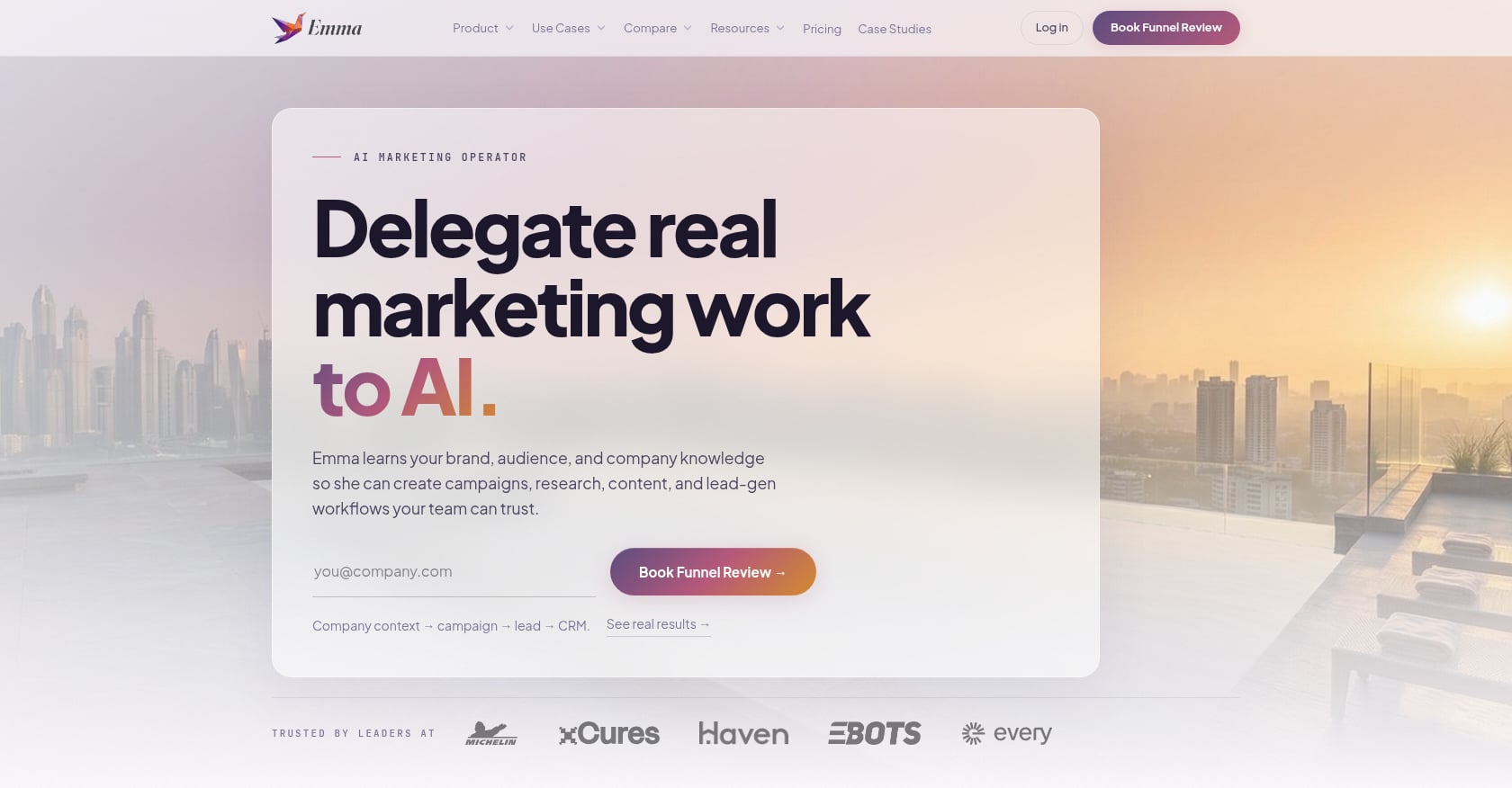
Best for: lean teams that need intent signals turned into shipped campaigns, not another dashboard.
AgentWeb is not a traditional intent data provider. It is an AI + human go-to-market execution service and platform. The company runs marketing for startups using its agentic AI marketer, Emma, plus a senior operator team. Where most intent tools stop at “here are accounts showing interest,” AgentWeb picks up at the point most teams stall: actually doing something about it.
Pricing:
- Self-serve platform: 7-day free trial, then $199/month via Stripe.
- Custom workflows (AI-led co-pilot): seasonal pricing; contact sales at founders@agentweb.pro.
- Done-for-you (human-led Growth Ops): seasonal pricing; contact sales at founders@agentweb.pro.
- Free GTM audit/diagnostic session available.
Key features:
- 90-day GTM diagnostic and plan.
- Agentic execution across Meta, Google, LinkedIn/X, email, and outbound.
- Slack/Teams approval workflows.
- AgentWeb Portal with calendars, dashboards, and optimization loops.
- Founder-brand support, including LinkedIn ghostwriting and executive comms.
- SEO/content production with up to ~20 assets/month.
- Weekly performance reviews and iteration.
- Self-serve templates for market research, competitive analysis, promotion planning, and audience insights.
- Integrations with existing ad platforms and CRMs.
Proof points:
- Nailed It case study: 4,000+ leads and 328 add-to-carts in 3 months, with 2.91% CTR at roughly $0.24 CPC. Read the full case study.
- Cora case study: 13.19% CTR peak, $0.74 CPC, 435+ qualified clicks in one month on a $300/month ad budget. See the results.
Tradeoffs:
- Not a raw intent data source like Bombora or G2.
- Service pricing is not fully public.
- External third-party reviews are limited.
- Best results require the client team to engage weekly and approve work.
Do not buy AgentWeb if you only want a raw intent data feed and already have a full GTM team executing campaigns.
Verdict: The best choice for pre-seed to Series A startups, founder-led companies, and lean teams that cannot hire a full marketing department. The question for these teams is not “who is showing intent?” but “what do we ship this week?” AgentWeb answers both.
2. 6sense
Best for: enterprise predictive ABM and buying-stage prioritization.
6sense is a major enterprise ABM and revenue AI platform. It uses predictive models, behavioral data, and multi-source intent ingestion to identify accounts moving through a buying journey and assign buying stages. Demandbase’s category analysis describes 6sense as a predictive account prioritization platform.
Pricing:
- Quote-only. No public paid pricing.
- Third-party analysis citing Vendr reports a $62,440/year median contract across 385 purchases, ranging from $11,376 to $176,809.
Key features:
- Predictive buying-stage modeling.
- Account prioritization and scoring.
- Audience building and advertising activation.
- Multi-source intent ingestion.
- CRM and sales workflow integration.
User sentiment:
- 4.1/5 stars on G2 across 2,656 reviews. Users praise earlier account identification but criticize lead-to-account matching and integrations.
- Practitioners on Reddit report mixed experiences. One 2026 thread notes teams like what 6sense does but struggle with enterprise pricing and procurement timelines. Another warns the platform can create “chaos and unwanted signals” if the audience and use case are not well defined.
Tradeoffs:
- Expensive relative to startup budgets.
- Requires operational maturity, RevOps support, and sales adoption.
- Black-box scoring can be hard for reps to trust.
- Overkill for teams needing simple visitor ID or lightweight outbound signals.
Do not buy 6sense if you do not have RevOps support, CRM hygiene, and sales team adoption in place.
3. Demandbase
Best for: enterprise ABM advertising and full-funnel orchestration.
Demandbase combines account intelligence, intent data, B2B-native advertising (its own DSP), sales insights, orchestration, and journey measurement into one platform. Its own educational content emphasizes that intent should be combined with account fit, first-party engagement, CRM data, and buying-group information, and that a signal alone does not prove buying readiness.
Pricing:
- Custom/quote-only.
- Third-party research cites a $68,591/year median annual contract value across 185 purchases.
Key features:
- Account identification and prioritization.
- Intent data and account intelligence.
- ABM advertising through its own DSP.
- Sales insights and orchestration.
- Journey and engagement measurement.
- Integration with third-party intent sources like Bombora.
User sentiment:
- 4.4/5 on G2 across 2,007 reviews. Users praise account targeting and analytics. Common complaints include learning curve, reporting complexity, and setup difficulty.
- Reddit users frame Demandbase as strong for mature enterprise ABM but too expensive for smaller teams. One 2026 post highlights its B2B-native DSP as a differentiator.
Tradeoffs:
- Likely enterprise-priced.
- Significant learning curve.
- Requires enough target-account volume and campaign budget to justify the platform.
- Not ideal for founders who need done-for-you campaign production.
Do not buy Demandbase if you do not have paid media budget, CRM/MAP maturity, and marketing ops support.
4. Bombora
Best for: raw third-party topic intent data as a feed into your existing stack.
Bombora is a data source, not a marketing operating system. It specializes in detecting increases in research activity around specific B2B topics by aggregating content consumption across a cooperative of B2B publishers.
Pricing:
- Quote-only. No public pricing.
- Third-party analysis reports a $25,000/year median across 35 analyzed purchases, with contracts ranging from $13,000 to $80,450 depending on topic count, integrations, and contract length.
Key features:
- Company Surge intent scoring.
- Account-level topic research signals.
- B2B publisher/co-op content consumption data.
- Topic taxonomy with thousands of categories.
- Data feeds and API for integration into platforms like Demandbase and 6sense.
User sentiment:
- 4.4/5 on G2 across 163 reviews. Users find it helpful for identifying in-market accounts but criticize it as expensive with a learning curve.
- Reddit users describe Bombora as an industry-standard raw intent source but note it still needs a workflow around it to be useful.
Tradeoffs:
- Mostly account/topic-level, not person-level.
- Does not tell reps who to contact.
- Needs an operator and activation stack.
- Signals can be broad or early-stage.
Do not buy Bombora if you need a complete outbound or campaign workflow and do not have people to build it.
5. ZoomInfo
Best for: sales intelligence with buyer intent signals layered in.
ZoomInfo is primarily a contact and company data platform used for prospecting and enrichment. Buyer intent signals are an added layer, not the core product.
Pricing:
- Quote-only.
- Third-party analysis citing Vendr reports a $33,500/year median contract across roughly 1,573 purchases, with ranges from about $7,200 to $155,000+.
Key features:
- B2B company and contact database.
- Buyer intent and buying signals.
- Contact enrichment.
- Prospecting workflows and sales engagement.
- CRM integrations.
User sentiment:
- G2 lists 12,952 reviews across ZoomInfo products. Sentiment is polarized.
- Practitioners on Reddit describe ZoomInfo intent as “hit or miss” and sometimes delayed because of third-party aggregation. Some reps debate whether intent talking points actually produce meetings.
Tradeoffs:
- Contract and credit complexity.
- Mixed sentiment on intent accuracy.
- Can be expensive for small teams.
- Intent may not be as transparent as first-party or public-trigger signals.
Do not buy ZoomInfo if you are only looking for intent data. The value is in contact data + signals together.
6. G2 Buyer Intent
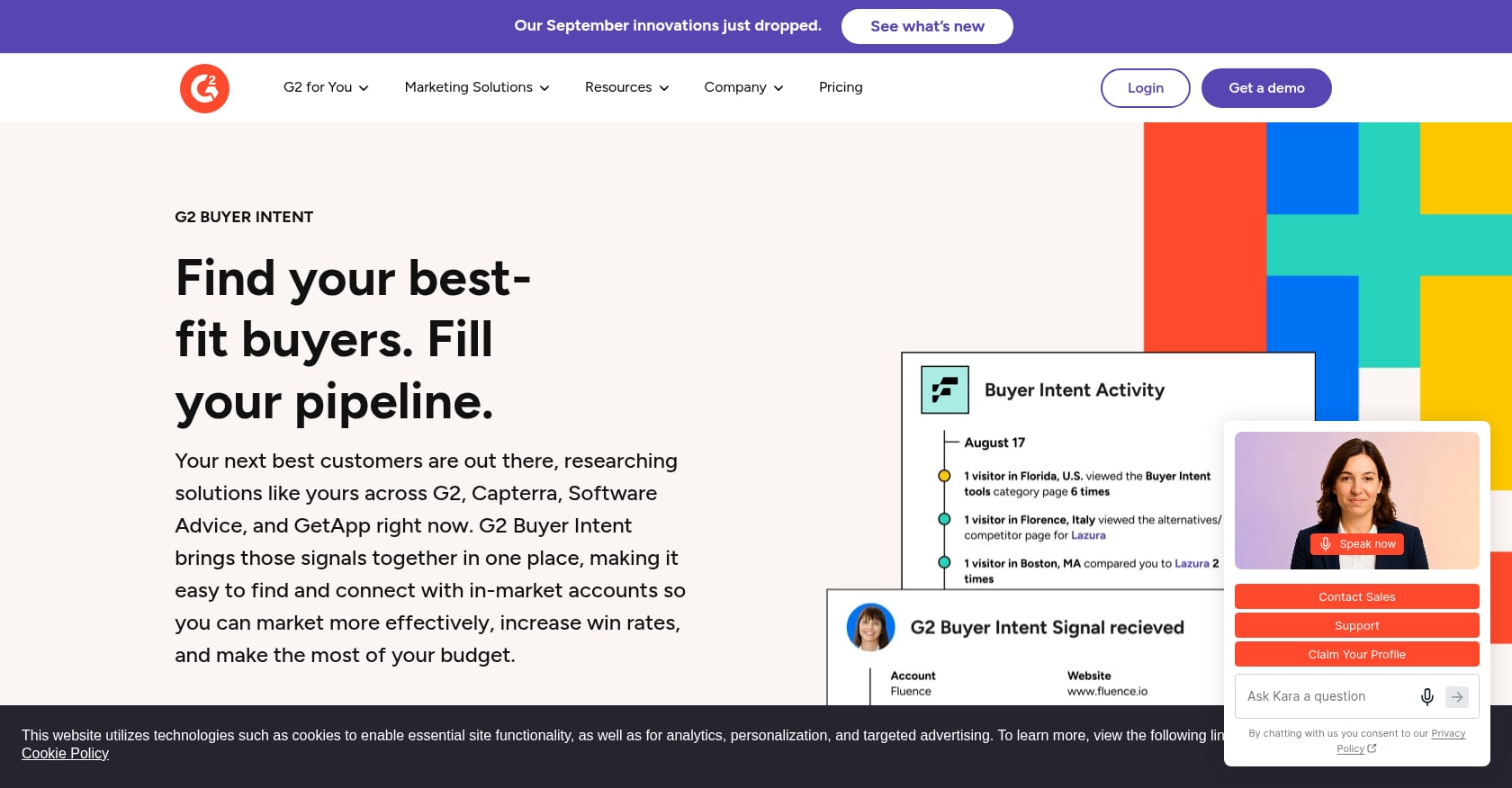
Best for: SaaS vendors with meaningful G2 category traffic who want bottom-funnel review-site signals.
G2 Buyer Intent captures account-level signals from review and comparison behavior: who is visiting your product profile, browsing your category page, comparing you to competitors, or viewing alternatives and pricing pages.
Pricing:
- G2 Core is required before purchasing Buyer Intent as an add-on.
- Paid plans begin at $2,999/year for Starter, with higher tiers unlocking intent data and analytics.
Key features:
- Product profile visitor data.
- Category and comparison page visitor data.
- Alternatives and pricing page activity.
- ICP signal filters.
- 20+ integrations including Salesforce, HubSpot, Marketo, Outreach, Demandbase, and 6sense.
User sentiment:
- 4.0/5 on Capterra across 43 reviews. Users praise integration simplicity but note that Buyer Discovery did not integrate with every ABM solution.
- Reddit users say G2 intent is useful because it comes from evaluation behavior, but criticize it as account-based rather than contact-based and warn it needs to be layered with other signals.
Tradeoffs:
- Not useful if your category has little G2 traffic.
- Account-level only, not contact-level.
- Tied to paid G2 packaging.
- Still requires outbound or retargeting workflows to act on signals.
Do not buy G2 Buyer Intent if your software category has minimal G2 research activity or you need contact-level identity.
7. Factors.ai
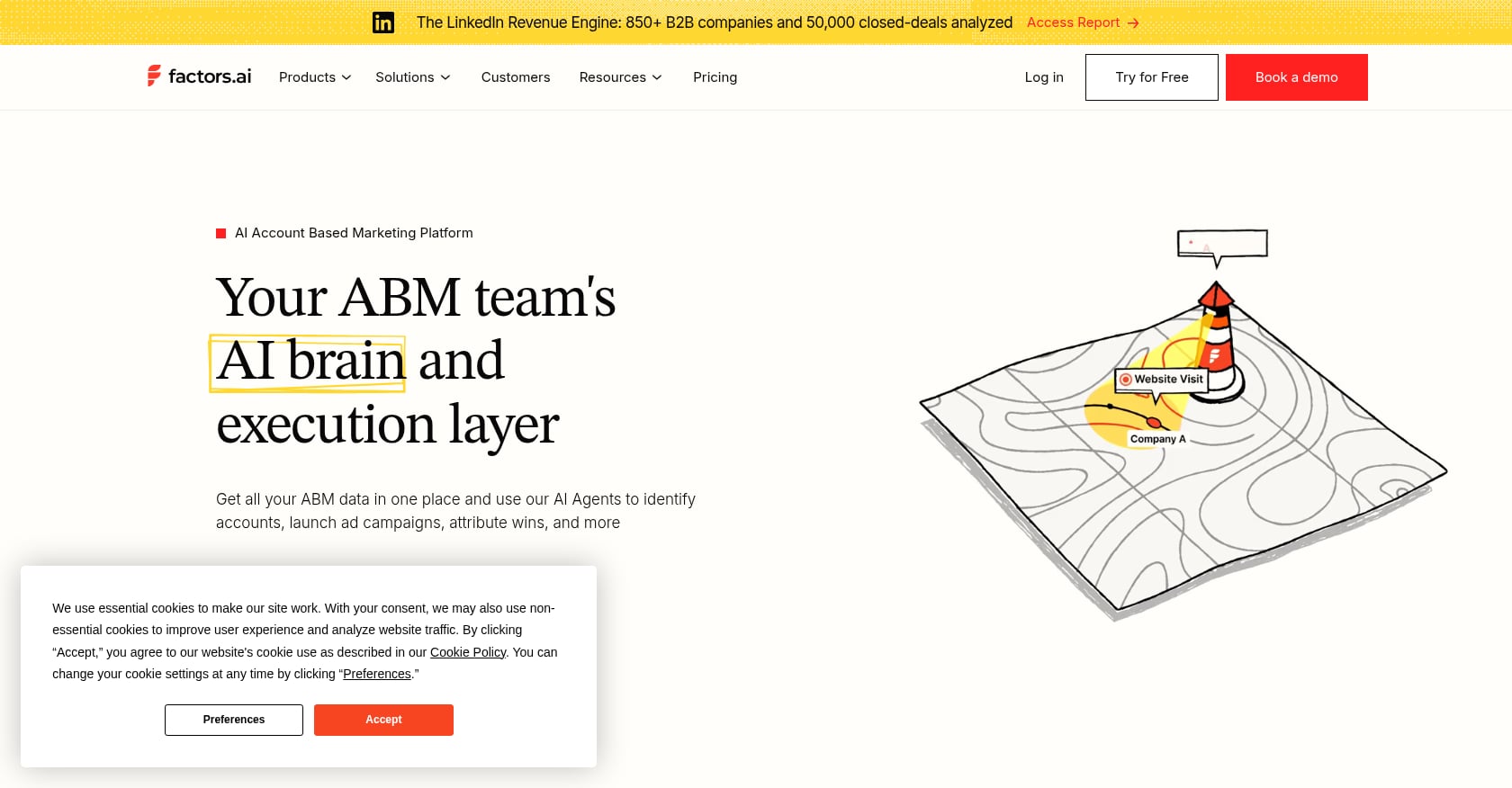
Best for: ABM analytics, multi-touch attribution, and blending website/G2/LinkedIn/Bombora signals.
Factors.ai combines account identification, first-party website intent, third-party signals from sources like LinkedIn, G2, and Bombora, scoring, and attribution into a single analytics layer.
Pricing:
- Tiered plans: Lite, Basic, Growth, and Enterprise. References cite starting around $6K.
- Free trial available.
Key features:
- Website visitor identification.
- Account enrichment and scoring.
- Customer journey timelines.
- Slack/MS Teams alerts.
- LinkedIn, G2, and Bombora intent signals (higher tiers).
- Multi-touch attribution.
- AI buyer journey analysis.
User sentiment:
- 242 reviews on G2. Users report using the data for remarketing campaigns and SDR outreach prioritization.
- One Reddit user questioned data reliability and looked for alternatives, suggesting teams should validate signals against pipeline data.
Tradeoffs:
- Pricing requires vendor conversation.
- Advanced features may exceed small-team needs.
- Signal reliability should be tested against actual pipeline outcomes.
Do not buy Factors.ai if you only need raw visitor identification and do not care about attribution or multi-source signal blending.
8. Apollo
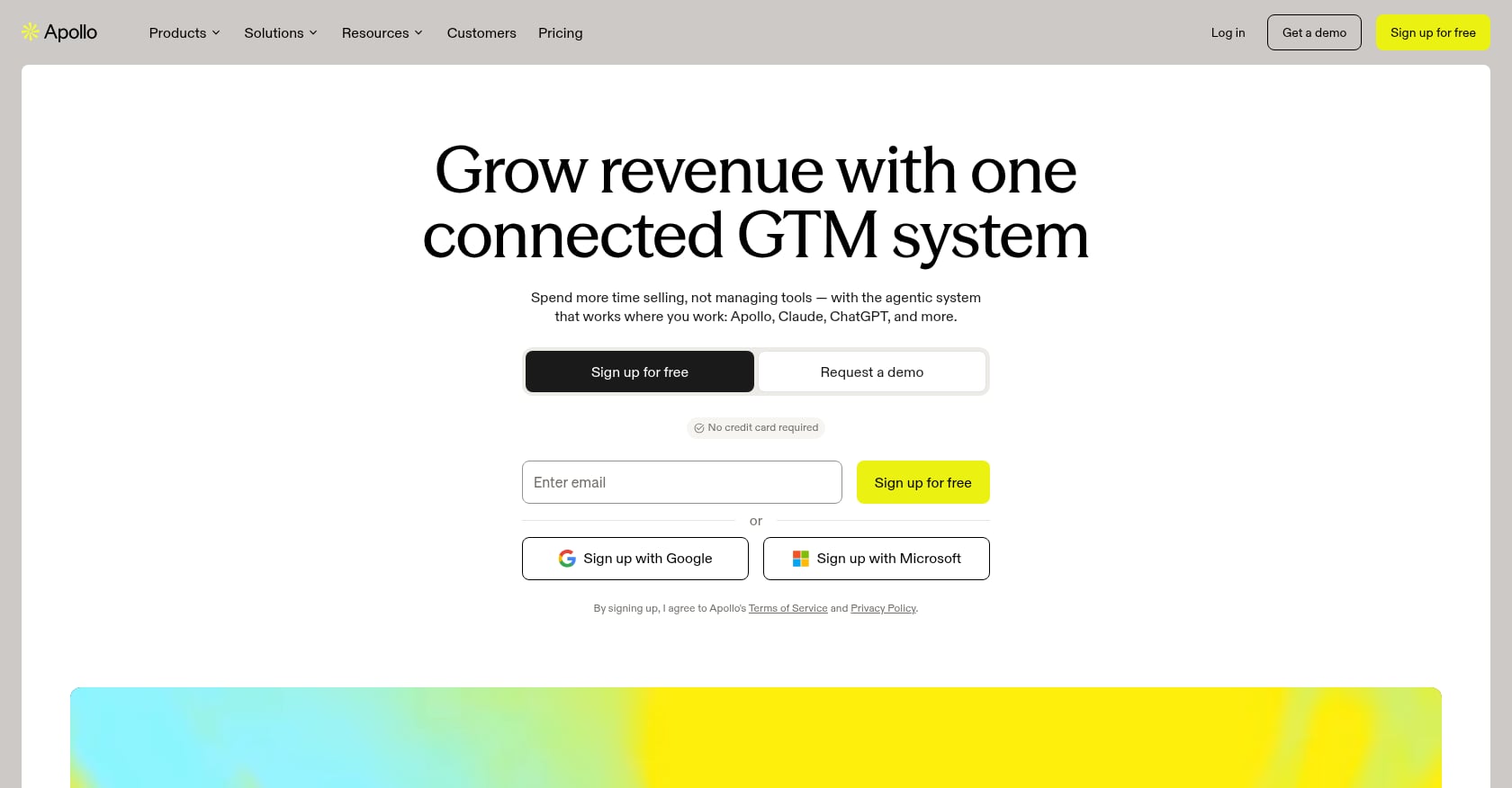
Best for: budget-friendly prospecting plus basic buying intent in one platform.
Apollo is a prospecting and sales engagement platform with buying intent filters built into the database workflow. It is not a pure intent tool, but for teams that want affordable contact discovery, email sequencing, and some intent filtering in one place, it works.
Pricing:
- Free plan tracks 1 intent topic.
- Basic/Professional: 6 topics. Organization: 12 topics.
- Paid plans from about $49/user/month billed annually.
- Apollo partners with Bombora and LeadSift for buying intent, covering 15,000+ topics.
Key features:
- B2B contact database.
- Buying intent topic filters.
- Email sequencing and sales engagement.
- CRM integrations.
- Company search and persona filters.
User sentiment:
- Reddit Apollo users highlight Buying Intent as an underrated feature and recommend combining it with persona filters instead of generic lists.
- Negative sentiment centers on teams blasting generic lists and damaging email deliverability, reinforcing that intent tools need disciplined outbound strategy.
Tradeoffs:
- Intent is lighter than enterprise ABM platforms.
- Topic limits vary by plan.
- Requires careful deliverability management.
- Easy to misuse as a bulk list source.
Do not buy Apollo if you expect enterprise-grade intent scoring or buying-stage prediction.
9. Leadfeeder
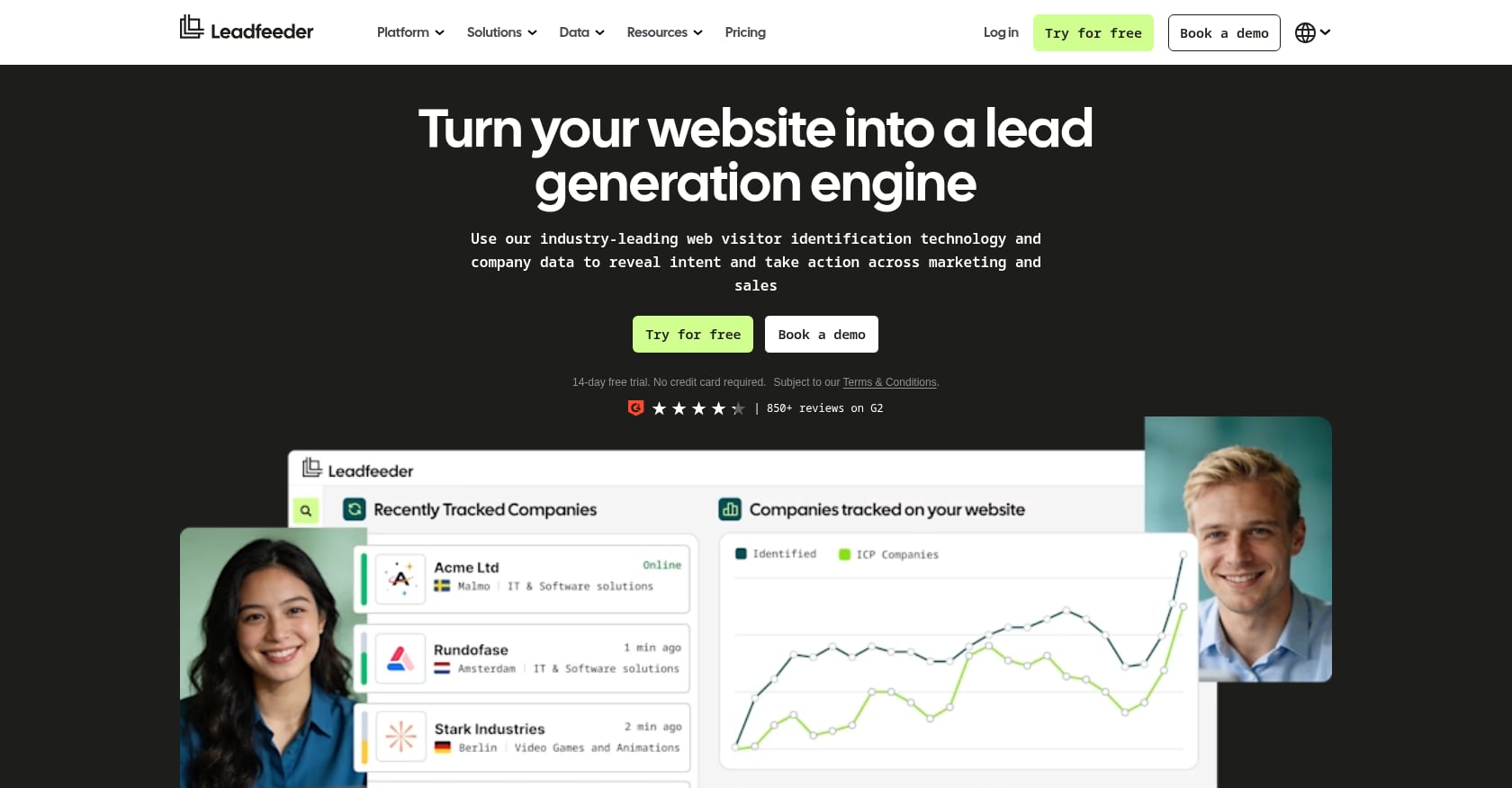
Best for: company-level website visitor identification with transparent pricing.
Leadfeeder identifies companies visiting your website, even when they do not fill out a form. It is straightforward, well-priced, and good for inbound-led teams with meaningful web traffic.
Pricing:
- Free Lite plan available.
- Discover: $79/month billed annually.
- Activate: $369/month billed annually.
- Scale: $599/month billed annually.
- Enterprise: custom.
Key features:
- Website visitor company identification.
- Real-time alerts.
- CRM push.
- Outreach and retargeting automation (higher tiers).
- Verified emails and phone on paid plans.
- Intent filtering.
User sentiment:
- 4.3/5 on G2 across 866 reviews. Users praise visitor insights. Some ask for more configurable buying-intent scoring based on specific pages.
- Reddit sentiment says Leadfeeder reveals hidden intent but can be noisier than expected.
Tradeoffs:
- Company-level, not always person-level.
- Less useful for low-traffic sites.
- Buyer intent scoring may need customization.
- Contact enrichment features raise the price.
Do not buy Leadfeeder if your website gets minimal traffic or you need person-level identification.
10. RB2B
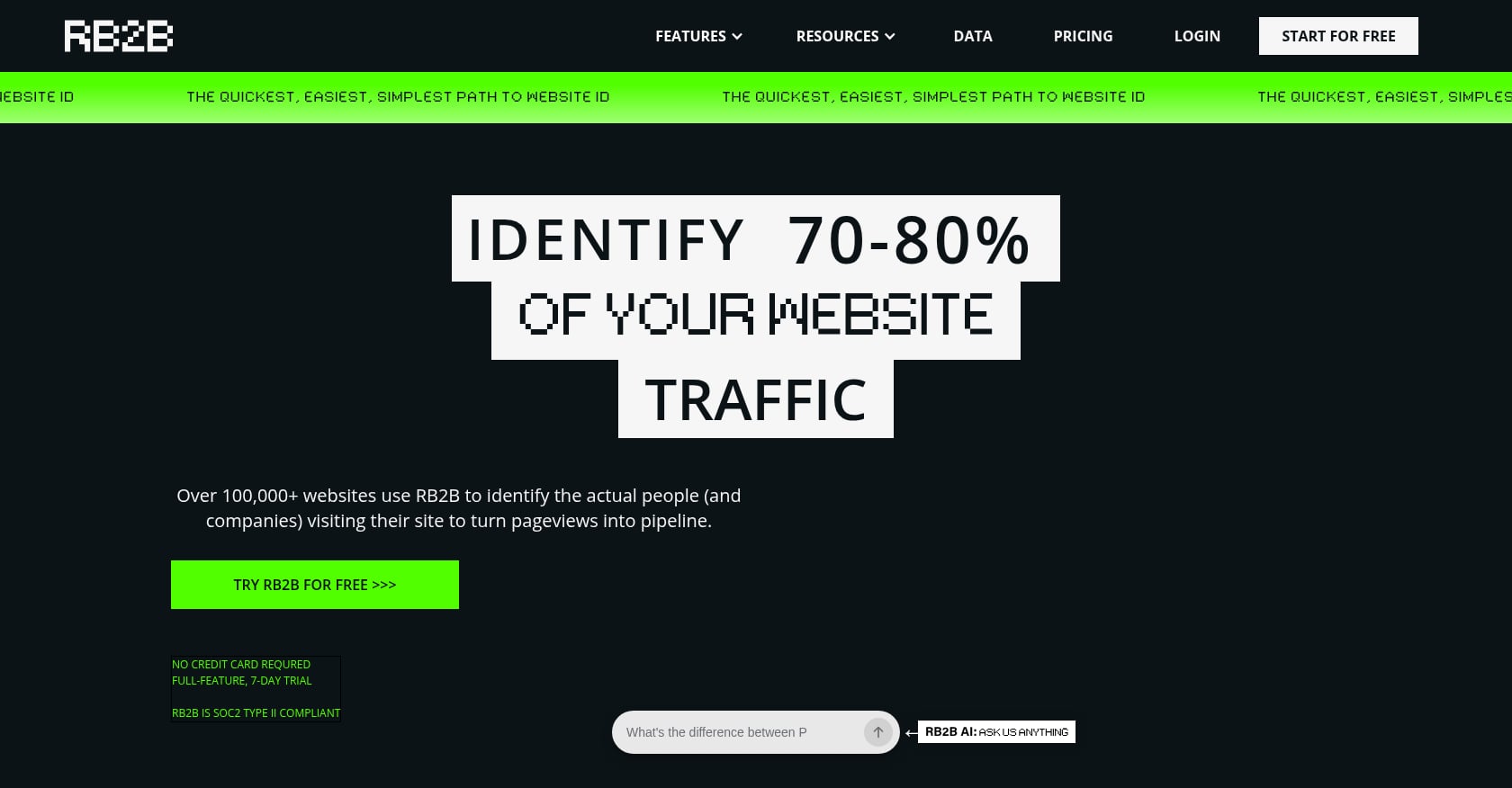
Best for: U.S. person-level website visitor identification at accessible pricing.
RB2B resolves anonymous website visits to individual contacts (not just companies) for U.S. traffic, pushing LinkedIn profiles and business emails to Slack or your CRM.
Pricing:
- Free: $0/month, company-level ID, 150 monthly resolutions.
- Starter: $79/month, 300 resolutions.
- Pro: from $149/month, business emails and integrations.
- Pro+: from $199/month, premium resolution.
- Contact-level ID is U.S.-only.
Key features:
- Website visitor identification.
- Contact-level site ID for U.S. traffic.
- Company-level ID globally.
- Slack/Teams alerts with LinkedIn URLs.
- HubSpot, Salesforce, Clay, Apollo, Zapier, and webhook integrations.
- Hot Pages and Hot Leads for ICP filtering.
User sentiment:
- G2 reviewers praise the speed of revealing real people behind anonymous visits, quick setup, and reasonable pricing.
- Community discussions caution that coverage claims vary by geography, plan, and whether reporting is company-level or person-level.
Tradeoffs:
- Contact-level coverage is U.S.-only.
- Coverage varies by plan tier.
- Still requires a rep or workflow to follow up.
- Compliance and cookie setup must be handled carefully.
Do not buy RB2B if most of your traffic comes from outside the U.S. or you need a full activation layer built in.
11. Warmly
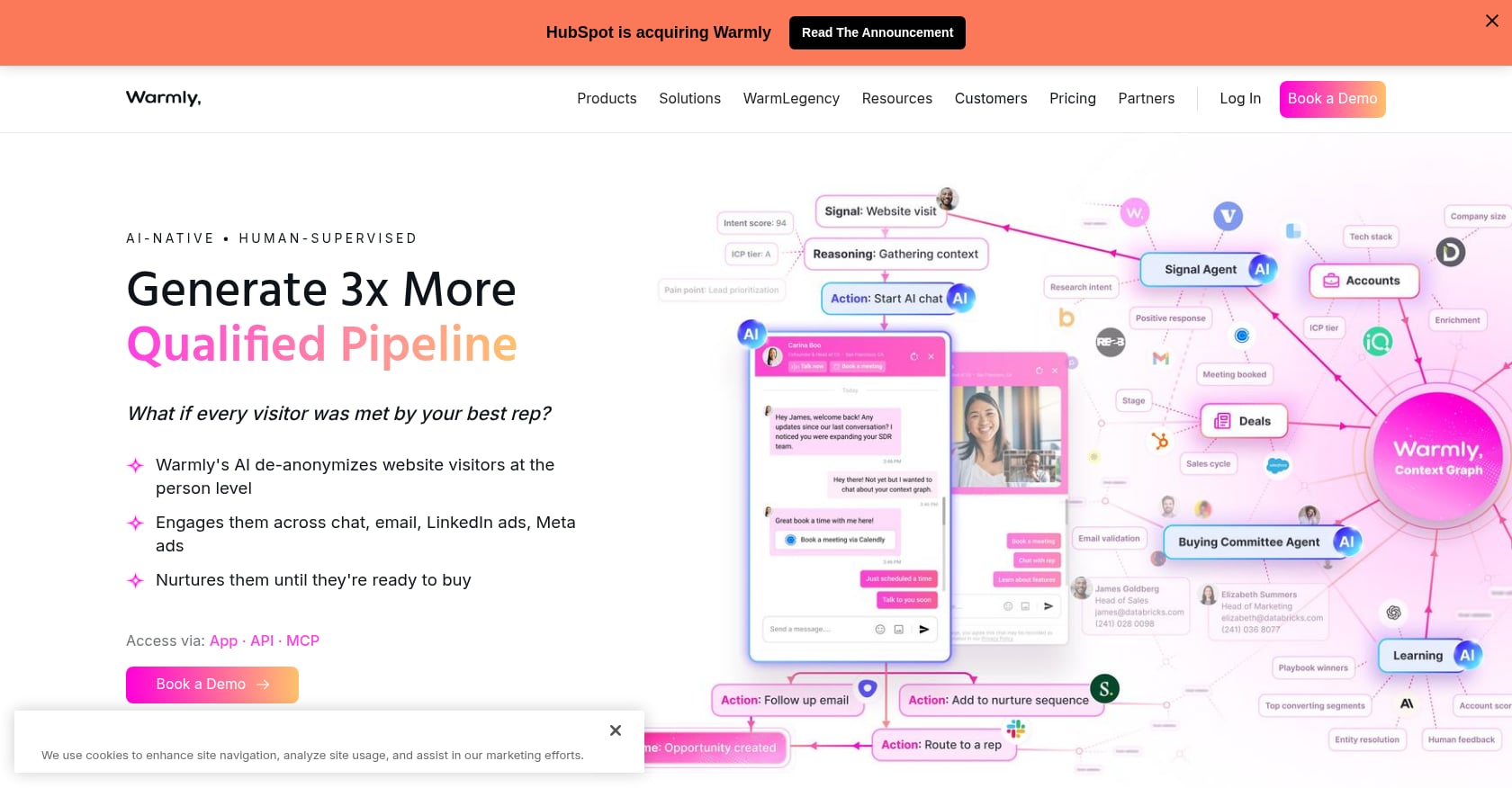
Best for: visitor identification combined with real-time chat and engagement orchestration.
Warmly goes beyond identifying visitors by adding AI chat, automated follow-up, and routing so sales teams can engage high-fit accounts while they are still on the site.
Pricing:
- Free tier available.
- Business plan from $7/user/month.
- Enterprise: contact sales.
- Pricing structure has been described as confusing by some reviewers.
Key features:
- Website visitor identification (company and person-level depending on package).
- AI chat and real-time engagement.
- Automated follow-up sequences.
- Routing and orchestration.
- Data provider waterfall.
User sentiment:
- 4.6/5 on G2 across 249 reviews.
- Reddit discussions group Warmly with Koala and RB2B in visitor identification and note that pricing may bundle features to justify higher costs.
Tradeoffs:
- Pricing clarity is weaker than RB2B or Leadfeeder.
- Product packaging may shift.
- Teams should confirm visitor-ID coverage and integrations before committing.
Do not buy Warmly if you only need basic visitor ID without the chat and orchestration layer.
12. Clay
Best for: custom intent signal workflows and GTM engineering.
Clay is a spreadsheet-like GTM data platform for teams that want to build their own signal machines rather than buy a single vendor’s intent score. It supports waterfall enrichment, AI research agents, public-web monitoring, and conditional logic workflows.
Pricing:
- Free plan available.
- Launch: from ~$185/month.
- Growth: from ~$495/month.
- Enterprise: custom.
- Uses a credit-based pricing model that changed in March 2026.
Key features:
- Waterfall enrichment across multiple data providers.
- AI research agent (Claygent).
- Public-web signal tracking (hiring pages, funding, tech changes, forum posts).
- Conditional logic and custom workflows.
- CRM and sequencer sync.
- Custom outbound personalization.
User sentiment:
- Power users praise Clay’s enrichment, integrations, and flexibility but acknowledge the learning curve is real.
- Reddit GTM operators say Clay’s value lies in how teams score, enrich, and act on signals. One thread recommends building monitors for competitor alternatives, Reddit posts, funding events, and job changes.
- Another thread warns Clay can get expensive because of per-credit pricing across multiple providers.
Tradeoffs:
- Requires technical/operator skill.
- Credit management matters and costs add up.
- Not an out-of-the-box marketing department.
- Easy to build complex workflows that nobody maintains.
Do not buy Clay if no one on your team owns GTM engineering or will maintain the workflows after setup.
Which Tool Should You Choose?
Choose AgentWeb if…
You are a startup or lean team, you do not have a full marketing department, and you need campaigns shipped weekly. You want strategy, creative, outbound, paid ads, content, and reporting in one operating model. You want a path from done-for-you to self-serve workflows.
Explore AgentWeb pricing and plans
Choose 6sense or Demandbase if…
You have enterprise ABM maturity. You have RevOps, sales adoption, CRM/MAP hygiene, and paid media budget. You need account-stage scoring and multi-channel orchestration.
Choose Bombora if…
You already have an activation stack. You want a topic intent feed to enrich account scoring. You have people to build campaigns around the data.
Choose G2 Buyer Intent if…
You sell B2B SaaS. Your category has active G2 research traffic. You want competitor and comparison signals.
Choose Leadfeeder, RB2B, or Warmly if…
You have meaningful website traffic. You need to identify anonymous visitors and route them to sales. You can follow up quickly.
Choose Apollo or Clay if…
You are outbound-heavy. You want contact data, enrichment, or custom signal workflows. You have someone who can maintain the system. Apollo works for budget teams. Clay works for teams with GTM engineering skill.
A Note on Pricing Honesty
Pricing in this category is unusually opaque. Enterprise platforms like 6sense, Demandbase, ZoomInfo, and Bombora usually require sales calls and annual contracts. One Reddit thread about revenue orchestration platforms reports that options often started at $50K+ annually, with many quotes reaching $80K to $100K once needed features were included.
Self-serve or transparent tools like Leadfeeder, RB2B, Apollo, and AgentWeb are easier to budget for, but they solve narrower jobs. Always compare the license cost with the cost of the operator required to make the data useful.
Common Mistakes When Buying Intent Marketing Tools
Mistake 1: Buying intent data without an owner
The most common failure. Teams purchase intent signals, push them to a dashboard, and nobody acts on them. If your sales team has not agreed to work intent accounts differently, or your marketing team does not have the bandwidth to build campaigns around the signals, the tool becomes expensive shelfware.
Mistake 2: Treating account-level intent as contact-level intent
A 2026 Reddit thread criticizes legacy providers for delivering aggregated account-level alerts without showing which person was active, what they read, or whether the behavior came from a real buyer. Reps cannot personalize outreach to “someone at Acme Corp, maybe.” Always check whether a tool provides account-level, company-level, or person-level data.
Mistake 3: Buying overlapping data sources
Bombora data powers intent signals inside Demandbase, 6sense, Apollo, and other platforms. Buying multiple tools that all draw from the same upstream source gives you the illusion of triangulation without actually adding new information. Reddit users note that high-intent lists can look identical month after month because vendors pull from overlapping sources.
Mistake 4: Not validating signals against pipeline
The right way to judge intent accuracy: pull your closed-won, closed-lost, and open-pipeline accounts and check how many had intent flags before opportunity creation. If high-intent accounts do not convert at a higher rate than ICP-matched non-intent accounts, the signal may not be worth the cost.
Mistake 5: Underestimating execution cost
The license fee is only the beginning. Enterprise ABM tools require RevOps configuration, CRM hygiene, content production, SDR training, paid media budget, and ongoing maintenance. For lean teams, this hidden cost often exceeds the software cost. That is why understanding your go-to-market execution model matters before selecting a tool.
How to Test an Intent Tool Before Signing an Annual Contract
Do not sign an annual contract based on a demo. Use this process:
- Export your last 12 months of closed-won, closed-lost, and open-pipeline accounts.
- Ask each vendor to show whether those accounts had intent signals before opportunity creation.
- Compare signal timing, source, and specificity.
- Check whether intent accounts converted at a higher rate than ICP-matched non-intent accounts.
- Run a 30-day holdout: reps work half the intent accounts and ignore half.
- Measure reply rate, meeting rate, opportunity creation, pipeline value, and win rate.
- Only then buy annual.
This approach is backed by practitioner advice in GTM engineering communities, where operators recommend retroactive match tests as the minimum validation before committing budget.
Final Recommendation
If you already have an ABM team, RevOps support, sales adoption, and paid media budget, a platform like 6sense or Demandbase can make sense. If you only need a signal feed, Bombora or G2 Buyer Intent may be enough. If you have site traffic, Leadfeeder, RB2B, or Warmly can uncover hidden demand.
But if you are a startup or lean team and the real bottleneck is execution, AgentWeb is the more practical path. It helps turn market research, audience signals, founder expertise, and campaign ideas into weekly GTM output, including content, outbound, paid ads, email, reporting, and iteration, without waiting to hire a full marketing team.
Start with a free GTM audit from AgentWeb
FAQ
What are intent marketing tools?
Intent marketing tools help B2B teams identify companies or people showing buying signals (website visits, product comparisons, review research, topic surges, or public triggers) and turn those signals into sales or marketing action. The best tool depends on whether you need raw intent data, website visitor identification, enterprise ABM orchestration, or done-for-you GTM execution.
What is the difference between intent marketing tools and intent data providers?
Intent data providers (like Bombora) supply raw signals about which accounts are researching specific topics. Intent marketing tools is a broader category that includes data providers, ABM platforms, visitor identification tools, and execution platforms. Some tools just provide signals. Others help you act on them.
Are intent data tools accurate?
Accuracy varies significantly by signal type and source. First-party signals (your own website visitors, demo requests) are the most reliable. Third-party topic surge data is weaker and more probabilistic. The best practice is to validate any tool’s signals against your actual closed-won and closed-lost data before committing to an annual contract.
What is the best intent marketing tool for startups?
For startups that need execution, not just data, AgentWeb is the strongest fit because it turns signals into shipped campaigns weekly. For budget-conscious outbound teams, Apollo offers basic intent plus contact data. For U.S.-focused teams with website traffic, RB2B provides affordable person-level visitor identification.
What is the cheapest buyer intent tool?
Apollo offers a free plan with 1 intent topic. RB2B has a free tier with company-level identification. Leadfeeder has a free Lite plan. AgentWeb’s self-serve platform starts at $199/month after a 7-day free trial. Enterprise platforms like 6sense, Demandbase, and Bombora typically require annual contracts starting in the tens of thousands.
What is the difference between account-level and person-level intent?
Account-level intent tells you “someone at Company X is researching your topic.” Person-level intent tells you “Jane Smith at Company X visited your pricing page.” Person-level data is far more actionable for outbound sales but is harder to get, often limited geographically (RB2B is U.S.-only for contact-level, for example), and raises more compliance considerations.
Is Bombora the same as 6sense or Demandbase?
No. Bombora is a data provider that supplies topic intent signals. 6sense and Demandbase are ABM platforms that consume Bombora data (among other sources) and layer on scoring, orchestration, advertising, and workflow features. If you already use 6sense or Demandbase, you may already have Bombora data inside your platform.
How do you measure ROI from intent data?
Compare conversion rates between intent-flagged accounts and non-intent ICP accounts across your funnel: reply rates, meetings booked, opportunities created, pipeline value, and win rate. Run holdout tests. If intent accounts do not meaningfully outperform, the tool is not adding enough value to justify its cost. Tracking what actually drives signups requires connecting intent data to downstream revenue, not just dashboard activity.
Or get a free AI Readiness Roadmap to see where your GTM has gaps.
Ex-Meta, Google, LinkedIn. 10+ years in ML & data science for GTM. Expert in customer acquisition and growth activation.
Get a free Stack Review.
30 min with Harsha and Matt.
We audit your last 30 days, pinpoint the highest-impact fixes, and hand you the exact playbook we'd run. No deck. No pitch unless there's a fit.