AI Marketing Agent for Startups (2026): 7 Top Picks


TL;DR
The AI marketing agent market is exploding, but most startups struggle to extract real value from these tools. This guide compares seven options across price, execution capability, and startup fit. AgentWeb stands out for founders who need done-for-you multi-channel execution without hiring a team. Jasper and Copy.ai work best for content-heavy teams that already know what to do. Technical founders on tight budgets should look at n8n or Relevance AI. Skip Albert.ai unless you have a six-figure ad budget.
88% of marketers now use AI daily. Yet 74% of companies still struggle to extract value from their AI tools, according to Averi.ai. That gap tells you everything about the current state of AI marketing agents for startups: the problem is not tool adoption. It’s implementation.
Quick Takeaway: What is the Best AI Marketing Agent for Startups?
The best AI marketing agent depends entirely on your startup's technical capacity and budget:
Best for Execution (Done-For-You): AgentWeb is the top choice for non-technical founders needing multi-channel campaign execution (Meta, Google, LinkedIn, email) without hiring an in-house team.
Best for Content Velocity: Jasper AI and Copy.ai excel for internal marketing teams needing high-volume, brand-consistent content generation.
Best for Technical Founders (DIY): n8n and Relevance AI offer maximum control and lowest direct cost for teams capable of building custom API workflows from scratch.
Most listicles throw fifteen tools at you without explaining which ones actually run campaigns versus which ones just generate text. This guide is different. It covers seven options that range from fully managed execution platforms to DIY agent stacks, with real pricing, honest limitations, and practitioner insights from founders who have actually deployed these systems.
If you’re a startup founder evaluating an AI marketing agent for the first time, the core question is not “which tool is best?” It’s “which tool matches my team, budget, and urgency right now?”
Here’s the breakdown.
Get a free GTM Discovery Report to see which model fits your startup before committing to any platform.
At-a-Glance Comparison Table
Platform | Starting Price | Best For | Setup to First Result | Multi-Channel Execution | Human Support | Free Trial/Tier |
|---|---|---|---|---|---|---|
AgentWeb | $199/mo (self-serve) | Done-for-you multi-channel execution | ~1 week (Week-0 diagnostic) | Yes (Meta, Google, LinkedIn, email, outbound) | Yes (senior operators) | 7-day free trial + free GTM audit |
Jasper AI | $39/mo (annual) | Brand-consistent content at scale | Same day | No (content only) | No | No free tier |
Relevance AI | Free (200 actions/mo) | Building custom agent workflows | Days to weeks | Partial (you build it) | Community only | Free tier available |
Copy.ai | $49/mo | GTM copy and sales outreach | Same day | Partial (copy + outreach) | No | Free tier (limited) |
Albert.ai | % of ad spend ($100K+ min) | Autonomous ad optimization | Weeks | Yes (paid ads only) | Yes (managed service) | No |
HubSpot AI (Breeze) | $890+/mo | CRM-first marketing teams | Days | Within HubSpot ecosystem | Tiered support | Free CRM (limited AI) |
n8n + DIY Stack | $0 (self-hosted) | Technical founders, maximum control | Weeks to months | Whatever you build | Community only | Open source |
What Makes an AI Marketing Agent Different from an AI Writing Tool
This distinction matters more than most articles acknowledge. An AI writing tool generates content when you prompt it. An AI marketing agent plans, executes, and iterates across channels with varying degrees of autonomy.
Think of it this way: ChatGPT can write a LinkedIn post for you. An AI marketing agent can research your ICP, draft the post, schedule it, A/B test variations, and shift budget to what’s working, sometimes without you touching anything.
The global agentic AI market was valued at $7.29 billion in 2025 and is projected to reach $139.19 billion by 2034, growing at a 40.5% CAGR according to Fortune Business Insights. That growth reflects a real shift from copilots to autonomous execution.
For startups, this distinction is practical. You don’t need more content. You need a marketing system that ships campaigns weekly, measures results, and compounds over time. The options below range from pure content tools (Jasper) to full execution platforms (AgentWeb) to build-your-own infrastructure (n8n). Knowing which category you need saves months of wasted effort.
The 7 Best AI Marketing Agents for Startups in 2026
1. AgentWeb
Best for: Pre-seed to Series A founders who need executed campaigns, not strategy decks, without hiring a full marketing team.
AgentWeb is an AI plus human go-to-market execution platform. Its agentic AI marketer, “Emma,” handles multi-channel execution across Meta, Google, LinkedIn/X, email, and outbound, backstopped by a senior operator team with experience at Microsoft, Google, Meta, and LinkedIn.
Pricing:
Self-serve (DIY): $199/month with a 7-day free trial
Custom Workflows (AI-led co-pilot): Contact sales
Done-for-you (Human-led Growth Ops): Contact sales; 3-month sprint engagements
Key features:
Week-0 GTM diagnostic produces a 90-day growth plan before any AI execution begins
Slack/Teams approvals keep founders in control without slow email chains
Founder-brand support including LinkedIn ghostwriting and executive comms
AgentWeb Portal with calendar, dashboards, and optimization loops
Flexible engagement: start full-service, then transition to self-serve with proven templates
Up to ~20 content assets per month across social, video, blogs, and ads
Honest tradeoffs:
Only two published case studies at time of writing
No public G2 or Capterra reviews yet
Best experience requires Slack/Teams and weekly founder engagement
Pricing for managed tiers is not fully transparent on site
Proof of results:
Nailed It case study: 4,000+ leads, 328 add-to-carts in 3 months; 2.91% CTR (roughly 3.2x industry average); ~$0.24 CPC. AgentWeb outperformed a competing agency running in parallel.
Cora case study: 13.19% peak CTR on a $300/month ad budget; 435+ qualified clicks in one month; CPC held at $0.74.
Verdict: AgentWeb fills the gap between expensive agencies and DIY tools that require a marketer to operate. The hybrid AI-plus-human model is particularly strong for founders who want multichannel campaigns running without building a team. The founder-brand emphasis, including LinkedIn ghostwriting and exec comms, is uncommon among agent platforms and valuable for early-stage companies where the founder is the brand. Start with the free GTM audit to see if the fit is right.
2. Jasper AI
Best for: Content-heavy marketing teams needing brand-consistent output at scale.
Jasper has been a household name in AI content since 2022, earning a 4.4/5 rating and offering 100+ specialized agents with brand voice training. It’s a content generation engine, not a campaign execution platform.
Pricing:
Pro: $49/month (monthly) or $39/month (annual) per seat
Professional: $69/month or $59/month (annual) per seat
Business: Custom pricing
No permanent free tier
Key features:
100+ specialized AI agents for different content types
Brand voice training and style consistency across all outputs
Enterprise-grade security and compliance
Template library covering ads, emails, blogs, social posts
Honest tradeoffs:
Revenue declined from $120M to $88M ARR, suggesting competitive pressure is real
No campaign execution: you still manage ads, scheduling, and distribution yourself
Practitioners on Medium report editing output more than expected, with one noting: “I kept Jasper for three months before canceling. It excels at volume content creation for campaigns, but I found myself editing its output more than I expected.”
The gap between Jasper and free alternatives like ChatGPT has narrowed considerably
Verdict: Excellent for teams that already have marketing expertise and need content velocity. Jasper is a writing accelerator, not a marketing system. If you need someone to figure out your channels, build your campaigns, and iterate on results, look elsewhere.
3. Relevance AI
Best for: Technical teams wanting to build custom AI agent workflows from scratch.
Relevance AI is a low-code AI workforce platform that lets you build custom agents across sales, marketing, and operations. Think of it as a construction kit rather than a finished house. Its G2 rating sits at 4.3/5, with reviewers praising it as a “versatile powerhouse.”
Pricing:
Free plan: 200 actions/month
Pro: Scales up from the free tier
Team: $349/month
Enterprise: Custom pricing
Caution: usage-based billing means costs can spike unpredictably if you run out of included actions
Key features:
Visual low-code agent builder
Connects to external APIs and data sources
Multi-step workflow automation
Flexible enough for marketing, sales, support, and operations agents
Honest tradeoffs:
This is a build-your-own platform, not a plug-and-play solution
Does not send cold emails, run LinkedIn outreach, or manage ad campaigns out of the box
Requires real technical investment to set up and maintain
Monthly spend becomes less predictable once usage grows past included limits
Verdict: Powerful if you have a technical founder willing to invest build time. Poor fit for non-technical teams or anyone who needs marketing results this month. The free tier is generous enough to experiment, but expect weeks of setup before seeing real outputs.
4. Copy.ai
Best for: GTM teams needing high-volume short-form copy and sales outreach automation.
Copy.ai pivoted from a simple copywriting tool to a full GTM platform with 17 million users, bundling content creation, sales outreach, lead scoring, and multi-step workflows. The ambition is impressive. The execution is uneven.
Pricing:
Starter: $49/month
Workflows: $249/month
Enterprise: $1,000+/month
Notable gap: nothing exists between $249 and $1,000, which leaves mid-market teams in an awkward spot
Key features:
High-volume ad copy and email outreach generation
Multi-step workflow automation for sales sequences
Lead scoring and enrichment features
17 million user community
Honest tradeoffs:
Long-form content needs heavy editing. Practitioners report rewriting 40-60% of every draft
The pricing jump from $249 to $1,000+ monthly creates a painful gap
The GTM pivot made the platform complex with a steep learning curve
Quick copy tasks can often be handled by ChatGPT for free, making the value proposition harder to justify for budget-conscious startups
Verdict: Good for sales-led startups doing high-volume ad copy and outbound outreach. The pricing structure and complexity make it less ideal for early-stage, marketing-first companies that need simplicity.
5. Albert.ai

Best for: Enterprise brands with large paid ad budgets seeking fully autonomous campaign optimization.
Albert.ai manages and optimizes digital advertising campaigns across channels without manual intervention. It’s genuinely autonomous in ways that most “AI agents” are not. But it’s priced for enterprises, not startups.
Pricing:
No fixed prices. Costs are determined by annual advertising budgets
Minimum ad spend requirements of $100K+/year
Pricing typically takes the form of a percentage of ad spend
No free trial. Contracts are designed around each client’s campaign size
Key features:
Fully autonomous cross-channel ad campaign management
Real-time budget allocation and creative optimization
Works across search, social, and programmatic channels
Honest tradeoffs:
Minimum ad budget requirements ($100K+/year) price out nearly all early-stage startups
Percentage-of-spend pricing means costs scale directly with ad investment
No self-serve option or free trial to evaluate before committing
Designed for brands with existing ad infrastructure and data
Verdict: Not suitable for most startups. Including it here for context: if you’re a Series C company with a large paid media budget, Albert.ai is worth evaluating. For everyone else, skip it.
6. HubSpot AI (Breeze)
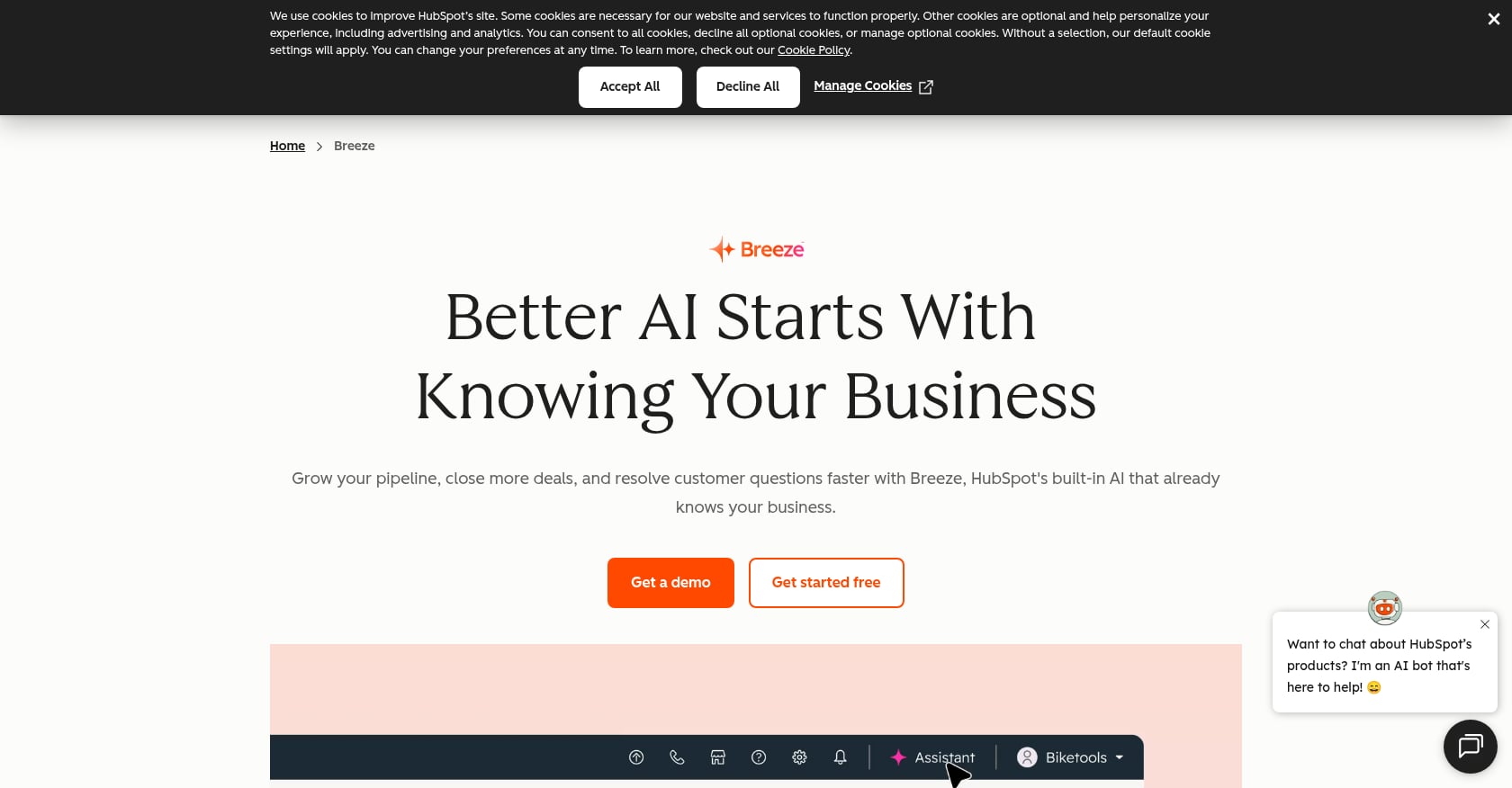
Best for: Well-funded startups with dedicated marketing operators who want CRM plus marketing in one system.
HubSpot’s Breeze agents are embedded within the HubSpot ecosystem, offering AI-powered content creation, customer service, and prospecting. If you’re already paying for HubSpot, the AI features add real value. If you’re not, the entry cost is steep.
Pricing:
Marketing Hub Professional starts at $890+/month
Breeze agents are priced per outcome ($0.50-$1.00 per action)
Credit packs range from $45-$1,000/month
Free CRM available but with limited AI capabilities
Key features:
Deeply integrated with HubSpot CRM, sales, and service hubs
AI agents for content creation, prospecting, and customer support
Workflow automation within the HubSpot ecosystem
Comprehensive reporting and attribution
Honest tradeoffs:
The $890+ monthly starting price for Marketing Hub Professional is prohibitive for pre-seed teams
Multi-platform marketing teams requiring automation outside HubSpot will find it limiting
The extensive feature set can overwhelm smaller teams
Ecosystem lock-in is real: switching costs increase over time
Verdict: If you’re already on HubSpot and have the budget, the embedded AI features create a smooth experience. But for pre-seed startups or teams using multiple tools outside the HubSpot ecosystem, the cost and lock-in make it a hard sell. Consider this option once you’ve raised a Series A and need a full-funnel growth strategy system.
7. n8n + DIY Agent Stack
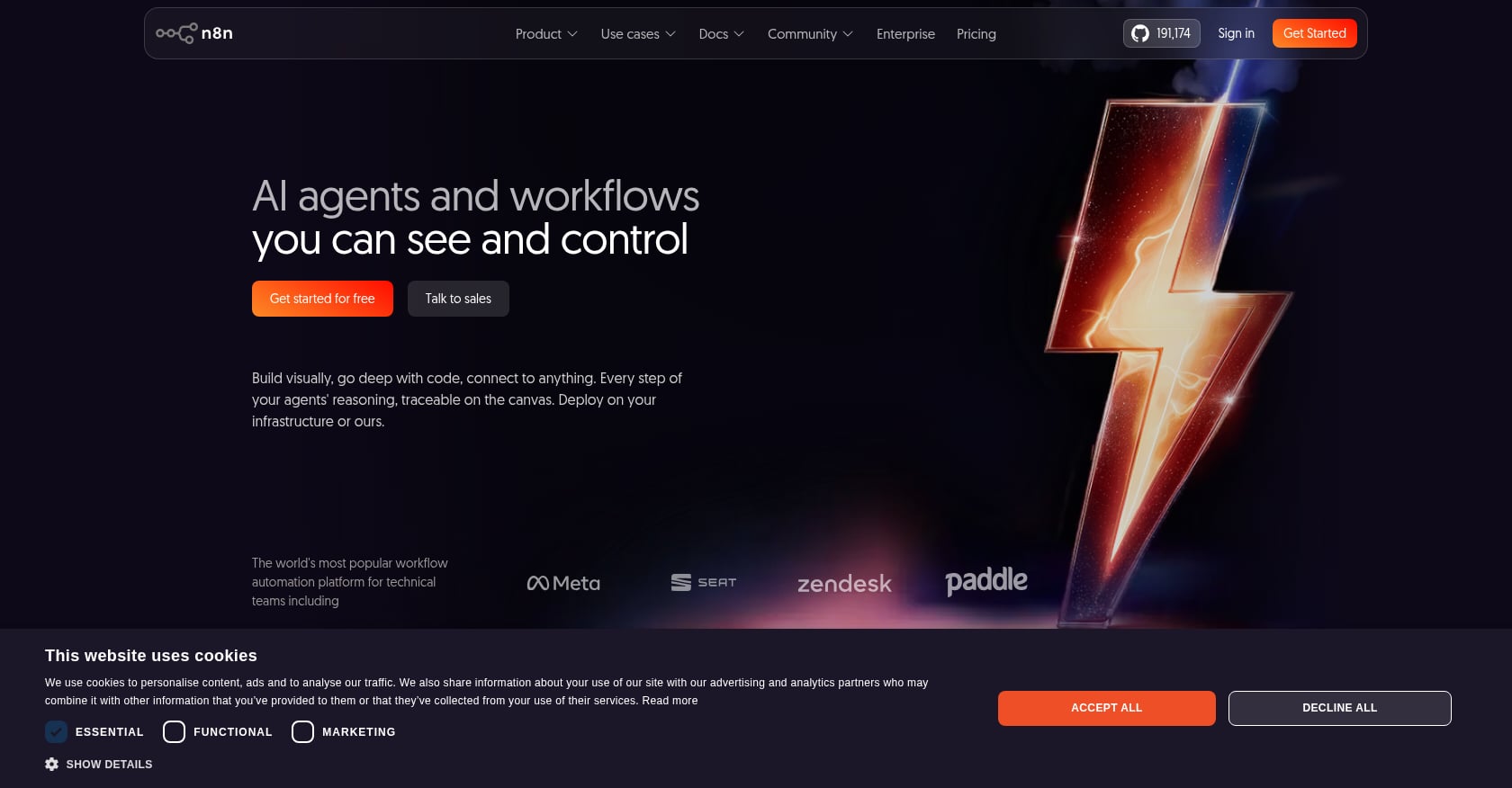
Best for: Technical founders who want maximum control and the lowest per-agent cost.
n8n is an open-source workflow automation platform. In 2026, its dedicated “AI Agent Node” lets technical founders drag and drop AI models and tools into cohesive multi-agent systems. Combined with other tools, you can build a functional marketing agent stack for a fraction of what managed platforms charge.
Pricing:
Self-hosted: Free (open source)
Cloud: Starting at ~$24/month
A functional DIY stack covering content, support, design, and automation runs approximately $300-$500/month total
Key features:
Visual editor for building complex AI workflows
Connects to virtually any API or service
Self-hosted option means complete data control
Active open-source community with shared templates
Honest tradeoffs:
Highest time investment of any option on this list
Not a marketing solution, it’s infrastructure for building one
Requires product-building skills and comfort with APIs
No human support beyond community forums
Debugging and maintenance fall entirely on you
Practitioner context: A functional DIY agent stack costs $300-$500 per month and replaces functions that previously required $80,000-$120,000 per month in human payroll, according to Mean CEO Blog. That sounds incredible until you factor in founder time. If your hourly opportunity cost is $200+, spending 20 hours a week managing agents eats most of the savings.
Verdict: Maximum flexibility, lowest direct cost, but highest time investment. Best for technical founders who enjoy building systems and can invest weekends setting up infrastructure. If you want to build your own agentic GTM engine, this is the path. Everyone else should buy rather than build.
How to Choose: A Decision Framework for Startup Founders
Picking the right AI marketing agent for your startup comes down to three axes.
By budget:
Under $200/month: n8n + DIY stack, Relevance AI free tier, or AgentWeb self-serve ($199/mo)
$200-$500/month: AgentWeb self-serve, Copy.ai, or Jasper
$500+/month: AgentWeb managed tiers, HubSpot AI, or Copy.ai enterprise
By technical capability:
Non-technical founder: AgentWeb (managed) or Jasper
Marketing operator: AgentWeb (self-serve), Copy.ai, or HubSpot AI
Technical founder: n8n, Relevance AI, or AgentWeb (self-serve)
By urgency:
Need results this month: AgentWeb (done-for-you) or Jasper
Need results this quarter: AgentWeb (self-serve), Copy.ai, or HubSpot AI
Building long-term infrastructure: n8n + DIY stack or Relevance AI
One framework that practitioners have found useful comes from SaaStr CEO Jason Lemkin: “Buy 90% of your AI stack. Only build the 10% where no vendor can do it well and it’s a P1 priority.” For most startups, the math strongly favors buying execution over building it.
Not sure which model fits? Get a free AI evaluation to match your team’s situation to the right approach.
The AI Marketing Agent ROI Benchmark (2026 Data)
Deploying autonomous agents yields distinct returns depending on the marketing sub-function. Data from recent 2026 performance indexes highlights where startups extract the highest efficiency gains relative to tool spend.
Marketing Function | Average Blended ROI | Primary Efficiency Driver |
AI Content Drafting | 3.2x | Automated layout generation and initial drafting speed |
Personalization Engines | 2.7x | Dynamic audience matching across ad platforms |
Audience Research | 2.4x | Automated ICP profiling and scraping |
Ad Copy Generation | 2.3x | High-velocity multivariate testing variants |
SEO Briefs & Optimization | 2.1x | Automated keyword semantic grouping |
Campaign Analytics | 1.9x | Cross-platform dashboard data aggregation |
The Intervener Premium: Startups that combine AI generation with human editor review (editing 20% or more of the machine output) achieve 2.7x better organic traffic outcomes than teams that publish unedited, raw AI copy.
Checklist: Buy vs. Build Evaluation for Early-Stage Startups
Before deploying an agent framework, cross-reference your operational capacity against this structural breakdown:
Do you have dedicated technical overhead? If no, cross off n8n and Relevance AI. Staging multi-agent loops requires consistent API maintenance.
Is your process thoroughly mapped out? AI agents fail when fed ambiguous goals. If you cannot outline the process step-by-step for an intern, buy a managed service like AgentWeb first to build the baseline framework.
Are your distribution channels live? Pure content tools like Jasper accelerate production velocity, but they assume your scheduling infrastructure, ad accounts, and email verification nodes are already healthy.
What Practitioners Actually Learned Deploying AI Marketing Agents
The gap between marketing hype and deployment reality is wide. Here’s what actual practitioners report after months of running AI agents.
SaaStr’s real numbers after 8 months with 20+ agents:
Jason Lemkin’s team at SaaStr shared detailed results from their deployment. The upside was significant: $4.8 million in additional pipeline and $2.4 million in closed-won revenue, with deal volume more than doubling and win rates nearly doubling.
But the honest truth was equally revealing. As Lemkin put it: “We maintain these agents every single day. Literally every morning before anything else, we’re checking our agents.” Each person on the team spends 15-20 hours per week managing agents. That’s not autopilot. That’s a serious operational commitment.
His key takeaway: “AI agents don’t enable lazy marketing. They enable better marketing and much more of it. Everyone wants an autopilot. Everyone wants to buy a tool and disappear. It doesn’t work that way.”
Jacob Bank’s 40-agent solo marketing operation:
Jacob Bank, featured on GrowthUnhinged, runs a marketing org consisting of just himself as CEO and more than 40 AI agents collectively doing the work of a five-person marketing team. Many of his agents include a human-in-the-loop component, similar to how a manager reviews an intern’s work before shipping it.
His core insight challenges conventional thinking. The people who get the most out of AI agents won’t be “super individual contributors.” They’ll be “super delegators” who map workflows, find discrete tasks, and create clear instructions for agents. This reframes AI marketing from “do things faster” to “manage systems better.”
The implementation reality:
HubSpot’s AI Trends 2026 report shows marketers recover 6.1 hours weekly on average, with senior practitioners saving 8-10 hours. That’s meaningful but not transformative unless those hours go toward higher-value work.
A practitioner shared in a HubSpot interview: “I was getting mediocre results until I realized I needed to map out processes I knew intimately first. Once I started with processes I could explain step by step, suddenly I was getting exceptional results.” This matches what experienced AI marketing teams report across forums and YouTube walkthroughs: the quality of your instructions determines the quality of your agents’ output. Understanding your AI marketing strategy before deploying tools is the prerequisite that most listicles skip.
What AI Marketing Agents Can’t Do (Yet)
Honesty about limitations builds more trust than over-promising. Here’s what AI marketing agents genuinely cannot handle in 2026.
Strategic judgment calls. Market validation, pricing strategy, competitive positioning, and the decision of which market to enter, these require founder judgment that no agent can replicate. AI can gather data to inform these decisions. It cannot make them.
Relationship-based selling. If your deal closes because a human VP trusts your founder, no AI agent is replacing that handshake. Agents can warm up leads and handle top-of-funnel. Closing complex B2B deals still requires people.
Novel creative leaps. Agents are excellent at producing content within established patterns. They’re bad at inventing new categories, crafting breakthrough positioning, or producing the kind of creative work that makes people stop scrolling. For a deeper reality check, consider what AI actually replaces versus what it augments.
The failure rate is real. Gartner projects that over 40% of agentic AI projects will be canceled by the end of 2027, with escalating costs, unclear business value, and inadequate risk controls as the primary drivers, according to Azumo’s analysis of the Gartner report. The 34% of enterprise marketing teams now running at least one autonomous agent in production, more than double the 14% reported in Q4 2025, according to Digital Applied, proves the technology works. But it works for teams that commit to ongoing management, not teams looking for set-and-forget.
The takeaway: AI marketing agents are force multipliers, not replacements. Startups that approach them as tools requiring active management, clear instructions, and human oversight will outperform those expecting magic.
The Bottom Line for Startup Founders
The AI marketing agent market in 2026 is worth $47.32 billion, according to SEO.com. Solo-founded ventures now represent 36.3% of new companies, and that figure keeps climbing as AI agent reliability improves. The opportunity is real. But so are the tradeoffs.
For most startup founders, the optimal path is clear: buy execution, don’t build it. Use the 90/10 rule. Start with a platform that ships campaigns in week one, and only build custom agents for the narrow areas where no vendor serves your specific needs.
If you’re a non-technical founder who needs multi-channel campaigns running without hiring a team, explore AgentWeb’s case studies to see what execution looks like in practice. The free GTM audit and 7-day platform trial give you a low-risk way to evaluate fit before committing budget.
Whatever you choose, remember: implementation beats selection. The best AI marketing agent for your startup is the one you’ll actually use, manage, and iterate on every week.
FAQ
What is an AI marketing agent for startups?
An AI marketing agent is software that autonomously plans, executes, and optimizes marketing tasks across channels like paid ads, email, social media, and content. Unlike simple AI writing tools, agents can handle multi-step workflows with minimal human intervention. For startups, they serve as a substitute for hiring a full marketing team during the earliest growth stages.
How much does an AI marketing agent cost for a startup?
Costs range widely. Self-serve platforms start at $0 (n8n open source) to $199/month (AgentWeb self-serve). Content tools like Jasper run $39-69/month per seat. Full-service managed options range from custom pricing (AgentWeb done-for-you) to $890+/month (HubSpot). A functional DIY agent stack typically costs $300-500/month in tool subscriptions, not counting founder time.
Can an AI marketing agent replace a marketing team?
Partially. AI agents can handle content creation, ad optimization, email sequences, and reporting that previously required multiple hires. SaaStr’s team generated $4.8 million in additional pipeline using 20+ agents. However, these agents still require 15-20 hours per week of human management per person. They’re best understood as force multipliers that let one or two people do the work of five, not as fully autonomous replacements.
What’s the difference between an AI marketing agent and an AI writing tool?
An AI writing tool (like a basic ChatGPT prompt) generates content when asked. An AI marketing agent plans campaigns, creates content, distributes it across channels, analyzes performance, and iterates, often with minimal prompting. The distinction matters for startups because agents build marketing systems, while writing tools create individual assets.
How long does it take to see results from an AI marketing agent?
It depends on the platform. Done-for-you services like AgentWeb can start shipping campaigns within a week after an initial diagnostic. Content tools like Jasper produce output on day one. DIY stacks using n8n or Relevance AI take weeks to months before they’re operational. Most practitioners report meaningful performance data within 30-90 days.
Are AI marketing agents reliable enough for startups in 2026?
Reliability has improved significantly, with 34% of enterprise marketing teams now running autonomous agents in production. But Gartner warns that 40%+ of agentic AI projects will be canceled by 2027 due to unclear value and escalating costs. The most reliable deployments use human-in-the-loop oversight, treat agents as managed systems rather than set-and-forget tools, and focus on well-defined, repeatable tasks.
Should I build my own AI marketing agent stack or buy one?
For most startup founders, buying is the right call. SaaStr’s CEO recommends buying 90% of your AI stack and only building the 10% where no vendor can handle your specific P1 priority. Building requires technical skills, ongoing maintenance, and significant time investment. The exception is technical founders who have experience with workflow automation and genuinely enjoy the building process.
What should I look for when choosing an AI marketing agent for my startup?
Focus on three factors: execution scope (does it actually run campaigns or just create content?), pricing fit (can you afford it at your current stage?), and support model (is there human help or are you completely on your own?). Startups with tight budgets and small teams should prioritize platforms that combine AI speed with human oversight, since pure DIY tools often create more work than they save in the early months.
Or get a free AI Readiness Roadmap to see where your GTM has gaps.
Ex-Meta, Google, LinkedIn. 10+ years in ML & data science for GTM. Expert in customer acquisition and growth activation.
Get a free Stack Review.
30 min with Harsha and Matt.
We audit your last 30 days, pinpoint the highest-impact fixes, and hand you the exact playbook we'd run. No deck. No pitch unless there's a fit.