10 Best AI Outbound Automation Tools for Startups (2026)


TL;DR
Fully autonomous AI SDRs promise to replace your sales team but deliver 1-3% reply rates at scale. Signal-based campaigns with human review hit 14-25%. This guide covers 10 AI outbound automation options, from done-for-you services to DIY platforms to autonomous agents, with real pricing, honest tradeoffs, and a clear framework for choosing. The winning model in 2026 is human-in-the-loop AI, not set-and-forget bots.
The Promise vs. the Reality of AI Outbound
The AI outbound automation market is projected to grow from $4.27 billion in 2025 to $18.19 billion by 2032, according to Fortune Business Insights. Every sales tool now has “AI” stamped on it. Every vendor promises autonomous pipeline generation.
But here’s what actually happened when companies went all-in on autonomous AI SDRs: only 2% successfully implemented them in a way that stuck. Between 50-70% of AI SDR tools churn within the first year. And 11x.ai, the poster child of autonomous AI sales, raised $74 million from Andreessen Horowitz and Benchmark, then lost 70-80% of its customers within months.
The numbers tell a clear story. Fully autonomous volume-based outbound produces 1-3% reply rates at production scale. Signal-based campaigns with human oversight produce 14-25%. That’s not a marginal difference. It’s an order of magnitude.
This article covers 10 AI outbound automation tools and services across three categories: done-for-you execution, DIY platforms, and autonomous AI SDRs. Each entry includes real pricing (not just “contact sales”), verified user feedback, and honest limitations. The goal is to help you pick the right approach for your stage, budget, and technical capacity.
At-a-Glance Comparison Table
| Tool | Starting Price | Best For | Key Strength | Key Limitation | Model |
|---|---|---|---|---|---|
| AgentWeb (Emma) | $199/mo (self-serve) | Founders wanting done-for-you execution | Human + AI; ships campaigns weekly | Newer brand, limited public reviews | Service + platform |
| Apollo.io | Free / $49/user/mo | Small teams testing outbound | All-in-one: database + sequencer + dialer | Data accuracy varies; credit costs escalate | DIY platform |
| Clay | $149/mo | RevOps teams wanting enrichment depth | 150+ data sources, waterfall enrichment | Steep learning curve; no sending capability | DIY enrichment layer |
| Smartlead | $39/mo | Agencies, high-volume email | Unlimited mailboxes, white-label | No database, no LinkedIn, no CRM | DIY email sender |
| Instantly | $47/mo | Budget solo founders | Cheapest flat-fee entry; 450M+ contacts | Email-only; no multichannel | DIY email sender |
| Lemlist | $63/user/mo | Small teams wanting multichannel | Email + LinkedIn + calling in one tool | Per-seat pricing scales expensive | DIY multichannel |
| Outreach | ~$100+/user/mo | Enterprise, 20+ rep teams | Governance, analytics, conversation intel | Overkill and expensive for startups | Enterprise platform |
| Artisan (Ava) | ~$1,500+/mo | Testing autonomous outbound | Fully autonomous workflow | Generic output; LinkedIn restricted; 3.8/5 G2 | Autonomous AI SDR |
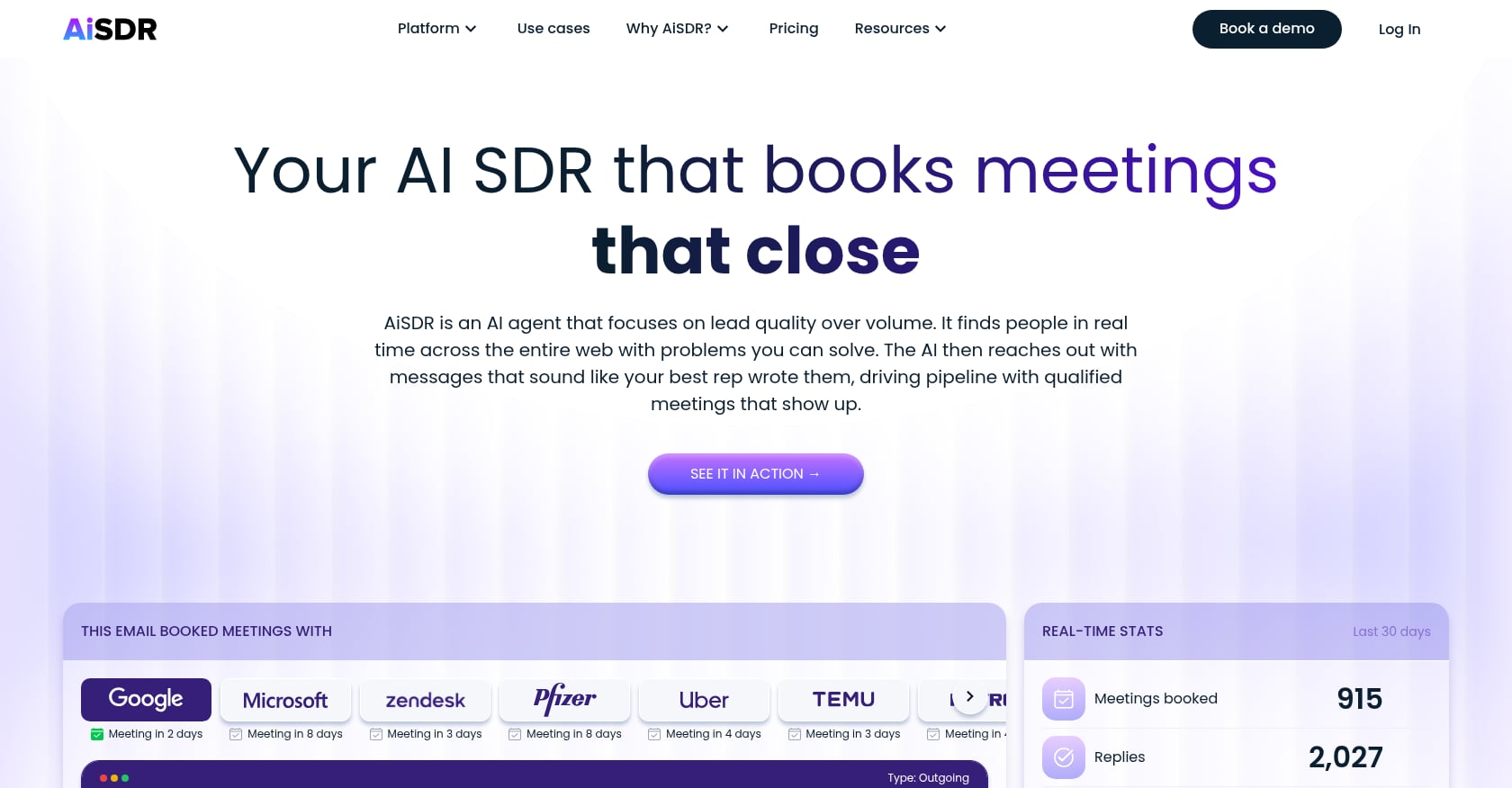
| AiSDR | $900/mo | Growth teams wanting autonomy + transparency | Reply automation; no annual lock-in | Quality drops in technical conversations | Autonomous AI SDR |
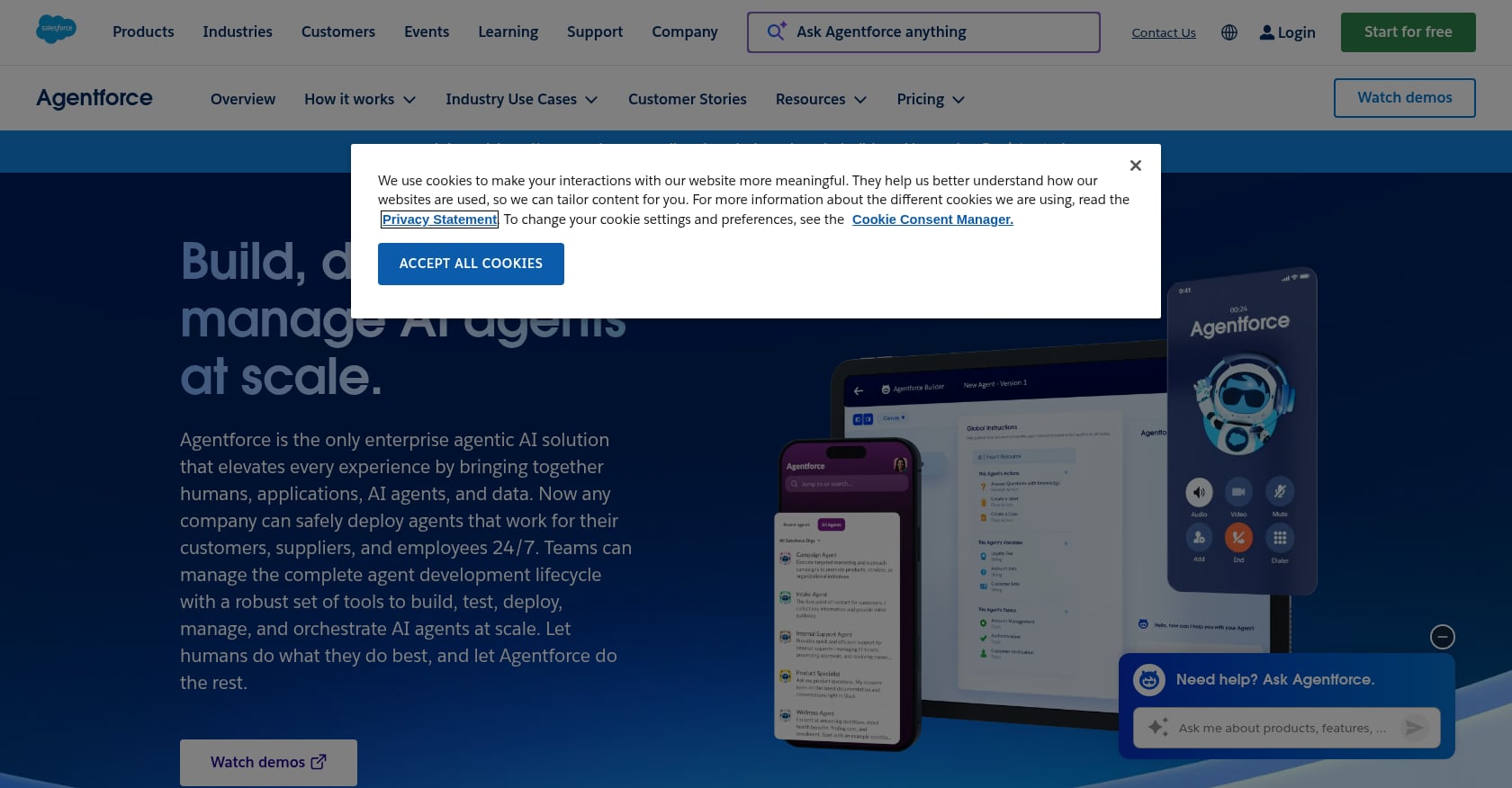
| Salesforce Agentforce | Enterprise pricing | Salesforce-native teams | Deep CRM context; full lifecycle | Complex setup; requires dedicated admins | Enterprise CRM add-on |
What Defines Good AI Outbound Automation in 2026?
The game has shifted from sending more emails to orchestrating smarter conversations across channels. Three distinct tiers have emerged:
Volume-first tools optimize for sending capacity. Unlimited mailboxes, bulk sequences, high throughput. These work when your targeting is already sharp and you have someone skilled managing deliverability.
Platform plays combine data, sequencing, and CRM in a single product. They reduce tool sprawl but often compromise on depth in each function.
Intelligence-first approaches use AI for research, signal detection, and personalization, then keep humans in the decision loop for quality control and authentic engagement.
The data overwhelmingly favors the third category. According to industry reports, 22% of sales teams have fully replaced their human SDR function with AI, while 45% run hybrid models. But the hybrid model is where results actually concentrate. One SDR does the work of three to four with a human-in-the-loop setup, and customer acquisition costs drop 35-60%.
HubSpot’s research confirms this: companies investing in AI and automation report a 10-20% boost in sales ROI, with 80% of top sellers using these tools regularly.
There’s a deeper problem that most tool comparisons ignore entirely. Operating cold email well means getting a lot of things right simultaneously: copywriting, verified lists, proper domain setup, deliverability monitoring, sequence optimization, and ongoing testing. That’s not a software setup problem. It’s an expertise problem.
Practitioners in the RevGenius community put it bluntly: founders at early growth stages are reading about AI on LinkedIn, reviewing tools, even testing them. They just don’t have the time and capacity to build out these automation engines. And they can’t afford an agency yet.
This is why the combination of human expertise and AI tools consistently outperforms either approach alone.
The 10 Best AI Outbound Automation Tools and Services
1. AgentWeb (Emma)
Best for: Founders who want outbound results without managing a tool stack
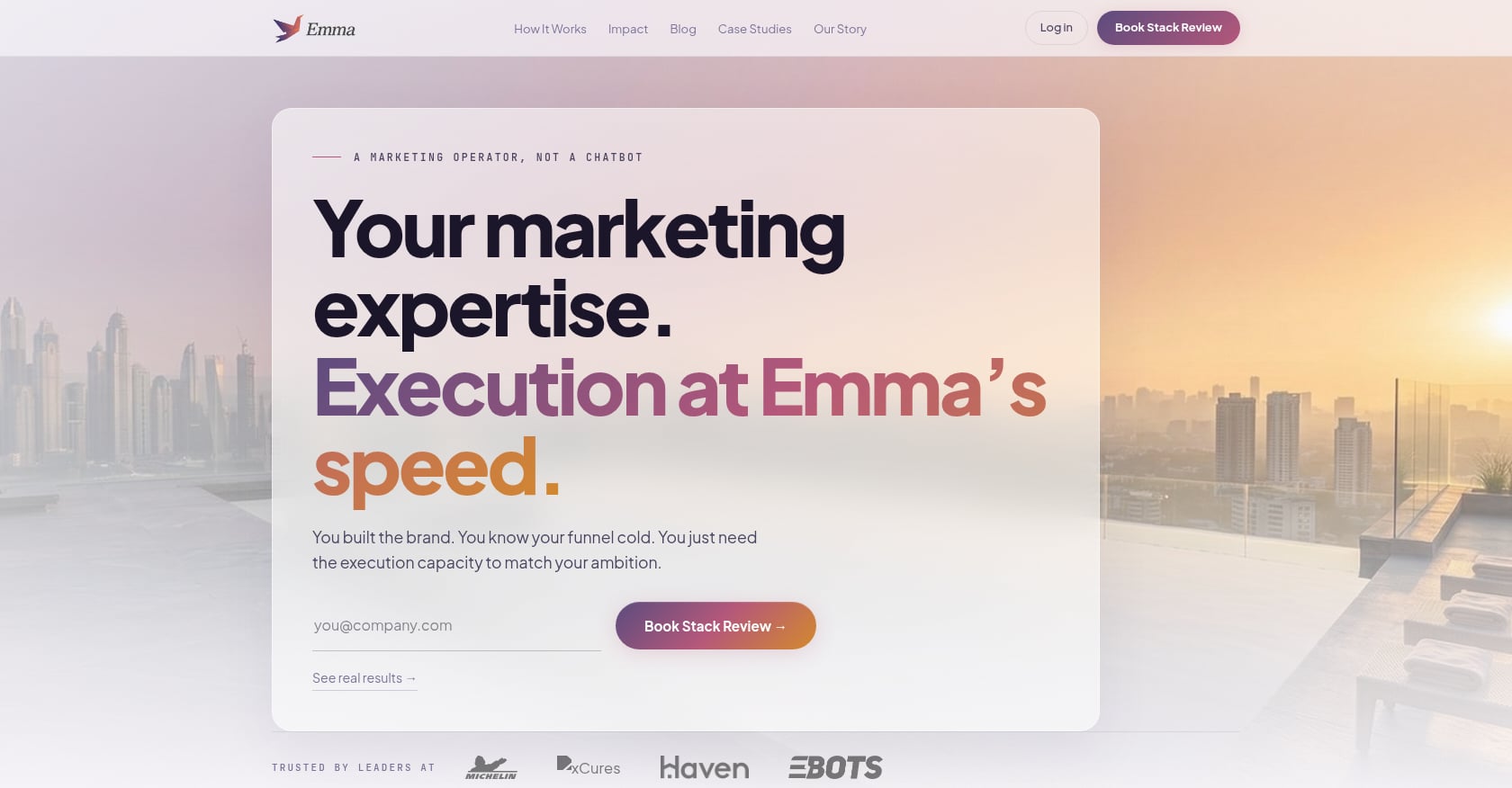
AgentWeb is an AI plus human go-to-market execution service. Its agentic AI marketer “Emma” runs outbound campaigns across email, LinkedIn/X, and paid channels, backed by a senior operator team. Rather than selling you software and wishing you luck, AgentWeb ships campaigns weekly and leaves behind a reusable system.
Pricing:
- Self-serve (DIY): 7-day free trial, then $199/month
- Done-for-you tiers: Seasonal pricing, contact founders@agentweb.pro
Key features:
- Week 0 diagnostic that produces a 90-day GTM plan mapped to your ICP, channels, and bottlenecks
- Multichannel execution across Meta, Google, LinkedIn/X, email, and outbound
- Slack/Teams approval workflows (one-click creative approvals)
- AgentWeb Portal with calendars, dashboards, and optimization loops
- Founder-brand support including LinkedIn ghostwriting
Proof:
- 4,000+ leads and 328 Add-to-Carts in 3 months for Nailed It, with 2.91% CTR at roughly $0.24 CPC
- 13.19% CTR peak for Cora on a $300/month ad budget
Tradeoffs:
- Less transparent public pricing on service tiers
- Limited third-party reviews as a newer entrant
- Best experience requires active Slack/Teams engagement
What makes it different: AgentWeb solves the expertise problem directly. Most AI outbound automation tools assume you have someone skilled to operate them. AgentWeb assumes you don’t, and provides the operator layer alongside the AI. For pre-seed to Series A founders who need pipeline this quarter (not next year), this is the fastest path to predictable lead generation without hiring.
2. Apollo.io
Best for: Small teams testing outbound for the first time
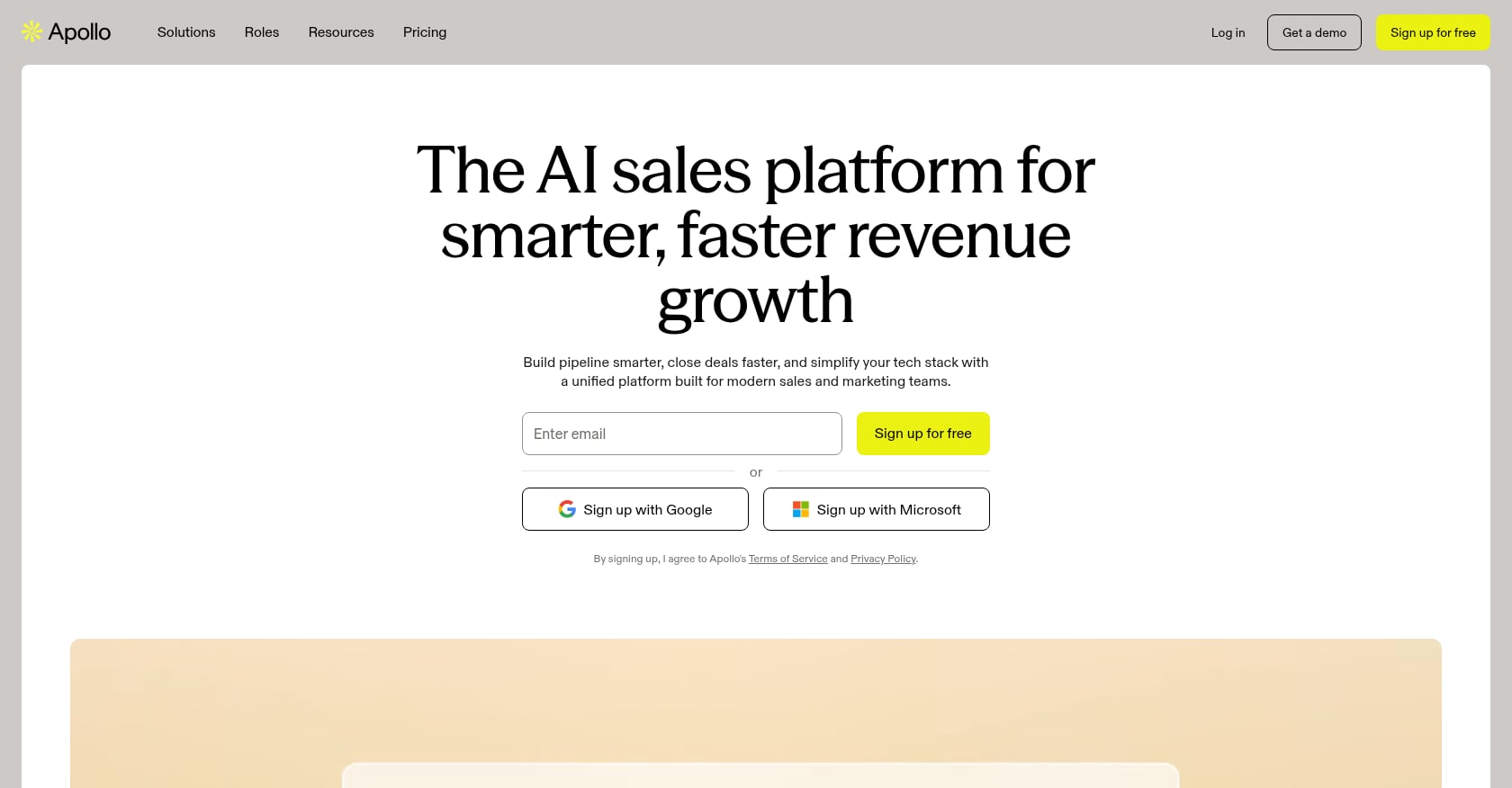
Apollo is an AI-powered outbound sales platform with a proprietary database of 280 million contacts and 73 million companies. It bundles prospecting, sequencing, a dialer, and CRM sync into one product, which makes it appealing for two-person teams that don’t want to manage five separate tools.
Pricing:
- Free tier available
- Basic: $49/user/month (annual)
- Professional: $79/user/month (annual)
- Organization: $119/user/month (annual)
Key features:
- 280M+ contact database with company-level filtering
- Built-in email sequences and multi-step workflows
- Dialer included on Professional tier and above
- AI email writing assistant
- Native CRM sync
User perspective: Apollo has broad adoption. Practitioners on Reddit and review sites note it’s solid value for small teams, and many peers carry it in their stack for sales outreach. However, real-world reports across G2, Capterra, and Reddit suggest bounce rates of 15-35% depending on geography. US-based tech and SaaS contacts tend to be most accurate.
Tradeoffs:
- The built-in sequencer works fine for low-volume prospecting, but at 500+ emails per day, you’re betting your pipeline on shared IP reputation
- The credit system can push actual costs to 2-3x the listed price
- Data accuracy outside US tech verticals is inconsistent
3. Clay
Best for: Data enrichment and hyper-personalization
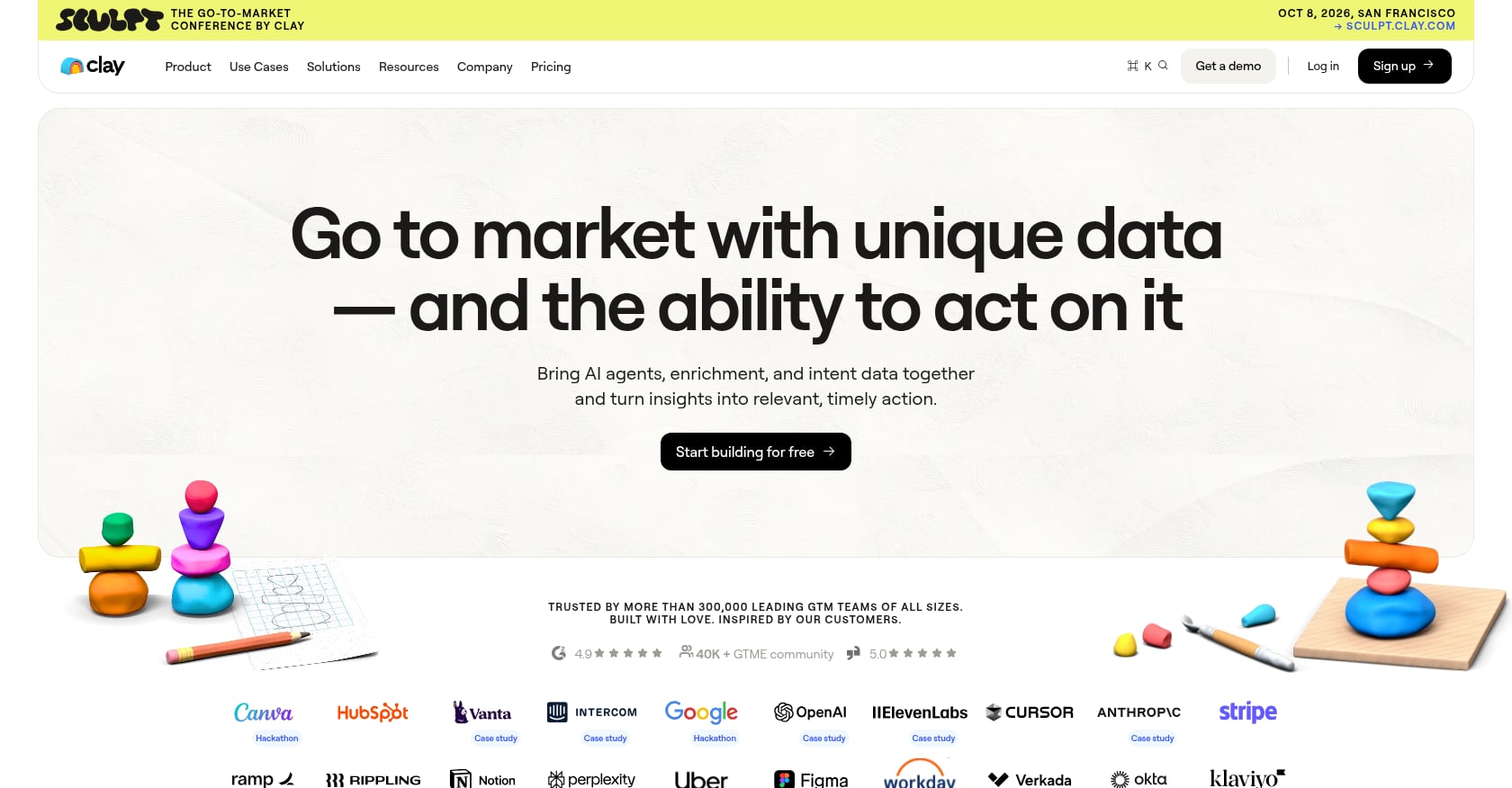
Clay aggregates data from 150+ sources, runs AI agents to research and enrich leads, and automates the flow of clean, enriched data into outreach tools. It’s an enrichment layer, not a sending platform, which means you’ll need to pair it with a tool like Smartlead or Instantly for actual outreach.
Pricing:
- Free Plan: $0/month, 100 credits
- Starter: $149/month, 2,000-3,000 credits
- Explorer: $349/month, 10,000-20,000 credits
Key features:
- Waterfall enrichment across 150+ data providers
- Claygent AI research agents for custom lead research
- Flexible table-based workflow builder
- Integrations with major outreach and CRM tools
User perspective: Clay maintains an impressive 4.9/5 rating on G2 with over 500 reviews. The community consensus is that it’s the best enrichment tool available, but it demands technical skill.
Tradeoffs:
- Moderate to steep learning curve for building enrichment tables and configuring Claygent prompts
- No sending capability whatsoever; purely a data layer
- Credits get consumed fast on complex enrichment workflows
- Best suited for RevOps teams, not solo founders
4. Smartlead
Best for: Agencies and high-volume cold email at scale
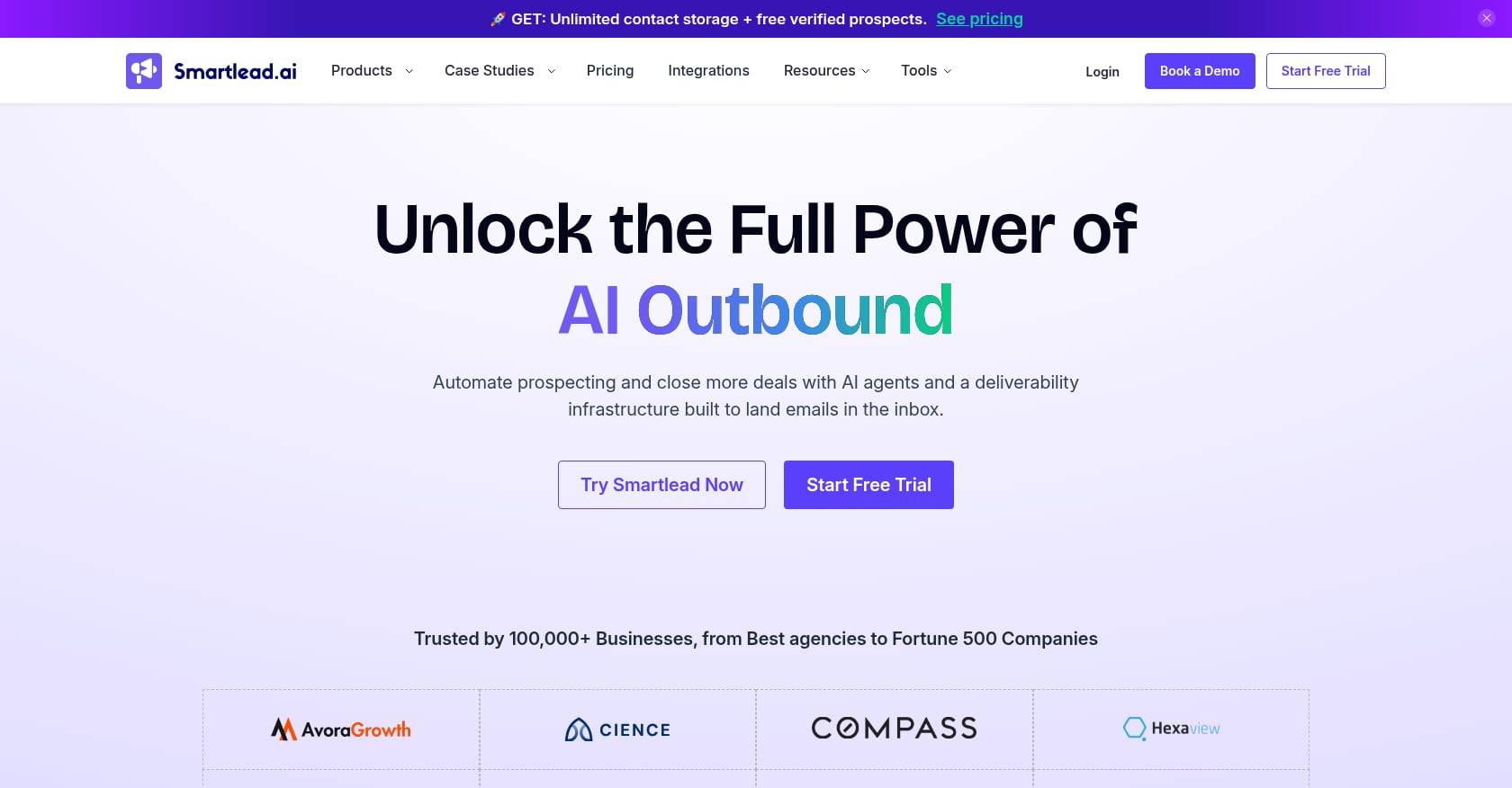
Smartlead is a cold email automation platform with a pricing model built specifically for agencies and operators running large inbox fleets. Its unlimited email accounts on all plans make it the go-to choice for high-volume sending.
Pricing:
- Base: $39/month
- Pro: $94/month
- Unlimited Smart: $174/month
- Unlimited Prime: $379/month
Key features:
- Unlimited email accounts on every plan
- White-label client portal (Pro and above)
- Automated email warmup
- Unified inbox for managing replies across accounts
User perspective: G2 rating sits at 4.5/5. Users note it’s “super easy to setup and launch cold email campaigns” and “for the price point you just can’t beat it.”
Tradeoffs:
- No contact database, no dialer, no LinkedIn automation, and no CRM. You bring your own leads
- Real total cost of ownership runs 3-5x the base price once you factor in domains, warmup infrastructure, and add-ons
- Purely a sending tool, so you need Clay or Apollo upstream and a CRM downstream
For a deeper look at building an email marketing automation stack as a startup, we’ve broken down the key decisions in a separate guide.
5. Instantly
Best for: Solo founders who want the cheapest entry point
Instantly offers flat-fee cold email with a built-in B2B lead database of 450M+ contacts. No per-seat pricing makes it the most affordable way to start testing AI outbound automation.
Pricing:
- Growth: $47/month (1,000 contacts, 5,000 emails)
- Hypergrowth: $97/month or $77.60 annually (25,000 contacts, 100,000 emails)
Key features:
- Flat-fee unlimited email accounts
- Built-in B2B lead database (450M+ contacts)
- AI-powered email warmup and deliverability tools
- Simple campaign builder
User perspective: One practitioner on a review site wrote: “I love Instantly’s deliverability tools, which are the best I’ve encountered. Having used Salesloft, Apollo, and other tools, Instantly gives me the highest reply rate by far.”
Tradeoffs:
- Email-only. No LinkedIn, no phone, no multichannel
- Database quality varies, particularly outside core US markets
- Limited analytics compared to full-stack platforms
- Better for simplicity than sophistication
6. Lemlist
Best for: Multichannel sequences combining email, LinkedIn, and calling
Lemlist positions itself as an all-in-one outbound platform with access to a 600M+ intent-driven lead database and the ability to build multichannel sequences across email, LinkedIn, WhatsApp, and calling.
Pricing:
- Email Pro: $63/user/month
- Multichannel Expert: $87/user/month
Key features:
- LinkedIn automation with AI-generated icebreakers
- Visual personalization (custom images and landing pages)
- Combined email + LinkedIn + calling sequences
- Intent-driven lead database
Tradeoffs:
- Per-seat pricing at $63+/user/month makes scaling expensive fast
- Teams of five or more start paying $315-435/month before add-ons
- LinkedIn automation features carry platform risk (LinkedIn regularly restricts third-party tools)
- Best suited for small teams of one to three SDRs
7. Outreach
Best for: Enterprise teams needing governance and analytics
Outreach is a sales engagement platform that uses AI to enhance email sequencing, task prioritization, and engagement timing. It includes native conversation intelligence and deal risk detection, making it the tool of choice for complex, multi-stakeholder enterprise sales.
Pricing:
- Custom enterprise pricing, approximately $100+/user/month based on third-party estimates
Key features:
- Conversation intelligence with AI-powered coaching
- Deal risk detection and pipeline analytics
- Governance controls for compliance-heavy industries
- Deep CRM integrations
Tradeoffs:
- Expensive and complex; requires a dedicated admin
- Overkill for startups with fewer than 20 reps
- Implementation timelines measured in weeks, not hours
- The ROI only makes sense at scale with enterprise deal sizes
8. Artisan (Ava)
Best for: Testing autonomous outbound (buyer beware)
Artisan’s Ava is presented as a full replacement for human SDRs, capable of running outbound autonomously from prospecting through booking. It’s the most visible autonomous AI SDR on the market, and also the most controversial.
Pricing:
- Not publicly disclosed. Third-party estimates suggest approximately $1,500-2,000+/month
Key features:
- Autonomous prospecting, email writing, and follow-ups
- Reply handling and meeting scheduling
- No human intervention required (in theory)
User perspective: Artisan’s G2 rating of 3.8/5 is the lowest among platforms reviewed here. Multiple reviewers report that Ava’s output at high volume tends toward generic, template-like messaging. Practitioners on Reddit have reported sending 1,400+ emails through Ava with zero responses.
Tradeoffs:
- LinkedIn restricted Artisan’s automated outreach at the start of 2026, removing a core channel from Ava’s multichannel capabilities
- Generic output quality at scale
- The fully autonomous promise rarely matches production reality
- Limited transparency on pricing
9. AiSDR
Best for: Growth teams wanting autonomous outbound with transparent pricing
AiSDR is a focused cold email and reply automation platform with strong positioning around category ownership. Its standout feature is reply automation: instead of dumping responses into a generic inbox, the AI agent stays in conversation, handling objections and scheduling.
Pricing:
- Explore: $900/month billed quarterly (1,200 lead search credits, 1,200 AI messages per month)
- Grow: $2,500/month (4,500 credits each)
Key features:
- AI-powered reply handling that manages objections and books meetings
- Multichannel outbound (email + LinkedIn)
- No annual lock-in, quarterly billing
- Transparent pricing with clear credit allocations
Tradeoffs:
- Quality of AI-handled replies varies by vertical. In technical or enterprise conversations, the agent’s responses can read as evasive
- $900/month minimum is steep for pre-revenue startups
- The fully loaded cost with data and infrastructure pushes closer to the $35K-65K/year range that industry analysts cite for autonomous AI SDR agents
10. Salesforce Agentforce
Best for: Teams already deep in the Salesforce ecosystem
Salesforce’s Agentforce suite turns Sales Cloud into a full AI outbound sales platform that can forecast, coach, and sell. It lives natively inside your CRM and can see a customer’s entire history, from support tickets to previous purchases to marketing clicks.
Pricing:
- Enterprise custom pricing (Salesforce $25+/user/month base, Agentforce add-on varies)
Key features:
- Native CRM integration with full customer lifecycle data
- AI-powered outreach that references purchase history and support interactions
- Forecasting and coaching tools
- Enterprise-grade security and compliance
Tradeoffs:
- Heavy criticism for setup complexity that typically requires dedicated administrators or external consultants
- Not viable for startups without existing Salesforce infrastructure
- Cost is opaque and typically high
- Best value only materializes for teams already paying for the Salesforce ecosystem
How to Choose: A Decision Framework
The right AI outbound automation approach depends on four factors: your team size, budget, technical capacity, and how complex your sales motion is.
Choose a done-for-you service (like AgentWeb) when:
- You’re a founder or lean team that needs pipeline this quarter
- You don’t have a RevOps person or experienced SDR on staff
- You’d rather pay for outcomes than spend 15-30 hours per week managing tools
- You want multichannel execution (not just email) without assembling a five-tool stack
Choose a DIY platform when:
- You have someone technical who can dedicate time to building and optimizing workflows
- Your budget supports the real total cost (not just the listed price)
- You’re willing to iterate for 2-3 months before seeing consistent results
- You’ve already validated which digital channels work for your audience
Choose an autonomous AI SDR when:
- You have low brand sensitivity (early-stage testing, not enterprise selling)
- You’re comfortable with 1-3% reply rates and high volume as your strategy
- You have budget to absorb the real cost ($35K-65K/year fully loaded)
- You want to experiment with the technology knowing the risks
The Hidden Cost of DIY AI Outbound
Most founders underestimate what production-grade outbound actually costs. Here’s a realistic breakdown:
Tool stack costs (monthly):
- Data layer (Apollo or Clay): $150-350/month
- Sending platform (Smartlead or Instantly): $50-175/month
- Warmup and domain infrastructure: $50-100/month
- CRM: $50-120/month
- Supplementary tools (verification, enrichment top-ups): $50-200/month
- Realistic total: $350-945/month minimum
That $39/month Smartlead headline? In production, practitioners consistently report that the real total cost of ownership runs 3-5x the advertised price.
Time costs:
Managing an outbound stack, writing sequences, cleaning lists, monitoring deliverability, and iterating on messaging takes 15-30 hours per week. For a founder, that’s time not spent on product, fundraising, or customers.
The expertise gap:
Copywriting, list building, domain health management, and sequence optimization are skills that take months to develop. Tools don’t teach them. In case studies across the industry, lead qualification time dropped from 48 hours to under 2 minutes and meeting-set rates increased by 30%, but only with experienced operators running the systems.
This is exactly why the concept of shipping more marketing without hiring has gained traction. A service model bundles the expertise and execution layer alongside the AI, so founders don’t have to become outbound experts to get outbound results.
The Verdict: Human-in-the-Loop Wins
The data is unambiguous. The highest-performing AI outbound automation approach in 2026 pairs AI speed with human judgment. AI handles research, signal monitoring, and draft generation. Humans provide quality control, authentic engagement, and strategic direction.
Paying $100,000+ per year per human SDR to execute a workflow that AI can run for $900 to $5,000 per month is difficult to justify, with one important exception: complex, high-ACV enterprise deals where authenticity and nuance close deals. For everything else, the hybrid model where one SDR does the work of three to four is the clear winner.
The autonomous AI SDR dream isn’t dead, but it’s years away from replacing skilled humans. In the meantime, the companies producing real pipeline are the ones that treat AI as a force multiplier, not a replacement.
If you’re a founder evaluating your options, start with a free AI marketing evaluation to see how your current outbound stacks up, or explore AgentWeb’s case studies to see what human-in-the-loop AI execution looks like in practice.
Frequently Asked Questions
What is AI outbound automation?
AI outbound automation uses artificial intelligence to handle parts or all of the outbound sales process, including prospect research, lead enrichment, email personalization, sequence management, follow-ups, and reply handling. Tools range from simple AI writing assistants to fully autonomous AI SDR agents that attempt to run outbound without human involvement.
Do autonomous AI SDRs actually work?
At scale, results are mixed. Fully autonomous AI SDRs produce 1-3% reply rates in production, while signal-based campaigns with human review achieve 14-25%. Only about 2% of companies that implement autonomous AI SDRs see results that stick, and 50-70% of these tools churn within the first year. The technology is improving, but in 2026, human-in-the-loop approaches consistently outperform.
How much does an AI outbound stack really cost?
Headline prices are misleading. A production-grade DIY stack (data + enrichment + sending + warmup + CRM) costs $350-945/month in tools alone, before accounting for the 15-30 hours per week of operator time. Fully autonomous AI SDR agents, when you factor in data, infrastructure, and oversight, land closer to $35K-65K per year per agent, far above the $500/month most vendors advertise.
What’s the difference between a DIY tool and a done-for-you service?
DIY tools give you the software to run outbound yourself. You handle strategy, list building, copywriting, deliverability, and optimization. A done-for-you service like AgentWeb bundles the AI tools with experienced operators who execute campaigns on your behalf, managing the entire workflow from research through sending and iteration.
Can I use AI outbound automation for LinkedIn, not just email?
Some tools offer multichannel capabilities. Lemlist covers email, LinkedIn, and calling. AiSDR includes LinkedIn outreach. However, LinkedIn has been increasingly restricting third-party automation tools. Artisan’s Ava lost LinkedIn access in early 2026. For reliable multichannel campaigns without a dedicated team, a service model that adapts to platform changes is more resilient than any single tool.
What reply rate should I expect from AI outbound?
Expect 1-3% from fully autonomous, volume-based approaches. Signal-based campaigns with human review and strong personalization (using tools like Clay for enrichment) can hit 14-25%. The variable isn’t the tool. It’s the quality of targeting, messaging, and follow-up.
Is AI outbound automation worth it for a solo founder?
Yes, but the approach matters. Solo founders rarely have time to manage a multi-tool stack. The cheapest entry point is Instantly ($47/month for email-only outbound), but results depend entirely on your ability to write good copy, build accurate lists, and maintain deliverability. If those skills aren’t in your wheelhouse, a service model that handles execution will produce faster, more consistent results.
How do I know if I should build my own outbound stack or hire a service?
If you have a RevOps person or experienced SDR, the time to iterate for 2-3 months, and the technical skills to manage deliverability and enrichment, build your own stack. If you’re a founder who needs pipeline this quarter and doesn’t have those resources, a done-for-you service is the faster path. The deciding factor isn’t budget. It’s whether you have the expertise to operate the tools well.
Get a free Stack Review.
30 min with Harsha and Matt.
We audit your last 30 days, pinpoint the highest-impact fixes, and hand you the exact playbook we'd run. No deck. No pitch unless there's a fit.