AI Marketing Automation for Startups: 10 Picks for 2026


TL;DR
AI marketing automation for startups has moved past hype into a baseline requirement, with 96% of marketers now using it and reporting an average 5x return. This guide covers 10 solutions ranging from free workflow connectors to full go-to-market execution services, with real prices, honest tradeoffs, and a framework for choosing between DIY tools and done-for-you systems. If you’re a founder stretched across every channel, start with the comparison table below to find your match.
What is the best AI marketing automation for startups?
The best AI marketing automation for startups depends entirely on your primary growth model and resources:
For full go-to-market execution without hiring internal operators: AgentWeb (Emma) is the top choice.
For an all-in-one CRM foundation and inbound growth hub: HubSpot Marketing Hub is the industry standard.
For behavior-triggered, event-based SaaS messaging: Customer.io is the strongest option.
For multi-source data enrichment and outbound pipeline building: Clay is the clear category leader.
What Is AI Marketing Automation (and Why Startups Can’t Ignore It)
Traditional marketing automation was rule-based. If someone opens an email, send another email three days later. Useful, but rigid. AI marketing automation is different. It learns from data, generates content, optimizes ad spend in real time, scores leads based on behavior patterns, and adapts campaigns without waiting for a human to update a spreadsheet.
For startups, this distinction matters because you don’t have the team to build and maintain complex rule trees. A full marketing function covering social, SEO, email, paid ads, and analytics requires four to six people minimum. Most Series A companies can staff one or two. The average marketing manager salary in the US hit $78,000 in 2025, and that’s one person covering maybe two channels well.
The numbers tell a clear story. In 2026, 96% of marketers use automation and report an average 5x return. Businesses that implement marketing automation see a 14.5% increase in sales productivity and a 12.2% reduction in marketing overhead. Companies using AI in marketing report a 42% reduction in customer acquisition cost compared to traditional methods.
Key AI & Automation Performance Metrics
Metric Impact Area | Data Baseline | Source Authority |
Sales Productivity Increase | +14.5% | Nucleus Research |
Marketing Overhead Reduction | -12.2% | Nucleus Research |
Content Creation Efficiency | 75% of marketers use generative AI for copy | HubSpot State of Marketing Report |
Martech Stack Underutilization | Marketers utilize only 49% of their stack capacity | Gartner Marketing Survey |
Here’s the founder paradox: early-stage marketers become generalists stretched across every channel, executing everything at 60% capacity. Full marketing automation can reclaim roughly 27 hours per week, the equivalent of a full-time marketing manager without the salary. That’s not a nice-to-have. That’s the difference between shipping campaigns and stalling out.
If you’re still building your AI marketing strategy, the tools below will give you concrete options.
How We Evaluated These Tools
Every tool on this list was assessed against six criteria specific to startup needs:
Startup-friendliness: Can a one or two person team actually use this without a dedicated ops hire?
Pricing transparency: Real starting prices, not “contact sales” walls wherever possible.
AI depth: Does it use AI meaningfully, or just slap a chatbot on a legacy platform?
Multi-channel capability: Can it handle more than one channel, or does it require stacking three other tools?
Time-to-value: How fast can you go from signup to a running campaign?
Real user feedback: What are practitioners on Reddit and G2 actually saying?
One important note: this list includes both DIY software platforms and AI-led execution services. Most listicles only cover software. But many startup founders don’t want to operate tools. They want marketing done. That distinction shapes everything.
At-a-Glance Comparison Table
Tool | Best For | Starting Price | G2 Rating | Key Differentiator |
|---|---|---|---|---|
AgentWeb (Emma) | Full GTM execution without hiring | $199/mo (self-serve); custom (done-for-you) | Early stage | AI agent + human operators; 90-day GTM sprints |
HubSpot Marketing Hub | All-in-one CRM + marketing | Free CRM; $890/mo (Pro) | 4.4/5 | Broadest feature set; steep price jump |
ActiveCampaign | Deep email automation | $19/mo (1K contacts) | 4.5/5 | Best automation builder; 94% deliverability |
Jasper | AI content at scale | $49/mo (Creator) | ~4.5/5 | Brand voice consistency; 100+ AI agents |
Brevo | Budget multi-channel | Free (300 emails/day); $9/mo+ | ~4.5/5 | Unlimited contacts; email + SMS + WhatsApp |
Gumloop | Custom AI workflow building | Free tier available | New/Emerging | No-code AI workflows; built-in LLM access |
Clay | Lead enrichment and outbound | ~$149/mo+ (credit-based) | ~4.5/5 | 150+ data sources; waterfall enrichment |
Zapier | Connecting existing tools | Free; $29.99/mo (Pro) | 4.5/5 | 6,000+ app integrations |
Averi | SEO + GEO content engine | $99/mo (Solo) | New/Emerging | Dual SEO/GEO scoring; strategy to publish |
Customer.io | Behavior-triggered SaaS messaging | $100/mo (5K profiles) | 4.4/5 | API-first; event-based automation |
The 10 Best AI Marketing Automation Solutions for Startups
1. AgentWeb (Emma)
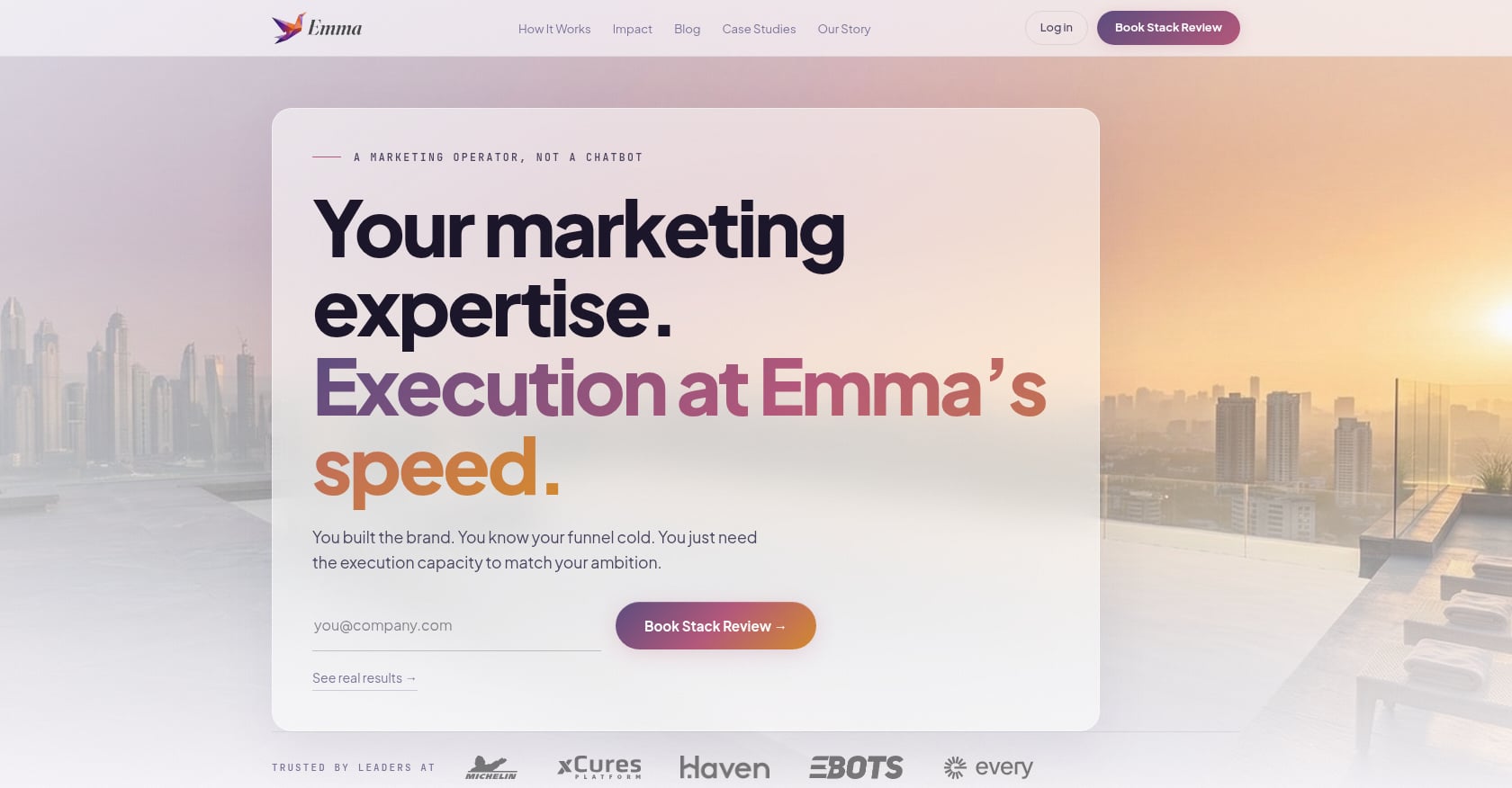
Best for: Full go-to-market execution without hiring a marketing team
AgentWeb is an AI + human go-to-market execution service and platform. It runs marketing for startups and lean teams using its agentic AI marketer “Emma” plus a senior operator team. This isn’t another dashboard you have to learn. It’s a system that ships campaigns.
Pricing:
Self-serve (DIY Engine): $199/mo after a 7-day free trial
Custom Workflows (AI-Led Co-Pilot): contact sales
Done-for-you (Human-Led Growth Ops): contact sales, 3-month sprint engagements
Key features:
90-day GTM diagnostic and plan, so you leave Week 0 with a clear growth roadmap mapped to your ICP and channels
Multi-channel execution across Meta, Google, LinkedIn/X, email, and outbound
Slack/Teams approval workflows for one-click creative sign-off
AgentWeb Portal with calendar, dashboards, and optimization loops
Founder-brand support including LinkedIn ghostwriting and exec comms
Up to ~20 content assets per month across social, blog, short-form video, and ads
Weekly performance reviews and budget shifts to what’s working
Proof of results: In a head-to-head test against another agency, AgentWeb generated 4,000+ leads and 328 Add-to-Carts in 3 months for consumer beauty startup Nailed It, with a 2.91% CTR at roughly $0.24 CPC. For digital health startup Cora, it achieved a 13.19% CTR peak on just a $300/month ad budget.
Tradeoffs:
Fewer public reviews than mature platforms (it’s an early-stage company)
Done-for-you pricing is seasonal and custom, not published
Best experience assumes your team uses Slack or Teams and engages weekly on approvals
What makes it different: AgentWeb is the only option on this list that combines agentic AI execution with senior human operators and a transition path to self-serve. The system built during a 3-month engagement keeps running after it ends. For founders who’ve tried cobbling together five tools and still can’t ship consistently, that’s the value.
Get a free GTM discovery report to see if this model fits your startup.
2. HubSpot Marketing Hub
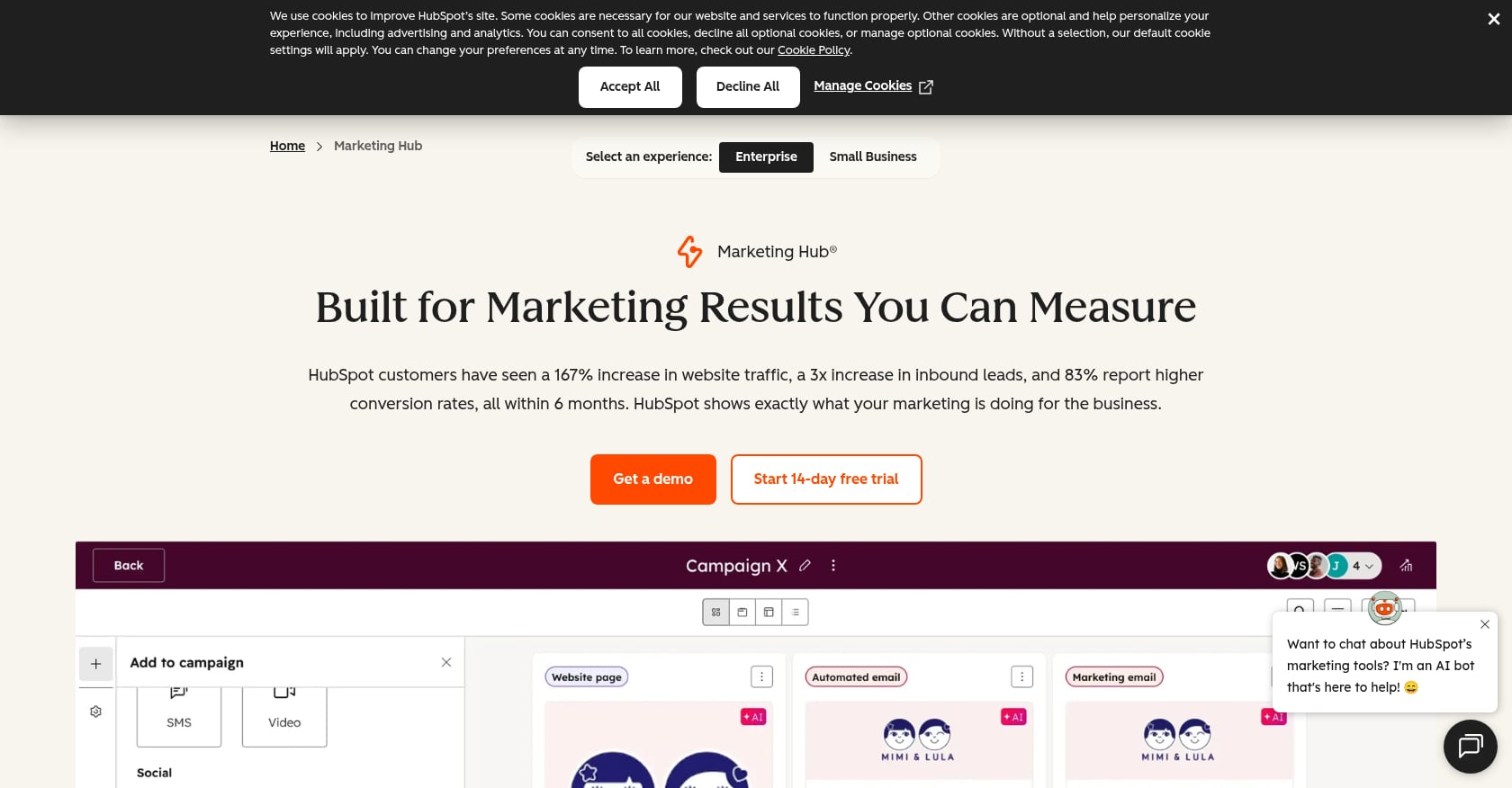
Best for: Teams of 10+ who want unified CRM and marketing on one platform
HubSpot is the category default for a reason. The free CRM is genuinely useful, and the ecosystem is massive. AI features now include a content assistant, predictive lead scoring, and automated campaign creation.
Pricing:
Free CRM and basic marketing tools
Starter: $20/mo
Professional: $890/mo (where real automation lives)
Enterprise: $3,600/mo
Mandatory onboarding fees: $3,000 to $7,000
Key features:
All-in-one platform covering marketing, sales, service, and CMS
AI content assistant for blog posts, emails, and social copy
Visual workflow builder with branching logic
Predictive lead scoring
Attribution reporting across channels
Tradeoffs:
Core multi-channel automation requires a steep price jump to the Professional tier ($890+/month)
Contact tier overages can accumulate rapidly if your list grows faster than your revenue
The system’s vast feature set can easily overwhelm small, early-stage teams without a dedicated admin
User perspective: A growth marketer in the r/martech community summarized the platform's current reality: "HubSpot’s onboarding fees and the quick leap to the Professional tier are tough adjustments for bootstrap budgets, but their updated core-seat pricing structure makes scaling your internal team members significantly more predictable without getting hit by sudden seat penalties."
3. ActiveCampaign

Best for: Deep email automation with the best visual workflow builder on the market
For email marketing automation specifically, ActiveCampaign has no close second. With over 14,500 G2 reviews at 4.5/5 stars and 94% deliverability, it’s the tool serious email marketers graduate to.
Pricing:
Starter: $19/mo (1,000 contacts)
Plus: $59/mo (1,000 contacts), where useful automation begins
Realistically: $95/mo+ for workflows that actually do something
Key features:
Most powerful visual automation builder available
Conditional branching with predictive content and send-time optimization
Built-in CRM with pipeline management
94% deliverability rate
Site tracking and event-based triggers
Tradeoffs:
No free plan, only a 14-day trial
Starter plan limits you to 5 actions per automation, which is a dealbreaker for real sequences (a basic welcome series needs 8 to 15 steps)
Pricing scales with contacts and can get expensive as your list grows
Learning curve is real, with 419 mentions of it in G2 reviews
If your primary channel is email and you have the patience to learn the builder, ActiveCampaign is the right pick. For startups that need help across multiple channels simultaneously, it’s only one piece of the puzzle.
4. Jasper

Best for: AI content creation at scale with brand voice consistency
Jasper has evolved from an AI writing tool into a full content platform. It learns your company’s tone, messaging preferences, and style, then generates blog posts, email campaigns, social content, ad copy, and landing page text from brief prompts.
Pricing:
Creator: $49/mo (one user, 50,000 words)
Teams: $125/mo (three users, unlimited words)
Enterprise: custom, typically starting at $500/mo
Key features:
Brand voice learning across all content types
100+ specialized AI agents for different marketing tasks
Campaign workflow generation from a single brief
Template library for ads, emails, blogs, and social posts
Team collaboration and approval workflows
Tradeoffs:
No SEO optimization built in; you’ll need a separate tool for keyword research and optimization
Not a distribution platform, so it generates content but doesn’t publish or automate delivery
The Creator plan’s 50,000-word limit can feel tight for content-heavy teams
Works best for teams with established processes who need to scale production, not for teams still figuring out what to say
5. Brevo
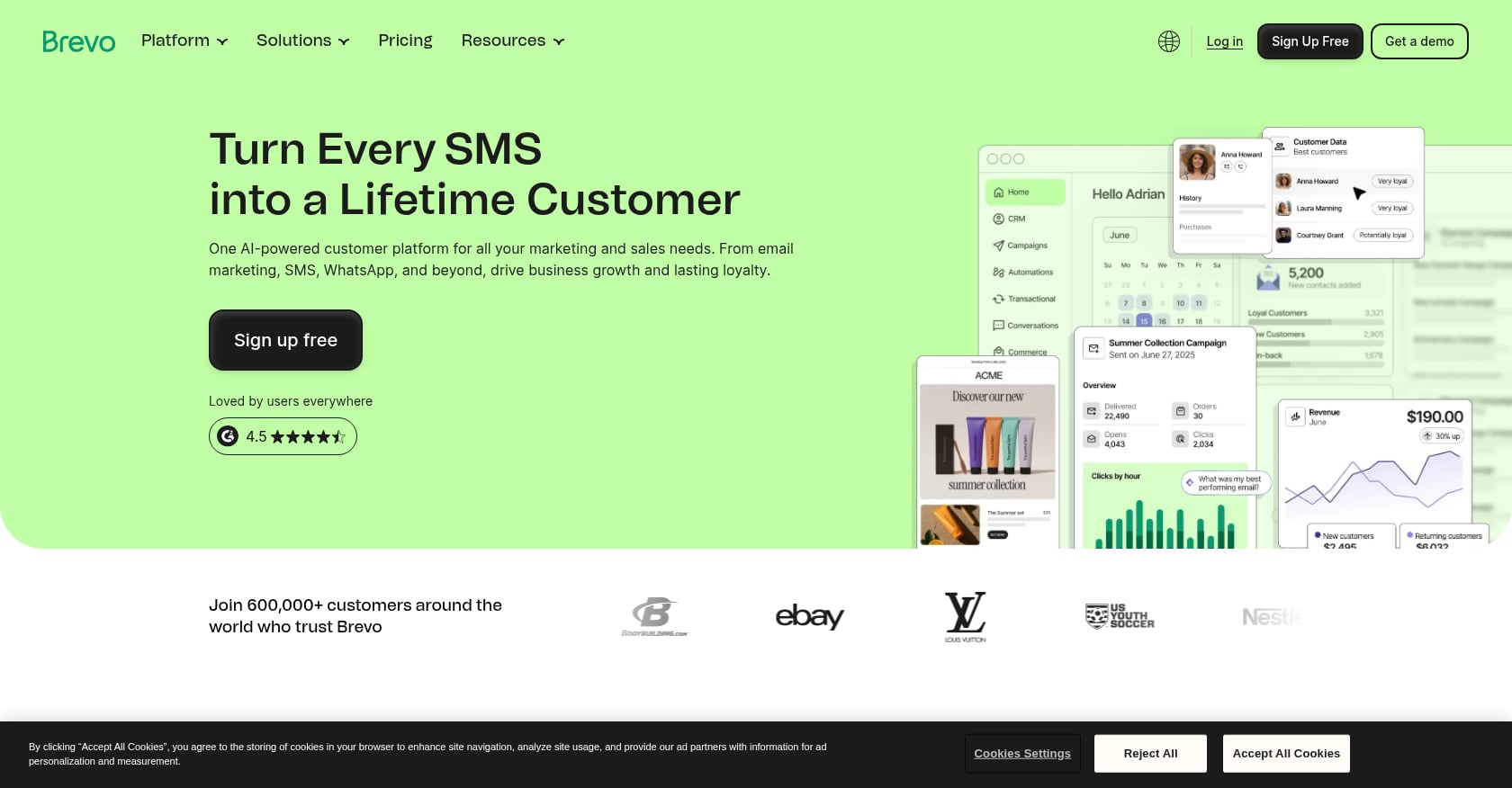
Best for: Budget-conscious startups wanting email, SMS, and WhatsApp in one platform
Brevo (formerly Sendinblue) does something rare: it offers unlimited contacts on all plans. Most competitors charge based on list size, which punishes startups as they grow. Brevo charges based on email volume instead.
Pricing:
Free: 300 emails/day, unlimited contacts
Starter: $9/mo
Business: $18/mo
Enterprise: custom
Key features:
Email, SMS, and WhatsApp marketing from one dashboard
Marketing automation workflows with visual builder
Built-in CRM (basic but functional)
Transactional email capability
AI-powered send-time optimization
Tradeoffs:
CRM is lightweight compared to HubSpot or even ActiveCampaign
Automation logic isn’t as deep or flexible as ActiveCampaign’s builder
Reporting could be more granular
Free tier includes Brevo branding on emails
For startups that need affordable multi-channel messaging and don’t want to worry about contact-based pricing, Brevo is the clear winner.
6. Gumloop
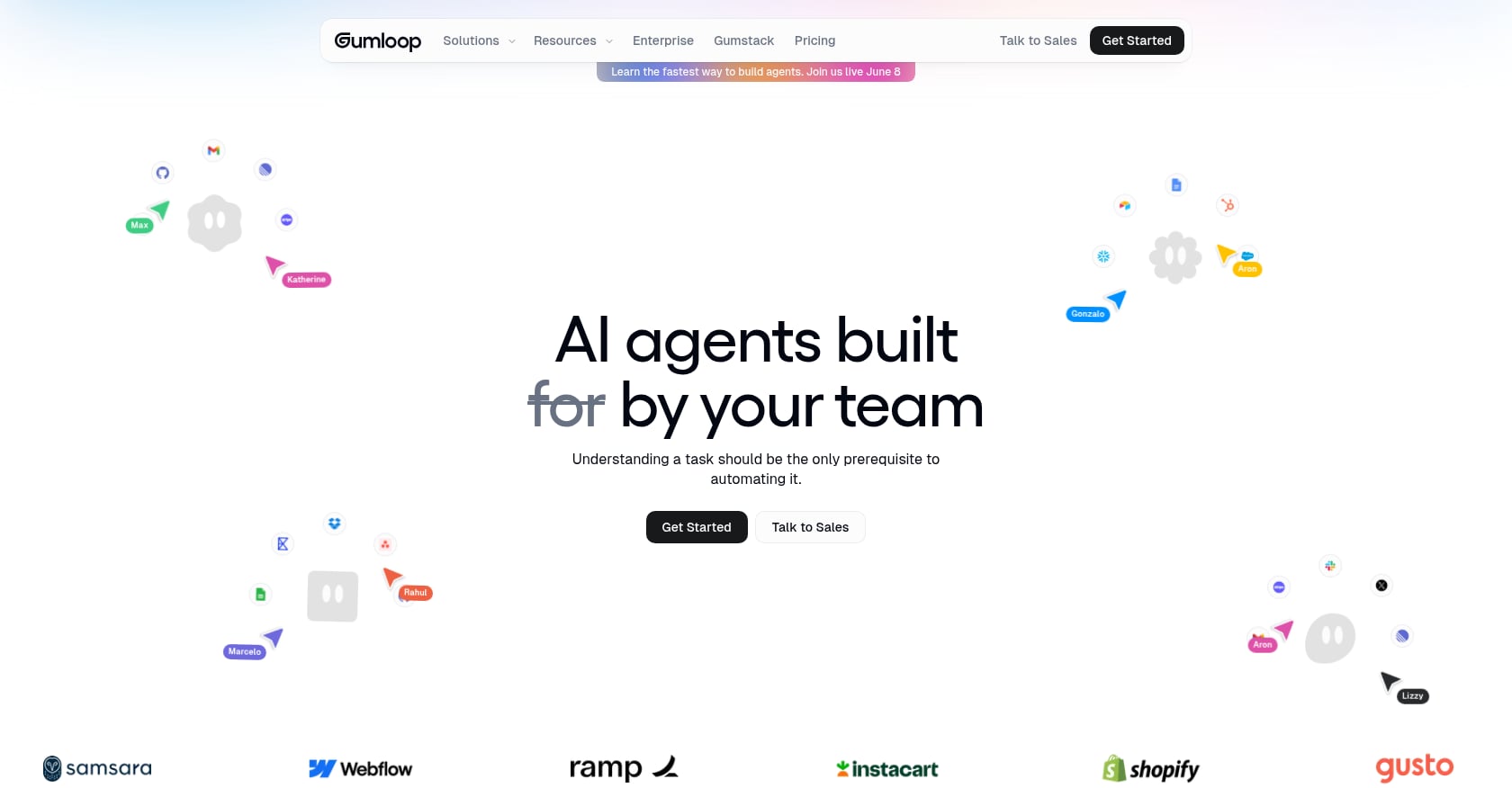
Best for: Technical founders building custom AI-native marketing workflows
Think of Gumloop as what happens when Zapier and ChatGPT have a baby. It’s a no-code platform for building AI-powered workflows, and it gives you access to premium LLMs (ChatGPT, Claude, Grok) right out of the box without needing your own API keys.
Pricing:
Free tier available
Paid tiers scale with usage
Key features:
No-code AI workflow builder with drag-and-drop interface
Built-in access to multiple LLM models
Connect AI directly to internal tools and data sources
Used by teams at Webflow, Instacart, and Shopify
Tradeoffs:
Building effective agents requires a solid understanding of your processes, not a simple point-and-click experience
The concept of AI agents is still new, so expect a learning curve
Documentation and community are still growing
Best suited for ops-minded builders, not marketing generalists
7. Clay
Best for: Lead enrichment and outbound data personalization at scale
Clay isn’t a marketing automation platform. It’s the pre-pipeline intelligence layer that makes your outbound campaigns actually work. It pulls from 150+ data sources using waterfall enrichment to build rich lead profiles.
Pricing:
Starts at ~$149/mo (credit-based)
Credits consumed per enrichment query
Costs can escalate quickly with high-volume usage
Key features:
150+ data source integrations
Waterfall enrichment (queries multiple sources until it finds data)
AI-powered message personalization at scale
Integrates with CRMs and outreach tools
Tradeoffs:
Not standalone, and must pair with email or outreach tools for execution
Credit-based pricing creates unpredictable costs
Users on G2 consistently note a steep learning curve for initial setup
Rapid credit consumption is a common complaint
For startups focused on outbound automation, Clay is a powerful enrichment layer. Just budget carefully and pair it with a delivery tool.
8. Zapier

Best for: Connecting your existing tools into automated workflows
Zapier is glue, not a marketing platform. It connects 6,000+ apps so that actions in one tool trigger actions in another. Form submission goes to CRM, CRM update triggers email sequence, email open logs to spreadsheet.
Pricing:
Free: 5 Zaps, 100 tasks/month
Starter: $19.99/mo
Professional: $49.99/mo
Team: $69.99/mo
Key features:
6,000+ app integrations
AI Flow Designer for building automations from natural language prompts
Multi-step Zaps with filters and conditional logic
Tables feature for lightweight data management
Tradeoffs:
Not a marketing platform itself; it connects other platforms
Complex data transformations are better handled by tools like Make
Task-based pricing means high-volume automations get expensive
No native content generation, analytics, or campaign management
Every startup marketing stack eventually uses Zapier somewhere. It fills the gaps between tools that don’t natively integrate.
9. Averi
Best for: SEO and GEO content strategy through publishing in one workflow
Averi focuses specifically on search-optimized content creation. It handles strategy, writing, and publishing in a single workflow, with dual scoring for both traditional SEO and generative engine optimization (GEO).
Pricing:
Solo: $99/mo
Growth and Enterprise tiers available
Key features:
AI-generated content briefs based on keyword and competitive analysis
Dual SEO/GEO scoring
Strategy-to-publish workflow
Startup-specific positioning with transparent pricing
Tradeoffs:
No multi-channel marketing (no email, ads, or social automation)
Focused entirely on content and search; you’ll need other tools for distribution
Relatively new platform with fewer public reviews
10. Customer.io
Best for: Product-led SaaS startups needing behavior-triggered messaging
Customer.io is built for teams where the product is the primary acquisition and activation channel. It triggers messages based on what users actually do in your app, not just what list they’re on.
Pricing:
Essentials: $100/mo (up to 5,000 profiles)
Premium: $1,000/mo
Enterprise: custom
Key features:
API-first architecture for deep product integration
Event-based automation triggers
Multi-channel messaging (email, push, SMS, in-app)
Visual workflow builder with real-time data
Webhooks and Liquid templating for technical teams
Tradeoffs:
Requires developer resources for proper setup
$100/mo starting price is high for pre-revenue startups
Not designed for top-of-funnel marketing or content distribution
Overkill if you don’t have a product with active users yet
DIY Tools vs. AI-Led Services: Which Path Fits Your Startup?
This is the decision most listicles skip, and it’s the one that matters most.
Practitioners on Reddit consistently report that one of the most common regrets in marketing automation is paying for sophisticated capabilities that sit unused. One thread in r/MarketingAutomation captured it well: start simpler than you think you need, then upgrade when you actually hit limitations. It’s easier to migrate up than to feel like you’re wasting money on an overpowered tool.
The real cost of AI marketing software isn’t the subscription. It’s the subscription plus onboarding plus the stack around it plus operator hours. The sticker price is usually the smallest of the four. Initial setup typically adds $2,000 to $10,000 one-time, with ongoing costs adding 15% to 25% annually.
Consider the Gartner finding that marketers actively use only 49% of their martech stack’s capabilities, while martech still consumes roughly 22% of the marketing budget. Meanwhile, 61% of marketers experienced buyer’s remorse on tech purchases in the last 18 months.
Here’s the decision framework:
Choose DIY tools if:
You have a marketer on staff who can operate them daily
Your budget is under $200/mo for marketing software
You enjoy building systems and have time to learn platforms
You’re validating one channel, not running multi-channel campaigns
Choose an AI-led service if:
The founder is doing marketing solo alongside product and fundraising
You need campaigns shipped weekly, not “someday when I figure out the tool”
You’ve tried the DIY path and ended up with five subscriptions and no consistent output
You want a system that compounds, not a one-off campaign
For a deeper comparison, read about AI vs. marketing agency costs and what each model actually delivers.
AI Data Privacy & Security: What Startups Must Verify
Deploying AI marketing automation means feeding customer records, proprietary data, and behavioral inputs into machine learning models. Before connecting any tool to your tech stack, your team must audit the platform's data governance policies to protect your brand and customer trust:
Zero Zero-Shot Training: Verify that the vendor does not use your custom prompts, proprietary data, or customer lists to train their public LLM models. This is an essential check for high-volume platforms like Jasper, Gumloop, and Clay.
SOC 2 Type II Compliance: If your startup targets enterprise B2B clients, ensure your automated marketing tools won't break upstream security compliance policies during data syncs.
GDPR & CCPA Handshakes: Ensure behavior-tracking platforms seamlessly execute "Right to be Forgotten" mandates across all connected automated endpoints automatically, preventing compliance failures in your pipeline.
The Startup Marketing Automation Ladder
Not every startup needs the same level of automation. Think of it as a ladder:
Level 1: Point tools ($0 to $50/mo). ChatGPT for copy, Canva for design. Manual and fragmented, but free. Good for validating messaging before spending.
Level 2: Workflow connectors ($30 to $200/mo). Zapier, Gumloop. Your tools talk to each other, but you’re still building and maintaining everything yourself.
Level 3: Channel platforms ($50 to $500/mo). ActiveCampaign, Brevo, Customer.io. Automated within a single channel, but you need separate platforms for each channel.
Level 4: AI content engines ($50 to $500/mo). Jasper, Averi. Production at scale, but distribution and strategy are still on you.
Level 5: Full GTM execution ($199/mo to custom). AgentWeb. The system plus operators, with compounding results and a transition path from done-for-you to self-serve.
Most founders start at Level 1, realize they need Level 3, buy Level 3 tools, and then discover they don’t have time to operate them. The smarter path is to build an agentic go-to-market engine from the start, even if it means spending more upfront to save months of scattered effort.
Common Mistakes Startups Make With AI Marketing Automation
Over-buying features. AI marketing spend hit $57.99 billion globally in 2026, but that doesn’t mean your startup needs enterprise tools. A practitioner on a popular marketing forum put it simply: map one tool to one job. Do not buy overlapping products because a sales page looked polished.
Skipping the strategy step. Automating bad marketing is still bad marketing. If you don’t know your ICP, your messaging, or which channels matter, no tool will save you. Before spending budget, validate your digital channels with small tests.
Not measuring baselines. If you don’t know your current CAC, email open rates, or conversion rates, you can’t measure whether AI automation is working. Set baselines before deploying anything.
Treating it as set-and-forget. AI marketing automation reduces manual work. It doesn’t eliminate the need for judgment. The startups that see a Duke University-cited 6.2% rise in sales and 7% rise in customer satisfaction from AI tools are the ones running weekly reviews and iterating, not the ones who set up a workflow in January and never looked at it again.
Building a stack instead of a system. As one practitioner wrote: “The real goal is about automating intelligence. Most companies chase flashy AI features without a strategy, ending up with expensive tools that don’t move the needle on revenue. They’re buying AI, not deploying an intelligent system.” The difference between a stack (disconnected tools) and a system (a repeatable GTM engine) is what separates startups that scale from those that stall.
How to Build Your AI Marketing Automation Stack
If you’re going the DIY route, here’s the sequence that works:
Step 1: Identify your bottleneck. Is it traffic, conversion, or retention? This determines which tools matter first. Most pre-seed startups have a traffic problem. Most post-seed startups have a conversion problem.
Step 2: Lay the CRM foundation. Pick one source of truth. HubSpot free, or even a simple spreadsheet connected via Zapier. Every lead, every interaction, one place.
Step 3: Add your content engine. Jasper or a similar AI writing tool for production. Pair it with a content scaling process so output stays consistent.
Step 4: Automate channel distribution. ActiveCampaign or Brevo for email. Connect to your CRM and content tools through Zapier or Gumloop. Set up basic sequences: welcome, nurture, re-engagement.
Step 5: Close the loop. Analytics and optimization. Weekly reviews of what’s working. Budget shifts to winning channels. Kill what isn’t performing. This is where most DIY setups break down because nobody has time for the review cycle.
FAQ
How much does AI marketing automation cost for startups?
For self-serve tools, expect $99 to $500 per month depending on the platform and your contact volume. Add $2,000 to $10,000 for initial setup and integrations. Done-for-you services like AgentWeb start at $199/mo for self-serve, with custom pricing for full execution engagements. The hidden cost is operator hours, which is the time someone on your team spends managing the tools.
Can AI marketing automation replace a marketing hire?
It can replace the output of a marketing hire, not the judgment. Full marketing automation reclaims roughly 27 hours per week, equivalent to a full-time marketing manager. But someone still needs to approve messaging, review performance, and make strategic decisions. The best setups combine AI execution with human oversight, whether that’s a founder spending 5 hours a week or a service that provides the human layer.
What’s the difference between marketing automation and AI marketing agents?
Traditional marketing automation executes pre-set rules: if X happens, do Y. AI marketing agents (like Emma from AgentWeb) make decisions, generate content, optimize spend, and adapt campaigns based on performance data. The agent approach reduces the need to manually build and update every workflow.
How long does it take to see results from AI marketing automation?
For email automation, you can see open rate and click improvements within 2 to 4 weeks. For content and SEO, expect 60 to 90 days before organic traffic starts compounding. For paid campaigns with AI optimization, initial learning periods run 1 to 2 weeks, with meaningful CAC improvements by week 4 to 6. AgentWeb’s 90-day sprint model is built around this timeline.
Should I start with one tool or build a full stack?
Start with one tool that addresses your biggest bottleneck. Reddit discussions consistently show that founders who buy a full stack upfront end up using less than half of it. Add tools only when you hit a specific limitation, not when a sales demo looks impressive.
Is AI marketing automation worth it for pre-revenue startups?
Yes, but choose the right tier. Free tools (HubSpot CRM, Brevo’s free tier, Zapier’s free plan) can handle early-stage needs. Once you have a product and initial users, stepping up to a paid platform or execution service pays for itself through faster iteration and lower customer acquisition costs. Companies using AI in marketing report a 42% reduction in CAC compared to traditional methods.
What’s the biggest risk of AI marketing automation?
Buying tools without a strategy. With 74% of companies still struggling to achieve real value from their AI investments, the risk isn’t the technology. It’s deploying it without clear goals, baselines, and a weekly review process.
Ready to stop assembling tools and start shipping campaigns? Book a free GTM audit to see what a 90-day execution sprint looks like for your startup.
Or get a free AI Readiness Roadmap to see where your GTM has gaps.
Ex-Meta, Google, LinkedIn. 10+ years in ML & data science for GTM. Expert in customer acquisition and growth activation.
Get a free Stack Review.
30 min with Harsha and Matt.
We audit your last 30 days, pinpoint the highest-impact fixes, and hand you the exact playbook we'd run. No deck. No pitch unless there's a fit.